
By John Ross
The United States’ military attacks on Iran and Venezuela, its support for Israel’s genocide in Gaza and invasion of Lebanon, and its mounting economic blockade of Cuba are the issues which have most hit the headlines, in what is clearly a rising pattern of U.S. military aggression. Less reported, but also a powerful part of the same pattern, is U.S. participation in military attacks deep inside Russia. This fact that the United States is now prepared to militarily attack a nuclear armed state, something it has never been prepared to do previously, is itself a new qualitative escalation in U.S. willingness to extend the scope of military aggression.
One reason for the failure of this to grab the headlines has been the attempt by the United States to camouflage its role in the attacks inside Russia—the reasons for which are analyzed below. However, the reason for U.S. actions becomes clear when placed in the framework of the most important strategic goal of U.S. foreign policy, which is to break up the good relations between Russia and China—also analyzed below.
On the progressive left some lack of clarity on this has been created by two misunderstandings.
First, acceptance of a view that the European powers are aggressive against Russia, and the United States is not so aggressive, when in fact the entire military organisation of NATO, and control of its military apparatus, means its military attacks inside Russia could not be carried out without the active participation of the United States.
Second, some people argue that the United States cannot aim to split Russia and China because for either country to do so would be to act against its national interests. But this makes a false assumption that social forces always act in accord with national interests. It is true that China firmly rebuffed U.S. attempts to entice it to break good relations with Russia—the evident U.S. offer was that if China cut off its economic relations with Russia during the Ukraine war, thereby severely weakening Russia, the U.S. would relent on tariffs and sanctions against China. China entirely rejected it because it perfectly understood the hypocritical character of such a proposal—if the United States defeated Russia, it would then then turn round and attack a more internationally isolated China. But China is a socialist state, which acts in a relatively united way. Russia is a capitalist state, not a socialist one, in which not only national bourgeois forces, acting in line with national interests, exist but also comprador bourgeois forces, which act against national interests to attempt to enrich themselves through alliance with imperialism. Such comprador bourgeois interests were dominant in Russia under Yeltsin, producing a national catastrophe, and Putin came to power precisely as a result of social opposition to such a path. But such comprador forces are still significant in Russia and it is with these that the U.S. aims to ally to break up good relations between Russia and China—as analyzed below.
The current escalating U.S. NATO offensive inside Russia is now creating, for the first time since 1945, the real threat of a general European war—as analyzed below. Key European countries, in particular Germany and Britain, are preparing for this. Germany’s leadership has set a concrete timeline for 2029 with Germany’s Chief of Defense, General Carsten Breuer, saying that “by 2029, we have to be ready,” and Germany preparing measures for conscription. In Britain Admiral Sir Tony Radakin, the former Chief of the Defense Staff (the head of the UK Armed Forces), declared of the likely incoming prime minister, Andy Burnham, “you’re almost like a wartime prime minister.”
The article below, the Chinese version of which was published at Guancha (guancha.cn), analyzes this U.S. role in military attacks in Russia, how they are aimed against China and the Global South as well as Russia, and the sharply rising military tensions this is creating in Europe.
—John Ross
* * *
The rising military tensions in Europe
Political and military tension are rising significantly in Europe. These are being created by increasing NATO military attacks deep inside Russia. On the surface these events appear complex, because the United States is not transparent in its role in such attacks. But in reality, the United States is deeply involved, and indeed indispensable, for them. The logic of these apparently complex events becomes clear when placed in the context of the U.S. strategic goal which is to weaken the relations between Russia and China.
First the facts—the increasing NATO military strikes inside Russia, the role of the United States in them, why it attempts to conceal this role—will be dealt with.
Second, how this affects other countries, in particular China, will be analyzed.
Rising NATO military attacks inside Russia
Most world attention on U.S. military aggression and economic sanctions recently has naturally been focused on the U.S.–Israel war against Iran, Israel’s genocidal campaign in Gaza, the kidnapping of Venezuela’s President Maduro, and increasingly serious U.S. threats to Cuba. But in parallel, if less widely reported in headlines, is an increasingly serious military situation in Europe developing from increasing NATO military attacks deep inside Russia.
The immediate origins of this military escalation in Europe around Ukraine can be traced to the May 2024 decision by NATO states, which necessarily involved U.S. agreement, to sanction the use of missiles they supplied, and drones, for long-distance strikes into Russia.
In reality, while they are officially carried out by Ukraine, such long-range strikes cannot be launched without NATO countries’ military guidance and intelligence systems actively aiding Ukraine’s command and control functions. Therefore, NATO, in fact, is participating in, and essential to carrying out, such military attacks inside Russia—as serious military analysts, and Russian military and foreign policy experts, know.
Analyses that this escalation is only by European countries and not by the United States will not stand up to factual examination. Ukraine could not carry out these attacks without direct involvement of NATO, which, in turn, could not act without the participation of the United States. As the Financial Times euphemistically admitted: “Since May, Ukraine’s campaign has…hit Russian refineries in the heart of Moscow and as far away as the Ural Mountains. American intelligence has aided the flights of Ukraine’s drones, helping to chart routes through Russia’s air defenses, according to people involved in the operations.” In fact, the entire military command and control, satellite surveillance, intelligence and targeting system of NATO is operationally under the control of the United States. It is therefore impossible to use this military apparatus without agreement by the United States. Claims to the contrary are fiction. Therefore, the United States is agreeing to the military attacks deep inside Russia.
Why is the military escalation of these attacks inside Russia taking place at this time?
Turning to the reasons why this build-up of attacks inside Russia is specifically taking place now, one is undoubtedly merely logistics. Initially, after the May 2024 NATO decision to carry out such attacks, military production of missiles and drones in NATO countries had not yet been ramped up. Therefore, initially, the number of such long-distance strikes inside Russia remained little more than pinpricks which Russia could, in practice, ignore. But in recent months the scale of NATO military production has been sharply increased in Europe—even if a very large part of the weapons of the U.S. itself are tied up in the attack on Iran.
But a second reason for the timing is likely to be political—as John Helmer and others have pointed out. In September Russia will hold parliamentary elections. NATO is likely hoping to encourage the growth of “peace at any cost” forces in Russia who are prepared to accept NATO’s demands—that is, they are trying to encourage the growth of anti-Putin/pro-Western forces.
Why the United States attempts to conceal its role in the military attacks inside Russia
But if the United States is in reality totally involved in the military strikes inside Russia, why is it attempting to conceal this and allowing a factually false myth to be circulated that these are attacks are merely due to bellicose Europeans? It is because any understanding of the U.S. role in Russia cuts across the most strategic goal of the Trump administration, which is to attempt to weaken the relations between Russia and China. If it was clear that the United States was completely involved in the military attacks deep inside Russia it would make clear U.S. hostility to Russia. Therefore the U.S. attempts to conceal this. The implications of this for other countries, including China, will be considered below. First, however, the facts of the escalating military attacks on Russia will be established.
Why the attacks deep inside Russia create a serious threat of escalation
To understand the degree of escalation created by the NATO strikes inside Russia, it is important to understand both their scale and their geography. Attacks on Russian cities, ports and production facilities are now taking place not only close to Ukraine but also in central Russia (Moscow region, Ryazan, Kapoitnya, Nizhny Novgorod, Syzran, and Yaroslavl), in the Urals (Perm), increasingly in northwestern Russia (Leningrad region, Kirishi, Tuapse, Novorossiysk, Grushovaya), and elsewhere.
These attacks in the Northwest have aroused particularly clear military and political discussion in Russia, as St. Petersburg, the center of the region, is 1,600 kilometers from Kyiv. It is argued in Russia, and outside, that it is not possible for Ukrainian drones to fly 1,600 kilometers across Russia without being detected, and, at a minimum, they are instead being permitted to fly across Poland and the Baltic states before entering Russian airspace—or, even more extreme, that at least some are being launched in the Baltic States or from ships in the Baltic Sea, which is almost entirely surrounded by NATO members. Any of these, if true, would make those countries direct participants in the war.
The Baltic States have admitted that drones involved in the attacks on northwest Russia have flown in their airspace, but have argued that they did not give permission for this. Whatever view is taken of the truth of such claims and counterclaims, it has inevitably led to an extremely tense situation in northwest Russia, with the governor of Leningrad, Alexander Drozdenko, declaring that the region has become a “frontline” one.
Jeffrey Sachs has even stated that he regards the situation which this creates with the Baltic States is the “most dangerous place” in the world—an apparently extreme claim, but the logic of which is considered below.
Ukraine has also escalated provocations
In addition to these increasing attacks, Ukraine has made a number of threats and actions which can only be regarded as provocations.
One was a threat by Zelensky to attempt to militarily attack the May 9 parade in Moscow celebrating the victory over Nazi Germany. To realize the significance of that: not only is May 9 the most solemn day in the Russian calendar; it is a day when it is known with certainty that both Putin and foreign leaders will be in Red Square.
The Russian Ministry of Defense replied by taking the extreme step of publicly warning foreign diplomats and citizens to evacuate Kyiv, threatening a massive, immediate retaliatory missile strike on the center of the Ukrainian capital if the Moscow parade was attacked. This Ukrainian provocation was so extreme that the United States de facto explicitly vetoed it by forcing Zelensky to declare a ceasefire covering May 9.
As any attempt to attack the May 9 victory parade was blocked, even more shocking to Russian public opinion was a May 21–22 attack on Starobilsk, a city in the Russian-speaking part of the Luhansk Oblast in eastern Ukraine, killing at least twenty-one people, the great majority of whom were young women students in their college dormitory. This strike was clearly not simply a missile going astray as at least three attacks were carried out on the same location. This led to an inevitable Russian retaliation against Kyiv, reportedly led by its Oreshnik hypersonic missile system.
This was accompanied by Russian foreign minister Lavrov phoning U.S. Secretary of State Rubio to urge foreign citizens, including foreign diplomats, to leave the Ukrainian capital as quickly as possible, and to tell residents to steer clear of military and government facilities, as “systemic strikes” on Kyiv were being prepared.
Less serious than the threat to Moscow, but also a clear provocation, was a series of drone attacks in the St Peterburg area in June, on the day before the St. Petersburg International Economic Forum—the most important annual international economic event in Russia’s calendar.
The consequences of NATO attacks deep inside Russia
The extremely dangerous escalatory logic of the May 2024 NATO decision to strike deep inside Russia, after the initial delay in its implementation, is therefore clear, and the reasons for this danger are already widely discussed inside Russia and increasingly outside. In purely militarily terms it is irrational for Russia to stay passive while NATO countries produce, and then pass unhindered, increasing quantities of weapons to Ukraine to attack inside Russia without Russia attacking these. It means that Ukraine is attacking Russia’s supply and production facilities, as well as the spearhead of its military forces in Ukraine, while Russia is attacking only the military spearhead of NATO within the Ukraine, even as the European NATO states are acting as an unattacked weapons supply base for Ukraine. In short, Russia is militarily fighting with one arm tied behind its back compared to Ukraine/NATO. In purely militarily terms it would be more logical and effective to attack not only Kyiv’s military launching and frontline forces centers but also the European weapon production facilities. That is, the passing of NATO’s attacks deep inside Russia from pinpricks to a mounting campaign is creating the risk of a more general European war.
Sergey Karaganov, Honorary Chairman of Russia’s Council on Foreign and Defense Policy, and a foreign policy advisor to Putin, Yeltsin, and Gorbachev, has argued that Russia, to prevent these attacks, must launch attacks against European infrastructure and military production facilities—that is, against NATO countries—and that Russia must lower its threshold for using tactical nuclear weapons.
For political reasons, however, the danger of a military attack on Ukraine’s foreign suppliers of these weapons for strikes deep inside Russia, which are in NATO member countries, would risk invocation of NATO’s Clause 5: “The Parties agree that an armed attack against one or more of them in Europe or North America shall be considered an attack against them all.” So far Russia has waged only war within Ukraine, and replied to the latest escalation of attacks deep inside its own territory by threatening to step up attacks on Ukraine’s command and control centers and transport and communications inside Ukraine being used for such weapons. But the disastrous decision to expand NATO eastward, and to try to include Ukraine in it, always created the strategic risk of a general war in Europe. NATO’s current actions are raising that strategic threat towards a more direct one.
Russia’s historical response to military aggression
NATO and the United States have, in an interlinked way, entirely and dangerously misjudged both the general character of Russia and the significance of Ukraine for it.
To understand the first, and the interconnection with the second, it is necessary to grasp the historical issues facing Russia and the key features of its “national character” and the policy this produces. Russia is geographically an enormous country—the world’s largest. This geographical size is so great that, although Russia has by far the largest population of any country in Europe, almost as large as Germany and France together, its population density is low. The harshness of Russia’s climate, due to the severe winter, for a long time made agricultural and industrial production difficult in large parts of the country. Russia’s per capita GDP for most of its history was, therefore, lower than major states to both its West (Germany, Poland, France, etc) and its East (China, Japan).
In addition to the threat posed from both East and West by countries with higher economic development, and therefore potentially more advanced military technology, Russia was also faced by a specifically military threat from extreme northeast Asia. Twice in Russian history it was overturned by invasions from northeast Asia, in the 4th century by the Huns and in the 13th century by the Mongols.
Russia was therefore faced with very real military threats throughout its history. A great leader in Russian history, one who allowed Russians to pursue their own chosen path of civilization, way of life, and culture was, therefore, one who secured the military defense of the country. Consequently, popularly regarded as the greatest leaders in Russian history are figures such as Ivan the Terrible, Peter the Great, Catherine the Great, and Stalin.
In the more modern period Russia was invaded by Napoleon, by the Whites during the post-1917 civil war, and by Hitler, and defeated all of them. Faced with such military threats, Russia was endured immense sacrifices to defeat them and secure its unity and independence. When, in 1812, Napoleon captured Moscow, the Russian response was to burn the city. Of the over 600,000 of Napoleon’s troops who invaded Russia, only around 60,000 survived to cross its border retreating westward. In the war against the foreign-backed Whites, following the 1917 Revolution, around ten million people were killed. In the Great Patriotic War against the German Nazi invasion in 1941, 27 million Soviet citizens were killed, almost 14 percent of the population—equivalent, in relative terms, to the hypothetical deaths of 48 million people in the U.S.
This is not to minimize Russia’s great cultural or scientific achievements; Pushkin, Tolstoy, Dostoevsky, and Tchaikovsky are evidently among the greatest figures in European culture. But this was within a framework in which the absolute top national priority, not in imagination but in reality, was the military defense of the country. Patriotism in Russia was therefore inextricably linked with military strength—the most admired institution in the country was the Russian/Soviet army.
This permanent historical reality of foreign military threats explains the fierceness of Russia’s response to foreign miliary threats and the willingness to make huge sacrifices to defeat them. It is easy to consider Russia NATO’s actions against Russia as simply part of a long line that includes Napoleon and Hitler. Failure to understand this leads to great mistakes in judging Russia’s likely responses to military threats and the willingness of its population to make great sacrifices and withstand great hardships to defeat them.
The escalatory logic of NATO’s actions
Within that overall historical context, Ukraine, the immediate flashpoint of the conflict in Europe, plays a specific role.
Ukraine is one of the traditional routes of invasion of Russia—the battle of Stalingrad, one of the decisive turning points of World War II, was the culmination of Hitler’s advance into Western Russia via Ukraine. Overall Ukraine’s geographical proximity to Russia makes it a decisive issue for Russia. The overwhelming majority of the population of Eastern Ukraine is Russian speaking and in reality Russian.
The present sensitivity of Ukraine for Russia is easy to understand, and should be in the United States, by comparison to the Cuban missile crisis of 1962—probably the closest the Cold War came to nuclear conflict. The distance from Havana to Washington is only 1,800 kilometers—a few minutes’ flight time for a missile. Consequently, the U.S. military could accurately state that defense against a nuclear attack from such a close distance was impossible. Therefore Kennedy, entirely logically, stated that there were no circumstances in which the United States, was prepared to accept the presence of Soviet long or intermediate range missiles, with nuclear weapons, in Cuba. The U.S. red line was that the missiles must be withdrawn. The United States would use any means, including nuclear war if necessary, to achieve their withdrawal. In the end, Khruschev fortunately understood the logic of the U.S. position and that it was not a bluff, and consequently ordered the withdrawal of the missiles.
But the distance from Kyiv to Moscow is less than 800 kilometers, only half the distance from Havana to Washington. Consequently, Russia is at least as unwilling to accept such a situation over Ukraine as was the United States with Cuba.
This combination of the historical character of Russia, and the extreme military sensitivity of Ukraine for Russia, made it entirely possible to predict that the Russia state would react extremely strongly to end such threats as Ukraine joining NATO. For comparison, imagine what would be the U.S. response if Mexico announced it was entering into a military bloc with China or Russia, which included the right of these two countries to establish military bases and station missiles on its soil? Indeed, numerous experts on Russia in the United States, not merely “leftists” but architects of U.S. imperialist strategy, warned that the whole expansion of NATO into Eastern Europe, and in particular Ukraine, would have disastrous consequences. George Kennan, the original architect of U.S. containment policy in the Cold War against the Soviet Union, wrote that “bluntly stated expanding NATO would be the most fateful error of American policy in the entire post-Cold War era.”
Why attack Russia?
But why is the United States stepping up its attack on Russia now, after Trump has made a priority of discussions with Putin, after Europe had refused to open negotiations with Russia? And why is the United States attempting to conceal its role on these increasing military attacks inside Russia and attempting to present a picture that they are only being carried out by the Europeans?
This immediately becomes clear if it is understood that the decisive goal of U.S. foreign policy is to attempt to end the good relations between Russia and China—in order to be best able to attack China, which the United States accurately understands to be the only state capable of blocking U.S. global hegemony. The United States has found that the effect of the good relations of Russia and China is a formidable obstacle to its policies, in many cases proving itself stronger than the United States. This is due to the complementary strengths of China and Russia.
Bases of the good relations of Russia and China
Socialist China has now by far the larger economy of Russia and China. China’s GDP, which was approximately the same size as Russia’s at the time of the restoration of capitalism and breakup of the USSR in 1991, is now over eight times as large as Russia’s at current exchange rates, and over five times as large measured by purchasing power parity. But despite this huge economic success, China has not yet had the time to build up its nuclear arsenal to the same size as that of the United States, whereas the United States and Russia are at rough parity in this field, with approximately 1,700 deployed nuclear warheads each—far more than China. Therefore, as long as Russia has good relations with China, its nuclear weapons are seen by the United States as potentially significantly complementing China’s nuclear deterrent. Russia also has powerful conventional military forces which are particularly seen as a problem by Japan, the United States’ key ally in Asia against China. In return China, and its economic strength, is decisive for Russia in allowing it, for example, to evade the consequences of U.S. sanctions.
But if the United States could succeed in breaking the good relations between Russia and China, both would be placed in a significantly weaker position. Therefore, as is openly proposed in the United States, a decisive strategic goal of the United States in foreign policy is to try to break the good relations of Russia and China—various U.S. foreign policy analysts have stated that it was a disastrous mistake for the United States to attempt to confront China and Russia simultaneously, and that the United States should instead seek good relations with Russia while attacking China. This is no secret; it is openly proposed by foreign policy analysts in the United States.
Trump’s tactics toward Russia
Therefore, when Trump came to office for the second time, he made it an immediate priority to try to end overt U.S. hostility to Russia—as shown most spectacularly at the Anchorage, Alaska summit between Putin and Trump in August 2025. The deal offered to Russia was obvious—break good relations with China and the United States will have good relations with you, including forcing Ukraine to make some concessions to Russia to end the war in Ukraine.
A problem for Trump was that the U.S. plan was transparently clear in any realistic analysis. If Russia broke off good relations with China, and if the United States were then able to defeat a more isolated China, the United States would turn around and attack a hugely internationally weakened Russia. This was so obvious that, for this and other reasons, Putin refused to go along and maintained good relations with China. Putin has maintained that position, as obviously shown by his recent visits to China.
Once “seduction” failed to separate Russia and China, the alternative for the United States was to attempt to use force to separate the two countries. That is, the United States would simultaneously attempt to inflict pain on Russia while offering to stop this if Russia broke off good relations with China. This is why the United States has turned to facilitating the increasing number of missile strikes deep inside Russia. However, because the strategic aim is to create good U.S. relations with Russia in order to break up its good relations with China, the United States seeks to cloak and conceal this—because if Russia, and the Russian people, clearly understood the U.S. role in the attacks in Russia, this would lead to strengthening opposition in Russia toward the United States.
This combination of U.S. facilitation of the NATO military attacks inside Russia and the United States’ simultaneous efforts to camouflage this role immediately becomes understandable if it is grasped that this is simply the latest stage in the U.S. attempt to break up good relations between Russia and China—as part of the U.S. strategic attack on China.
Social forces inside Russia
Some argue that there is no possibility that Russia will break its good relations with China because this would be completely against Russia’s national interests. That breaking good relations with China is against Russia’s national interests is entirely true. This applies both to its present development and for defending itself against external attacks, both economic and potentially military—for example, without Russia’s good relations with China, U.S. economic sanctions would be hugely more effective.
But to believe that all social forces in Russia, or indeed any country, act in the national interest, rather than their own personal enrichment, is false. It has been shown in practice in many countries, and particularly dramatically in Russia, that there are social forces who will act against their own country’s interests, even to the point of decisively weakening or devastating the country, if they think it will enrich them. This is the social category analyzed by Mao Zedong and other Marxists as the comprador bourgeoisie.
This was seen particularly clearly in Russia itself, starting with the breakup of the Soviet Union. This breakup was a national disaster for Russia, evaluated by Putin as “the greatest geopolitical catastrophe of the [20th] century.” Russia was reduced from being the chief force in a state of 290 million people, roughly on a par with the 253 million in the United States at that time, to being in a state with only just over half that population today—146 million. It was reduced from being a superpower in overall strength comparable to that of the United States, to being decisively weaker than the United States. Wars broke out in the former territories of the Soviet Union—between Azerbaijan and Armenia, inside Russia against Chechen separatists, and finally and most seriously, with Ukraine. National chauvinism was unleashed in this process, with hugely damaging results; the comprador bourgeoisie in Russia proclaimed that if Russia broke up the unified Soviet state—thereby breaking ties with the nationalities of Central Asia, which were at that time within the Soviet Union—it would benefit Russia. In fact, after the breakup of the Soviet Union, in addition to the geopolitical weakening of Russia compared to the Soviet Union, the economies of these central Asian states grew much more rapidly than Russia’s.
This comprador bourgeois project was spearheaded by Boris Yeltsin. After he had secured the breakup of the Soviet Union in 1991, the greatest economic collapse in peacetime of any major economy since at least the Industrial Revolution took place, with Russia’s GDP declining by over 40 percent between 1991 and 1998. Meanwhile well over a trillion dollars was taken out of Russia, instead of being used for investment to grow its own economy, with much used to buy luxury property outside Russia. There used to be a joke: “participate in Russia’s prosperity, buy property in the South of France.” This consolidated the national catastrophe for Russia.
The national humiliation was reflected up to the highest levels of the state, with total corruption surrounding Yeltsin, who was a visible national embarrassment by his supine subordination to the United States (accompanied, more trivially, by his obviously drunken appearances on foreign visits). The total contradiction of all this with Russia’s national interests is obvious. Russia’s foreign policy under such forces was total subordination to the United States and total disinterest, or even hostility, toward building good relations with China.
But a social layer became extremely rich as a result of these policies, and therefore inaugurated and promoted them. These were the infamous oligarchs and their hangers-on, political operatives, and others. They were prepared to see devastating blows to their own country provided they themselves became rich. This disastrous experience is proof positive that powerful social forces can be totally prepared to act against the national interest. Putin came to power in Russia precisely because of the pressure of the majority in Russia to put an end to this national destruction and humiliation.
But far from disappearing, the comprador oligarchs and their political operatives who brought Russia to such disaster have maintained their wealth, although a number were progressively removed from office, fled abroad, or both—billionaire Mikhail Khodorkovsky and former chief of privatization, Anatoly Chubais, being the most famous. These forces were aided by some economic policies in Russia, in particular by the Central Bank, which for a prolonged period totally opposed controls to prevents the export of capital from Russia, thereby facilitating the looting of the country. The comprador oligarchs were therefore further severely hit when the beginning of the war in Ukraine forced the introduction of controls on the export of capital in February 2022 with the beginning of the war in Ukraine.
The dream of these comprador oligarchs is, of course, to reverse all these recent developments and return to the situation which existed in the 1990s, when they were allowed to loot Russia for their personal enrichment. They want an end to the controls on the export of capital, so they can return to anti-national export of capital. To secure this goal, they want an end to war in Ukraine—regardless of whether the terms of any peace settlement is in Russia’s national interests—and a return to a foreign policy of subordination to the United States and an end to good relations with China. In the media they control, and on social media, the comprador oligarchs show this by systematically covering up the role played by the United States in the military strikes inside Russia, presenting the economic way forward for Russia as big deals with the United States and U.S. companies, while minimizing, and typically not even mentioning, Russia’s relations with China.
It is with these forces that the United States hopes to link to break Russia’s good relations with China. This would, of course, be a national disaster for Russia now—and even more so if the United States were to succeed in its dream of defeating China, as the U.S could, and would, turn round to attack a now isolated Russia. It would be a new national disaster for Russia. But such forces don’t care. They got rich during the national disaster of Russia in the 1990s and would be extremely happy to return to such a situation.
It is true that there are formidable obstacles to the U.S. dream of recreating the alignment of forces which existed under Yeltsin in the 1990s, with these comprador forces to power in Russia. The national disaster, economic collapse, and huge deterioration of the living conditions of the living conditions of the Russian people produced in the comprador Yeltsin period deeply discredit such forces among the Russian population. The comprador oligarchs may retain great wealth, but they have negligible mass political support—the pro-U.S. parties led by figures such as Yavlinsky had difficulty gaining the 5 percent to get into parliament. The strongest political party separate from the main party of the Russian national bourgeoise, Russia’s Choice—that is, the Communist Party of the Russian Federation—is at least as committed to the defeat of NATO’s aggression against Russia as is Putin.
Domestic Russian politics and its relations with China and the United States
It is for this reason that the struggle between patriotic and comprador forces in Russia has become inextricably tied up with its foreign policy and relations with China. Forces defending Russia’s national interests, national bourgeois forces, and the Communist Party want good and close relations with China. Comprador forces want to break such good relations with China and return to the policy of subordination to the United States.
But despite the great difficulties faced by the United States in attempting to break the good relations between Russia and China, the United States has no alternative but to keep trying. This is because the good relations of Russia and China, in combination with the support their alliance provides to the Global South, has proved a formidable obstacle to U.S. imperialism.
The United States was so far defeated by the China in the trade war launched by the United States. Russia has been winning the war caused by the attempt to include Ukraine in NATO—although the final scale of that victory is not yet clear. Israel and the United States were able to deploy a fascist level of violence against the Palestinian people in their genocidal campaign in Gaza, displaying complete contempt and indifference to the overwhelming international opposition to Israel’s assault and to the huge sustained popular mobilizations against it in numerous countries. But resistance by a powerful Global South state, Iran, has so far imposed defeats on U.S. military aggression—a resistance that was only achievable economically by China’s large-scale purchases of Iranian oil in defiance of U.S. sanctions, and by partially clear (satellite information for targeting strikes) and partially hidden military relations among Russia, China, and Iran.
Therefore, to attempt to carry out its international aggression against the Global South and other parts of the world, the United States must attempt to break the good relations of Russia and China whether or not this succeeds in the short run. Only the tactics may change—the attempt to seduce Russia immediately after Trump’s reelection as president; the present, badly concealed attempt to inflict damage on Russia; and various combinations of the two.
Conclusion
In summary, the military attacks being escalated by NATO, and therefore in reality by the United States, deep inside Russia not only affect that country, but are significantly escalating tensions inside Europe, creating the risk of a general European war. The inevitability of such a war, and the need to prepare for it, is now openly proclaimed by European states such as Germany and Britain—these states being careful to attempt to conceal from their populations that this real risk is not created by a Russian military threat to attack Europe, which does not exist, but by the sustained record of reckless NATO aggression against Russia. Meanwhile the United States is attempting to cultivate a camouflage that these current military attacks deep inside Russia are merely due to aggressive Europeans, when in reality U.S. participation is indispensable—the concealment being because the United States is attempting to link up with comprador forces inside Russia who attempt to present a myth that the United States is not hostile to Russia. All this becomes clear when it is understood that these military attacks deep inside Russia are in reality also aimed by the United States against China and against the Global South.
The international left should not be taken in by the confusions that U.S. imperialism attempts to spread, and should understand this situation clearly.
About John Ross
John Ross is a senior fellow at Chongyang Institute for Financial Studies, Renmin University of China. He is a winner of the Special Book Award of China—China’s highest state award for foreign writers on China. He was formerly director of economic policy for the mayor of London.
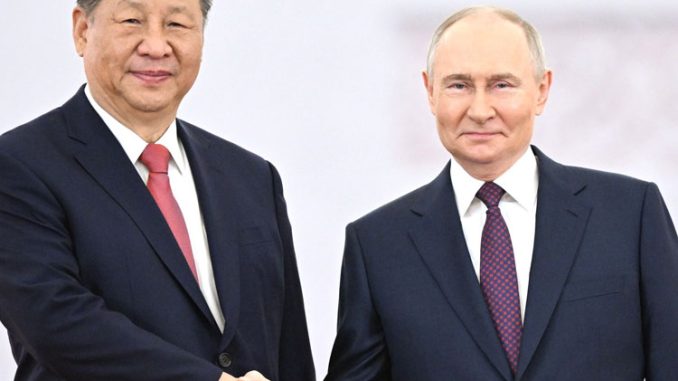
The above article was previous published here by Monthly Review.Image: Talks between President of Russia Vladimir Putin and General Secretary of the Chinese Communist Party Xi Jinping took place in the Kremlin; Author: Sergei Bobylev, RIA Novosti – http://en.kremlin.ru/events/president/news/76870; Licensed under the Creative CommonsAttribution 4.0 International license; Image cropped