
By Michael Wongsam
American politics has been completely dominated by big money, especially following the Supreme Court’s 2010 ruling in Citizens United v. Federal Election Commission, which reversed the previous campaign finance restrictions and enabled corporations and other outside groups to spend unlimited money on elections. This was taken to grotesque proportions in the 2024 General Election when Elon Musk embarked on a series of million dollar giveaways to voters in the swing states. This has been the dominating feature of American elections since. As of 25 June, according to the Washington Post the fifty biggest donors have so far contributed $1,369,377,080 in the current election cycle.
However, even such an unequal state of affairs is becoming insufficient to guarantee the ability of the ruling class to carry forward their agenda. In particular, Israel’s genocidal assault on Gaza, the creeping annexation of the West Bank, and the occupation of Southern Lebanon is provoking a grassroots rebellion in the Democratic Party. This, combined with a new layer of progressives, threatens to unseat many of the reliable corporate Democrats in the remaining primaries.
Added to this, polling invariably indicates that popular approval for the Trump administration is at historic lows, suggesting that a key demographic in the Trump coalition – white non-college graduates – is beginning to crack. Trump’s approval rating among this group currently runs at 33% (Fox News); 39% (CBS); 40% (Maris); 43% (CNN); 47% (New York Times). These figures are significant because they are the infamous ‘white working class’ supposedly whose interests Trump claims to represent, since Democrats didn’t attend to their anxieties. The true function of this framing has nothing to do with putting the interests of white workers first, but has everything to do with preventing class solidarity between white and non-white workers directed against the class whose interests Trump truly represents, that is those of the big bourgeoisie[1]. Trump’s identification with the anxieties of white workers seeks to utilise the historic “public and psychological wage” of whiteness that was described by W. E. B. DuBois in his book Black Reconstruction in America.
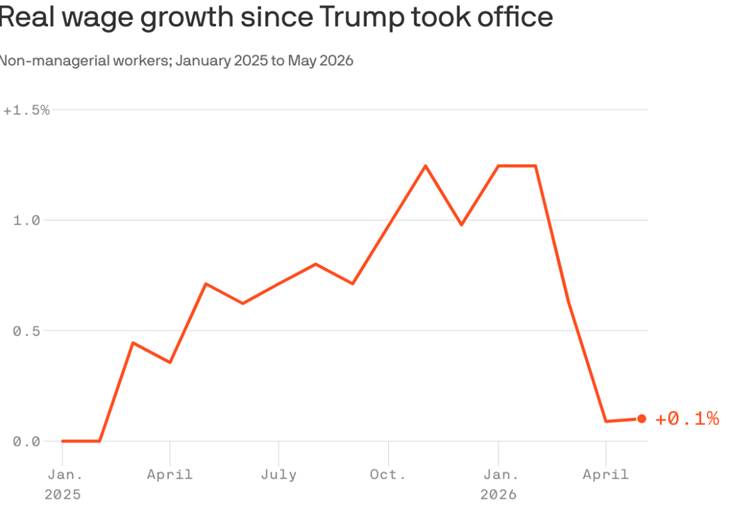
This is primarily because real wages have declined through the current administration while the Trump tax cuts means that the rich have fortunes which have ballooned, signifying an exacerbation of the ‘K-shaped’ economy. This means that a massive upward redistribution of wealth and income has taken place. This has been greatly amplified by the war in the Gulf.
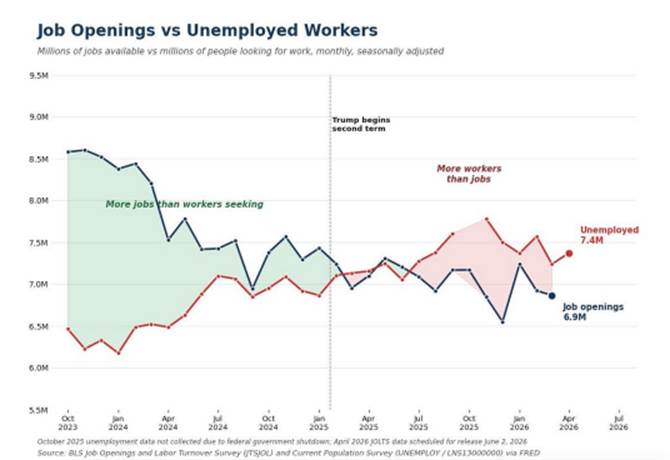
The Figures below show the plummeting of real wage growth directly resulting from the war, which started in February 2026; and an inversion of the relation between the number of job openings and unemployed workers – specifically, the number of job openings exceeded the number of unemployed workers prior to the beginning of the second Trump administration, whereas the number of unemployed exceeded the number of job openings after the beginning of the second Trump administration. The actual inversion took place in the summer of 2025 – coincident with the taking effect of the Trump tariffs, which unleashed uncertainty on the US economy resulting in the loss of 89,000 manufacturing jobs.
In particularly, energy tycoons have experienced a massive surge in their fortunes directly as a result of the oil supply shock. Inflation recently reached a three year high of 4.2%, primarily due to soaring energy and food prices resulting from the war in the Gulf, which compounds the already existing inflationary tendencies remaining from the tariff wars of 2025. In other words, Trump’s policies are affecting the working class as a whole. In response, a ballot initiative in California – pushed by SEIU-United Healthcare Workers West – to impose a one-time 5% wealth tax on billionaires has gained enough signatures to qualify for the November elections despite millions of dollars being spent to oppose the vote.
The Wall Street Journal reported that “..labor’s share of gross domestic income (conceptually similar to GDP) sank to 51%, the lowest since records began in 1947. Profits’ share climbed to 12.1%, the highest since 1950…Adjusted for inflation wages are up 3% since the end of 2019 while profits are up 50%.” Moreover, while the income share of GDP of the wealthiest 1% increased from 12% in 1970 to 20% in 2020, the proportion of workers unionised fell from 26% to 10% over the same period. Total worker compensation during the first three months of the current year constituted the lowest share of the American economy since the government started these measurements in 1947. These facts demonstrate that the upward transfer of wealth is eminently a class issue.
In the primaries so far Democrat turnout is far higher than Republican turnout – “12.6 million ballots in Democratic House primaries compared with 8.6 million in GOP primaries“ – as of 22 June, including in solidly Republican districts. Within Democratic primaries in large East coast cities it is the left, specifically backed by the Democratic Socialists of America, that is dominating the momentum despite extremely large sums being spent to keep corporate Democrat incumbents in seats, or else replace them with more corporate Democrats. This surge to the left accompanies the implementation of the campaign promises made by mayor Zohran Mamdani, specifically with the city passing a rent freeze. For instance, in New York, DSA candidates backed by Zohran Mamdani beat two House Minority leader Hakeem Jeffries endorsed Democratic incumbents and defeated a Governor Kathy Hochul endorsed candidate in a third race.
In order to be able to deliver and safeguard the rest of their agenda it is therefore necessary to (i) prevent voters casting votes for the Democratic Party; (ii) gerrymander the vote by re-drawing the congressional districts on a partisan basis to remove solid Democrat seats and absorb them into surrounding solid Republican seats, beginning with the midterms this November. Both of these measures first and foremost disproportionately affect Black voting rights and Black political representation.
In March Trump signed an executive order aimed at ‘ensuring citizenship integrity in federal elections’, requiring the US Postal Service to determine who can receive a mail-in ballot. This requires that to comply with the executive order, states would have to hand over their voter lists, effectively giving the federal government an unprecedented role in elections. Currently, around 30% of voters use mailed ballots, and the purging of voter rolls already has a long history in voter suppression[2].
As of 22 June 2026, the DOJ had filed 31 cases to gain access to state voter files – no doubt in an effort to bolster claims of voter fraud – failing to win any of these and losing 9, with the remainder still in process. In the nine cases that have been lost, five were decided by judges that had been appointed by Trump. Recently, a federal judge blocked federal agencies from implementing Trump’s executive order.
In the current primary season Trump has leaned heavily into this well worn messaging claiming that there has been fraud in California’s recent elections gubernatorial and mayoral primaries, sending a federal prosecutor to observe ballot processing in Los Angeles. Furthermore, Trump is holding up the passage of legislation in Congress in order to force it to pass his Safeguard American Voter Eligibility (SAVE) Act.
The gutting of the Voting Rights Act
Starting with the Supreme Court decision of 2013 in Shelby County vs Holder, which removed the requirement of federal pre-clearance from the former Jim Crow Southern states, this year’s Supreme Court decision in Louisiana vs. Calais [3], (April 29, 2026) completed the gutting of the 1965 Voting Rights Act.
Since the Supreme Court decision in Louisiana vs. Calais Republicans have gained an edge in 15 districts and Democrats – responding in kind[4] – have gained an advantage in six districts. The result has been new Republican congressional gerrymanders in Florida, Louisiana, and Tennessee, and the revival of an old one in Alabama. Such was the haste to ensure that the new electoral maps were in place in time for the midterms, Louisiana and Alabama suspended primary elections already in process – 42,000 people had already cast mail ballots – in order to impose the new maps. In Missouri gerrymandered maps have been imposed despite voters gathering 300,000 signatures to effect a veto, which is consistent with the state constitution.
Redistricting is a normal practice of redrawing electoral maps, usually to take account of population changes and things of that nature. However, given the polarised character of US politics, the past practice has resulted in partisan gerrymandering through redistricting. However, in the context of the modern revanchist white nationalism, of which Trump is just the latest expression, the leading edge is now overwhelmingly racial gerrymandering.
Redistricting, which aims to eliminate mainly Black majority districts – and which also leads to the Democrats moving to adopt white candidates in preference to Black candidates – is also an attack against cities as a whole.
“Blacks live in cities, as do Latinos, Asians, Jews, professionals, scientists, and young people, each of them preponderantly hostile to MAGA’s cramped and cruel core beliefs. Cities also are ground zero for the concentrated economic inequality that has radicalized millions of young Americans.
Texas is red, but Austin and Houston are blue. Tennessee is red, but Nashville and
Memphis are blue. Louisiana is red, but New Orleans is blue. Alabama is red, but
Birmingham is blue. Mississippi is red, but Jackson is blue. Rural North Carolina is red, but Charlotte and Raleigh are blue. Rural Georgia is red, but metro Atlanta is blue. “
The gerrymandering resulting from both the partisan and racial redistricting measures ensures that even as the population moves left, representation moves even further to the right. In November, Zohran Mamdani was elected mayor of New York. The momentum behind his election has carried forward with the election of a further three left wing candidates in New York’s congressional primaries. Janeese Lewis George, another socialist, won the Democratic primary for mayor in Washington DC, achieving the most dominant primary performance since 2006. This means that she is virtually certain to become mayor in November, since Washington is an overwhelmingly Democrat city.
However, when Democrat dominated urban congressional districts are dismembered and absorbed into surrounding Republican dominated suburban districts the result is a dilution in the Black, progressive and younger vote.
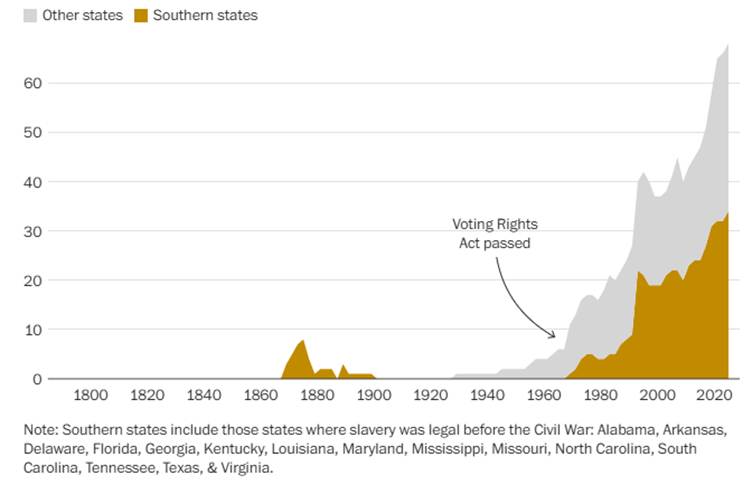
Since the passage of the Voting Rights Act in 1965, there has taken place a major increase in Black political representation. The figure below shows Black legislators increasing over time, particularly in the Southern states. The overwhelming majority of Black legislators represent the Democratic Party. Therefore, it is this historic trend that this year’s Supreme Court decision seeks to send into reverse, beginning with the midterms.
General elections in the US are usually dominated by intense campaigning in a relatively small number of battleground states which can swing behind either Republican or Democratic candidates according to the ebbs and flows of the political struggle. Most states are either solidly Republican or Democrat and do not elicit more than a passing inspection of the particulars of the movement of votes either way. In particular, the period opened by the 1968 election cycle saw the use of the ‘southern strategy’ by the Republican Party under Richard Nixon to detach the southern white conservative part of the voter base of the Democratic Party and attract it towards the Republican Party. In this way, a period of Democratic Party dominance between 1933 and 1968 was transformed into a succeeding period of Republican Party dominance. In particular this strategy transformed the deep south from being solidly Democrat to solidly Republican over the period between 1968 when they swung behind Nixon, until 1992 when they were voting for Republican candidates in state-wide as well as presidential elections.
However, the growth of large metropolitan centres, especially in the South, has transformed the objective situation. This growing urban population – more Black, Latino, Asian, progressive, and unionised than the country as a whole, and therefore moving leftward – from the point of view of the ruling class poses a threat which even the astronomical sums currently deployed into elections are unable to prevent from breaking through. Therefore, either diluting, or outright preventing these votes from being expressed is the next necessary step.
Notes
- A full discussion is beyond the scope of the present article. However, further discussion can be found in The white working class knows the American project isn’t working. Here’s why that will never matter to them; https://www.theguardian.com/inequality/ng-interactive/2026/jun/21/american-racial-anxiety-white-working-class-rights. Discussion of DuBois’ discussion can be found in Beyond the Wages of Whiteness: Du Bois on the Irrationality of Antiblack Racism; https://items.ssrc.org/reading-racial-conflict/beyond-the-wages-of-whiteness-du-bois-on-the-irrationality-of-antiblack-racism/. A theoretical discussion is available in On the interrelation between race and mass consciousness; https://www.socialistaction.net/2025/01/14/on-the-interrelation-between-race-and-mass-consciousness/.
- See for instance What you need to know about hotly debated US voting laws; 14 July 2021; Al Jazeera; https://www.aljazeera.com/news/2021/7/14/what-you-need-to-know-about-the-us-voting-changes-sparking-debate; Purging voters: Inside Republican efforts to restrict 2024 US election vote; 3 November 2024; Al Jazeera; https://www.aljazeera.com/news/2024/11/3/purging-voters-inside-republican-efforts-to-restrict-2024-election-vote; US Justice Department sues Virginia for purging voters before election; 3 November 2024; Al Jazeera; https://www.aljazeera.com/news/2024/10/12/us-justice-department-sues-virginia-for-purging-voters-before-election.
- The Louisiana legislature in 2024 enacted a new congressional map after a federal court struck down the previous map for violating Section 2 of the Voting Rights Act and ordered the implementation of a new map with two majority-Black districts (majority-minority), in line with the 2020 census. 12 “non-African American” voters challenged the state’s 2024 congressional map, and claimed that it was ‘racially gerrymandered’ and violates their right to vote under the 14th and 15th Amendments. They asked the court to block any future use of the 2024 map and adopt a new map that complies with the U.S. Constitution. The Supreme Court’s decision gutted the ability of the Voting Rights Act (VRA) to compel the creation of majority-minority districts, the point of which is to address the history of discrimination.
- In November, California voters approved a plan to temporarily circumvent their state’s independent redistricting commission and enact a map designed to counter the Republican gerrymander in Texas.
Image: Señalización de lugar de votación en California. 2008; Author: Tom Arthur; Source: https://commons.wikimedia.org/wiki/File:Voting_United_States.jpg; Licensed under the Creative Commons Attribution-Share Alike 2.0 Generic license; image cropped.
