
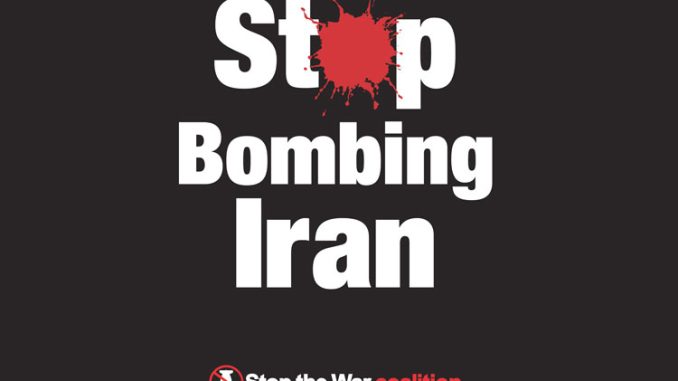
By Steve Bell
The AGM of the Stop the War Coalition on March 14th was a genuinely upbeat event. In the face of a dangerous international situation, the activists present demonstrated a determination to build up the anti-imperialist and anti-war opposition. Following this success, it is vital to deepen the analysis of the present situation to maximise the effectiveness of the campaign.
At the AGM, there was a collective understanding that the US war drive is accelerating. Equally understood was that this is a result of the relative decline of the US economy, and the failure of successive US governments to stem that decline. That which US imperialism cannot secure by peaceful competition is to be won by using the most formidable military force in history.
What needs to be explained at present is why that acceleration is focused on Venezuela, Cuba, Iran, and Lebanon rather than the key targets of US strategy – China and Russia.
Setback for US by China
Trump’s initial policy towards China, for this 2nd Presidential term, was to use tariffs against imports from China. This was to shrink the trade deficit the US had with China. It was to create the conditions for “reshoring” US capital abroad, creating investment and employment in the US. It would hamper China’s economic development and render the People’s Republic more amenable to US interests. The seriousness of this policy is evident in the use of a 145% tariff imposed by Trump on Chinese goods from April 2025.
However, the Chinese government refused to be intimidated. It imposed substantial reciprocal tariffs on US goods, without bothering to follow Trump in every escalation. Trade was directed away from the US and increased particularly with the ASEAN countries. Chinese exports and trad surplus continued to increase, topping $1 trillion for the first time. China also restricted the export of rare earths to the US, causing panic in US businesses dependent upon those minerals. In short. China won the confrontation with Trump
At present, Trump is fighting his own Supreme Court’s rulings, having been forced to end extortionate tariffs. The current tariff on Chinese exports to the US is 15% – the same as Trump’s worldwide “minimum”.
At the end of 2025, the IMF estimates that China is $10.4 trillion larger than the US economy, in purchasing parity prices. In 2025, China grew by 5% while the US grew less than half as fast by 2.1%.
After a year of direct conflict, the US government has been forced off its policy, without China facing any overall damage to its prospects. This represents a setback for US imperialism.
It is the nature of imperialism to seek hegemony over countries emerging from the shadows of classical colonialism. The US government is now seeking other routes to hinder China’s development.
Setback for US by Russia
Trump came to power promising to end the war with Russia in Ukraine. This he could present as a break in the deadlock of Biden’s Ukraine policy. Yet Trump was to learn Biden’s failure was not easily resolved. Despite the massive subsidies and arms flows from NATO allies and the US, NATO and the Ukrainian government has been unable to defeat Russia.
In turn, the Russian government having made such an immense commitment in armed forces would not be satisfied with a “peace” which was merely a prelude to NATO rearming and reorganising in Ukraine. For Russia it must be a settlement which ends the threat of NATO expanding into Ukraine and guarantees the rights of the extensive Russian-speaking national minority in the old territory of Ukraine.
Trump aimed for a “ceasefire” where US disengagement would allow for a more extensive pivot against China. The administration also aimed thereby to weaken Russia’s alliance with China. In the interim, Ukraine would be rearmed, with the EU and Britain bearing the brunt of the cost.
On the issue of the Russian national minority in Ukraine, Trump was prepared to accept some territorial adjustment, based on the existing front line, rather than any principle. If the national question is left unresolved then it can also be a cause for resumption of the war in future when Russia may be more vulnerable than now.
Trump’s policy has been a failure to date. There is no likelihood of Russia agreeing to the fake peace he has been seeking. Nor is there any likelihood of an improvement in the military prospects for NATO supported forces in Ukraine. Trump is carrying the weight of failed US aggression since 2022 in Ukraine. That represents another setback for imperialism which had been determined to keep open the strategic possibility to bring Ukraine into NATO.
US imperialism’s offensive against weaker allies
This gives context to the current offensive of US imperialism against Venezuela, Cuba, Iran, and Lebanon. After receiving setbacks against its most powerful “enemies,” US imperialism is attacking weaker states who are allied to China and Russia.
Without this context activists will be tempted to seek more subjective answers for the current acceleration in imperialist belligerence. The suggestion that Trump is simply becoming more deranged is completely subjective. Or the suggestion that imperialism is entering a new era of viciousness ignores the actual uninterrupted history of imperialist barbarity. Such impressions cannot substitute for concrete analysis.
The shift in the immediate theatre of US intervention is not outside its overall strategy, as outlined in the “National Security Strategy.” The assault upon Venezuela and Cuba is motivated by the ‘Trump Corollary’ – “We will deny non-Hemispheric competitors the ability to position forces or other threatening capabilities, or to own or control strategically vital assets in our Hemisphere.” (1)
The invasion of Venezuela, and the kidnapping of President Maduro and Congresswoman Celia Flores has allowed the US to attempt to divert the country’s oil resources away from trade with China and Cuba. These “strategically vital assets” should now profit the US rather than the Venezuelan people. Equally, the complete siege of Cuba aims to dislocate its contribution to the development of the Global South, and replace it was a US aligned regime completing US domination of the Caribbean.
The US National Security Strategy document states that the US wants serious push back against “non-Hemispheric competitors” that have made inroads into the Western Hemisphere. It is in particular about detaching the continent from economic relations with China. Like the example of Venezuelan oil, the war on Iran severely disrupts China’s access to the oil trade with West Asia. It is not helpful to ignore, or understate, such links. US imperialism is building up a remote siege upon China’s access to energy resources. This is what political analyst Brian Berletic calls a “global maritime oil blockade being imposed on China.”
The first acceleration of US aggression was in Gaza
The recent offensive against weaker states really started in the Biden administration’s initial response to the failure of the Ukrainian “Spring Offensive” in 2023. By the end of 2023 it was obvious that the Kyiv government could not defeat the Russian forces. The failure of the US/NATO campaign in Ukraine demonstrated an underlying weakness in US imperialism. Biden’s administration could not allow the US’s international reputation as a hegemonic power to be further damaged. Hence, he retreated from any attempt to restrain Netanyahu’s government initiation and carriage of genocide in Gaza. Palestine was the first victim of the US turn to attack weaker states.
Trump allowed this to continue until the superiority of the US/Israeli position was built on Gaza’s absolute destruction. Then it was the turn of imperialism to demonstrate its power by allegedly creating a new riviera from rubble, under the direction of Trump’s Board of Peace. This is supposed to be the crowning achievement of the US negotiated “peace” – funded by Gulf States and enforced by a generalisation of the Abraham Accords across West Asia. Gaza’s rubble would be the future offered to any state in the Global South who continued to oppose US hegemony.
In line with this, Lebanon was kept in a state of grumbling conflict, Israeli ceasefire breaches acting as a spur for the Lebanese government to disarm Hezbollah. With the opening of the war on Iran the stakes here too are raised. Trump now sees an opportunity to attempt to finish Hezbollah and Iranian influence in Lebanon. For Netanyahu cabinet this is an opportunity to further the “new Middle East” by creating a new occupation and expansion of territory for the Greater Israel project.
Another, initial, setback for US imperialism in Iran
What the first month of the renewed war on Iran has revealed is that the initial tactics of US imperialism have failed. The assumption was that the Iranian regime would be easily overturned – through selective assassinations, fearsome bombing to degrade defence systems and missile launch capacity, and a domestic uprising either by the population at large or by national minorities.
Four weeks into the war the tactics have yielded very limited results – let alone the “unconditional surrender” Trump demanded. Having Mojtaba Khamenei as Supreme Leader does not constitute regime change. Iran’s ability to strike US bases across the Gulf, continually hit Israel, and closing the Straits of Hormuz to the enemy does not look like extreme degradation of its arsenals. And the population have rallied in defence of the independent Iranian state rather than open the gates to the invader.
Given that regime change was the explicit aim of the war, Trump is facing a major setback. This despite the death and destruction imposed upon the Iranian people.
The choice surely facing Trump is between engaging in an unsatisfactory exit or beginning an extremely hazardous escalation. The depth of this quandary is immediately illustrated by the third announcement today, March 27, of a deadline to open the Straits of Hormuz or have Iran’s electricity and energy grids destroyed. The notable build-up of US troops in the region suggests that a ground invasion, or localised raids, may be the most imminent form of escalation.
The next rise of the anti-war movement?
The public quandary of US imperialism must give encouragement to the anti-war movement to further develop its work against the war. Here it is necessary to register the nature of opposition to the war, and to grapple with the obstacles to its growth.
The opposition to the war on Iran begins from a wide social base, even more than in the 2003 war on Iraq. This time public opposition is so widespread that most European governments are rhetorically opposing their involvement, whilst in practice facilitating US operations. Statements from governments have condemned Iran’s counterattacks on US bases in the Gulf as an “escalation” whilst refusing to condemn the original unprovoked war of the US and Israel. This includes the British government, which denies it is taking offensive action while allowing the US to use bases in Britain for the bombing campaign. The Spanish government is a notable exception in opposing the war in both words and deeds. But the breadth of public opposition in Europe has led to the US facing disappointment, to date, in its efforts to get direct naval involvement in hostile action in the Persian Gulf.
One factor limiting the mass mobilisations in Europe, so far, is that the population’s opposition is accommodated by government in word’s reluctance to commit to Trump’s war. In Britain this has even forced Reform and the Tories to step back from advocating for joining the war, using all sorts of convenient hypocrisies and hopes for a turnaround in public opinion.
The domestic opposition in the US is something of an exception. Congress has now been on a knife edge on three occasions in failing to impose a War Powers Act on Trump. Consequently, the need for broad actions to hinder the war party is expressed more strongly in the US than in Europe, for the moment.
The other, and perhaps decisive, factor limiting the mobilisation is the extent to which everything Iranian has been demonised in Europe and North America for nearly five decades now. A comparison with the Palestinians may help to illustrate this.
Ever since 1967 Palestinian resistance – whether that be the armed factions or the mass uprisings of the Palestinians – has been demonised. But the established consensus of bourgeois politics over the same period has been that the Palestinian people are entitled to some form of national rights.
This has meant each war by the occupiers, and each uprising has prompted a growing body of support amongst the popular masses internationally. The turning point in this was the “Unity” intifada of 2021 which resulted in the qualitatively largest international solidarity mobilisation in the history of Palestine’s struggle. That height then became the starting point for an even greater mobilisation against the post October 2023 Gaza genocide. Of course, the tireless work of seriously committed activists around the globe created a framework of organisation which gave coherence to the spontaneous mass mobilisations.
The Iranian people have no such pre-established support. In Britain, a tiny minority of activists have laboured against sanctions and the permanent threats of war upon Iran. Nor have the social media posts of the Iranians yet created the concern that the Palestinian posts from Gaza achieved, with a profound impact upon hundreds of millions of people around the globe.
The response to the June 2025 war was encouraging, with the anti-war movement correctly incorporating opposition to that war in the larger Palestinian mobilisations at the time. A similar correct approach is being used in the current war.
However, the setback registered in US imperialism’s initial tactics today lays the basis for a wider mobilisation, particular should Trump attempt escalation. If Trump attempts a rapid exit, then there will be a larger active opposition should war be later resumed.
If Trump attempts to carry through his threats this will immediately broaden the active forces of opposition. Escalation carries the threat of world recession, climate catastrophes and horrendous levels of fatalities and suffering.
Until the next US turn becomes clear, the anti-war movement must be preparing to oppose any escalation and work to achieve a wider mobilisation. Escalation will draw in massive forces across parties, faith communities, amongst young people, within trade unions and popular organisations, and across both popular and high arts practitioners. In Britain, the anti-war movement is in an advantageous position if it displays the necessary energy and clarity of purpose.
Notes
- “National Security Strategy of the United States of America,” November 2025, p.15
- Speeches to Stop the War AGM, 14March 2026, https://www.stopwar.org.uk/article/keynote-speeches-from-our-annual-conference/