
By Michael Wongsam
Recent days have witnessed a Turkish owned oil tanker being attacked by naval drones off the coast of Senegal; a military coup in Guinea Bissau; a failed coup attempt in the Benin Republic; Nigeria’s air force conducting bombing raids on Benin; regional umbrella organisation ECOWAS declaring a state of emergency across the region; and Nigerian military personnel and an aircraft being detained by Burkina Faso after an unauthorised violation of its airspace. Barely two weeks separate the first from the last of these events.
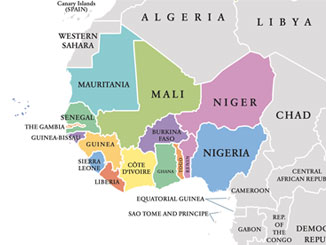
It is instructive to consider how global geopolitics impact on and determine these events. First, consider that West Africa consists of two blocs – the Alliance of Sahel States (AES) comprising Mali, Burkina Faso and Niger; and what remains of ECOWAS. The AES broke ties to imperialism by ordering the departure of French military forces and the closure of a US AFRICOM drone base in Niger. They currently have close ties with both Russia and China. The countries comprising ECOWAS are still tied to imperialism, which continues informal supervision of the politics of these countries by maintaining in power comprador elites whose favour derives from their ability to subordinate their country’s economic development to the interests of imperialism.
The AES states are landlocked, whereas the ECOWAS countries are coastal. Therefore they exert a massive influence on the ability of the AES to conduct intercontinental trade. Since France lost its influence over the AES states it has become particularly concerned to protect its influence over the coastal states as a means of exerting pressure on the AES.
Pressure is also exerted by the covert use of insurgent rebel forces which are endemic in West Africa, but particularly so in the AES, and in particular, Ukraine has become heavily involved in supporting jihadist insurgencies in the Sahel particularly as a separate front in its conflict with Russia.
Recently, imperialism has become tested by Russia concluding various agreements with both Togo and Benin last July, and conducting high level talks with Togo on trade and security. In particular, Togo’s deep water container port at Lome offers low cost rapid turnaround advantages and access to the sea for the AES, which relieves their landlocked situation. These developments illustrate the antinomies facing the comprador elites: their attachment to former colonial powers – in this case France – comes into contradiction with the devastation experienced at the hands of insurgent forces which are surreptitiously abetted by France [1].
No doubt these moves by Russia which threatened to further weaken the unity in ECOWAS and relieve the pressure on the AES rang alarm bells in Paris and Kiev. Furthermore, rising debt, youth unemployment and the cost of living crisis throughout the continent has resulted in increasing difficulty for the comprador elites maintaining power. Several elections just this year have resulted in both pre and post election violent uprisings despite constitutional changes, arrests and banning of opposition leaders, ballot rigging, etc. Traditionally, whenever imperialism could not get its way by electoral and constitutional means it has sought to utilise naked force: there have been over one hundred military coups d’etats in Africa since the 1960s – around 90% have taken place in Francophone Africa, generally to remove governments that were not compliant and to put into power more compliant forces.
Occasionally, popular revolutions have been carried out through military takeovers, such as that which brought to power the revolutionary government of Thomas Sankara in Burkina Faso in the 1980s, or the AES governments today. Given the objective material conditions there must be the fear that the example of sovereignty shown by the AES, and their alignment with Russia and China, will be imitated by other countries.
Recently, on 26 November the military in Guinea-Bissau announced that it had taken over the government one day before the nation was scheduled to announce the results of its recent presidential election. “The spokesman, Dinis N’Tchama, declared that the takeover was in response to “an ongoing plan to destabilize our country” and announced that the military had deposed President Umaro Sissoco Embaló, closed the country’s borders and airspace, and suspended the electoral process.”
The opposition released a statement claiming that the country’s President staged the coup because he knew that he was going to lose the election. Both the President and the opposition leader had both declared victory prior to the coup and the scheduled announcement of the results. It should be noted that officers were arrested on accusations of attempting a coup the month prior to the elections. The Black Alliance for Peace have reported that “official reports to the Regional Electoral Commissions (CRE) from the 10 Regions indicate that Fernando Dias da Costa won the election with a confirmed vote tally of 54%, while Ebalo Sissoco, the illegitimate president seeking re-election, garnered 44% of the vote”, while Xinhua have reported that the Transitional President appointed as Prime Minister Ilidio Vieira Te, who served as finance minister from July 2022 until the recent political shift in the country. “During this year’s presidential election, Te was national campaign director for the No Kumpu Guine coalition, an alliance of several political parties that endorsed deposed President Umaro Sissoco Embalo as their candidate.” The obvious conclusion is that the coup was organised so as to ensure political continuity.
Simultaneously with the attacks by Ukraine against commercial shipping carrying Russian oil in the Black Sea, a Turkish (Besiktas Shipping) owned oil tanker carrying oil destined ultimately for Mali was attacked off the coast of Senegal by four Ukrainian naval drones, sustaining severe damage. This attack places Ukraine in complete alignment with the attempted fuel blockade of Bamako by insurgency forces.
This has been followed by a media campaign alleging that Russia’s Africa Corp have been committing atrocities against civilians in their campaign against the jihadist insurgency.

This was followed by a media campaign statement by the Minister of Foreign Affairs of Ukraine Andrii Sybiha regarding the AP investigation about Russian atrocities in Mali. In particular the statement demanded:
We are demanding international legal action, including arrest warrants and sanctions. We also insist on an international fact-finding missions and independent investigation, possibly under UN auspices, to establish the facts and the full scale of atrocities, which might be far larger.
Last but not least, we caution all African governments against any cooperation with the Russians. Modern Russia has nothing to do with the Soviet Union’s legacy in Africa — it brings not liberation, but lawlessness, atrocities, and plundering. Do not undermine your security.
This can be seen as a direct warning to countries such as Togo and Benin who have recently concluded agreements on military cooperation and trade with Russia which hold the promise of breaking the isolation of the AES and gaining for them access to the Gulf of Guinea and the Atlantic.
The attempted coup in the Benin republic
Finally, there must be commentary on the attempted coup in Benin and its aftermath. The attempted coup on the morning of 7 December briefly took over the national TV station. A major motivation for the coup was the escalating security situation due to jihadist insurgents. For instance, in April fifty four Beninese soldiers had been killed in clashes with Jama’at Nusrat al-Islam wal Muslimeen (JNIM) near the northern border with Burkina Faso and Niger.
The domestic political situation has become dominated by Presidential Elections planned for April. As President Patrice Talon served the maximum two mandates he changed the constitution with a contested vote at the National Assembly after one day of debate. The new constitution creates a senate whose members will not be elected but will be ex-presidents including himself, with the senate having greater powers than the National Assembly. The main opposition party the Democrats have been barred from standing candidates in the Presidential elections but they are allowed to participate in the legislative elections.
At the time of the attempted coup, and following a telephone conversation between French President Macron and Nigerian President Bola Tinubu, a French air force plane was maintaining a circular pattern over the capital, Cotonou, and France had claimed a role in putting down the rebellion. Three Nigerian airforce planes entered Beninese airspace, and explosions were heard in the capital. As reported in People’s Dispatch, “Soldiers from Sierra Leone, Ivory Coast, and Ghana were also deployed alongside the Nigerian troops as part of the stand-by force of the Economic Community of West African States…French troops stationed in secret bases across Benin also played a key role in putting down the rebelling soldiers of Benin’s army”. These soldiers remained in the country and have led to ECOWAS, and hence France, reconsolidating its influence.
Since the 10th of November reports from North Benin note five helicopters, including two French have been making ceaseless shuttles at night, and there are continuous overflights by French intelligence spy planes. In central Benin a Ukrainian plane Antonov AN124 of the French army – the second biggest type of plane in the world, which transports very heavy loads such as tanks, helicopters etc. – landed at the Torou airport. This unusual activity means that France was already preparing for a major military operation prior to the coup on 7 December.
ECOWAS moves to a state of high alert
Following these events, on 9 December ECOWAS declared a state of emergency in the region, which “has been shaken by political instability”. ECOWAS Commission President Oumar Touray said
“Apart from fresh military interventions, he cited several key risks, including non-compliance with transition norms in Guinea, eroding electoral inclusivity, rising influence of terrorists and criminal networks, and mounting geopolitical pressures on member states’ diplomacy and cohesion.” [my emphasis]
These “mounting geopolitical pressures on member states diplomacy and cohesion” reflect the fact that global issues are bearing down on West Africa: the region is split into two blocs with opposing alignments – the AES is aligned with Russia and China and ECOWAS is aligned with the West.
A particularly mysterious incident occurring in the aftermath of the events in the Benin Republic is the flight of a Nigerian Lockheed C130 aircraft which violated AES airspace and was forced to land in Burkina Faso. Nigeria claimed that it had technical difficulties and was obliged to enter the airspace of Burkina Faso. However, when asked about its original mission Nigeria claimed that it was en route to Portugal. Portugal however has claimed no knowledge of such a mission and had not given clearance for the flight. Due to the fact that Nigeria has failed to satisfactorily clarify the nature of the mission the personnel and aircraft have been detained in Burkina Faso. This now constitutes a further point of friction between the two sides.
The US National Security Strategy, the changing geopolitical situation, and West Africa
The publishing by the US of the latest National Security Strategy (NSS) has provoked much discussion about the implications for the global political situation. One of its salient features is the US build up of a confrontation in the Western hemisphere, most immediately focussed on Venezuela and Cuba – as part of its strategic cold war with China. Important in understanding the significance is, as the document says, “China adapted to the shift in U.S. tariff policy that began in 2017 in part by strengthening its hold on supply chains”. It notes that China’s exports to low-income countries doubled between 2020 and 2024, and are now “nearly four times its exports to the United States”. In other words, China has largely mitigated any purely economic attacks that the US can make. This has been confirmed by the trade war conducted throughout this year. Importantly, China is at the centre of many critical supply chains which would be severely disrupted in the event of an open military confrontation. Each time this has been tested the US has had to retreat. Therefore, a precondition for an open military confrontation with China is a reconfiguration of supply chains to exclude China. This is a long term project: hence the need to step up the focus to the Western hemisphere. Important in this vision are critical minerals and other natural resources. In the section on Africa, the document states
“For far too long, American policy in Africa has focused on providing, and later on spreading, liberal ideology. The United States should instead look to partner with select countries to ameliorate conflict, foster mutually beneficial trade relationships, and transition from a foreign aid paradigm to an investment and growth paradigm capable of harnessing Africa’s abundant natural resources and latent economic potential.”
“The United States should transition from an aid-focused relationship with Africa to a trade and investment-focused relationship, favoring partnerships with capable, reliable states committed to opening their markets to U.S. goods and services.” [My emphasis]
Given that China is the main trading partner of the overwhelming majority of African countries, and that Russia has increasingly important trade and security interests in Africa, this puts the US in direct competition with both China and Russia – the clash between imperialism and the anti-imperialist forces in Africa is a fight over the control of supply chains. Seen in this light developments such as the AES which embody sovereignty and resource nationalism, and which provide an example of progress for the entire continent, represent an obstacle to the path outlined in the NSS. This is exactly the same consideration which applies to the current war drive in Latin America with respect to Venezuela and Cuba, and we must expect exactly the same approach from imperialism.
[1] An informative discussion of this on YouTube is provided by Nathalie Yamb at https://youtu.be/pvvWhIsahHs.
Image: Map of West African countries; By PirateShip6; Licensed under the Creative Commons Attribution-Share Alike 4.0 International license; image edited/cropped.