
By Michael Wongsam
Marx and Engels understood colonialism as a necessary process through which the bourgeoisie expands its markets and compels societies to adopt capitalist modes of production. Colonial rule often destroyed pre-existing social and economic systems, replacing them with production oriented toward the European market. In India, Marx observed, British rule undermined the existing Asiatic mode of production, dismantling large-scale public works and forcing agriculture and textiles to serve European interests through the cultivation of tea and opium. Slavery was central to capitalist development: “Without slavery, you have no cotton; without cotton, you have no modern industry”1. In this context, the exploitation of enslaved Africans in the Americas and of colonised populations across Asia and Africa underpinned the industrial growth of Europe.
Settler Colonialism and Land Expropriation
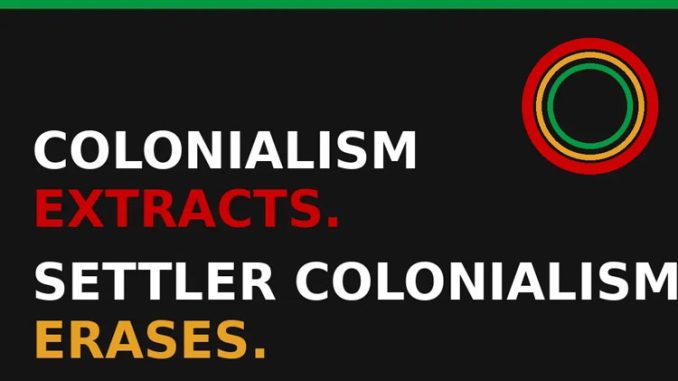
Settler colonialism differs from colonialism proper in that it involves permanent settlement and the elimination or subjugation of indigenous populations. Its legitimacy was historically justified through a series of Papal Bulls, collectively known as the ’Discovery Doctrine’, issued by the Catholic church. The Papal Bull Inter Caetera issued by Pope Alexander VI on May 4, 1493, played a central role in the Spanish conquest of the New World. The document supported Spain’s strategy to ensure its exclusive right to the lands discovered by Columbus the previous year. The ’Discovery Doctrine’ granted European Christian monarchs the right to claim lands inhabited by non-Christian peoples — that they were available to be ’discovered’2.
Thus the expulsion of the Moors from Spain by Ferdinand and Isabella, which marked the beginning of the change in the relationship between the white nations of Europe and the non-white nations of West Asia and North Africa, was accompanied by Columbus’ first voyage to the Americas, which led directly to the subjugation and eventual colonisation of the continent. As early as 1494 Pope Alexander VI was instrumental in brokering the Treaty of Tordesillas whereby a first division of the non-European world between the Crown of Castile and Portugal was defined along a meridian 370 leagues west of the Cape Verde Islands. The division of the other side of the world between these two powers was agreed at the Treaty of Zaragoza in 1529 specifying the demarcation as the anti-meridian of the earlier treaty. In this way, Spain and Portugal became the first modern colonial powers and Spain became the first great power of renaissance Europe, and its conquest of the new world gave it access to an abundance of precious metals and hence a treasury beyond any of its competitors. This was the first and most spectacular act of primitive accumulation of capital in modern history.
From its inception, and as it evolved over the centuries, the Doctrine of Discovery under-pinned European colonial claims to sovereignty over Indigenous peoples and their territories.
The Doctrine of Discovery influenced the imposition of national, colonial laws on Indigenous peoples, since it denies the validity of longstanding systems of Indigenous governance and sovereignty. ”More broadly, the doctrine of discovery can be described as an international law doctrine giving authorisation to explorers to claim terra nullius — i.e. said inhabited land in the name of their sovereign when the land was not populated by Christians”3. ”The ideology associated with the Doctrine of Discovery extends far beyond the formal confines of the legal doctrine outlined above. Over time, it came to be understood more generally as the political, social, cultural and economic concept that European colonisation of Indigenous peoples and territories is morally justified because Indigenous peoples are inferior to Europeans”4. The Vatican officially repudiated the Doctrine of Discovery in a statement 5 issued on March 30th, 2023.
Two forms of settler colonialism are distinguished in Marxist analysis:
● Farming Colonists: for example, the northern United States and Australia, and similar cases, who primarily sought to produce their own livelihood, displacing Indigenous peoples in the process. This often required genocidal wars of extermination, such as the First Nations wars in the US and the frontier wars in Australia 6. These exhibit certain characteristics.
– They served as colonising regions for the surplus population of European countries, and therefore became extensions of their social and cultural systems.
– In the age of imperialism they became Dominions, that is members and extensions of the imperialist system.
– They were based on the premise that non-Christian peoples were not entitled to sovereign ownership of their land.
– They took the form of expulsion of the Indigenes from the land by force, up to and including their physical extermination.
– They asserted sovereignty and control over the indigenes by the settlers, entailing the eradication of their culture, customs and self governance. They adopted widespread use of boarding schools for indigenous children to remove them from their social environment, erase their culture, language and customs, and to acculturate them to accept a servile and subordinate status, and absorb into them the values and customs of the colonisers.
– They reshaped the economy and social structures — including adopting segregation policies — and enforced the adoption of cultural norms to suit the needs of the colonisers.
● Plantation Colonies: for example, the southern United States, where commercial production was intended for the world market, and was therefore from the outset a part of the capitalist mode of production. It relied on enslaved, mainly African labour 7. This type also included fairly large numbers of subsistence farming colonists, or poor whites who existed on a marginal, subsistence basis, since slave plantation owners had seized the most fertile land.
In the United States these two systems were not independent; they operated within the broader Eurocentric mercantilist system, combining racialised oppression with capitalist accumulation. These largely pre-dated industrial capitalism, although a modern variant – Zionism – is ongoing 8. Some notable examples are surveyed later in the following installments of the present series..
Thanks for reading! Subscribe for free to receive new posts and support our work.
Notes
1. Marx, Karl; Capital, Volume III, Chapter 20; https://www.marxists.org/archive/marx/works/1894-c3/ch20.htm.
2. As far back as 1838, William Howitt was concerned to ”lay open to the public the most extensive and extraordinary system of crime which the world ever witnessed. It is a system which has been in full operation for more than three hundred years, and continues yet in unabating activity of evil”. See Howitt, William; COLONIZATION AND CHRISTIANITY: A POPULAR HISTORY OF THE TREATMENT OF THE NATIVES BY THE EUROPEANS IN ALL THEIR COLONIES ; The Project Gutenberg eBook of Colonization and Christianity, May 27th, 2017; https://www.gutenberg.org/cache/epub/54800/pg54800-images.html
3. doctrine of discovery; Legal Information Institute, Cornell University; https://www.law.cornell.edu/wex/doctrine of discovery
4. The Doctrine of Discovery: Some Basic Facts Publication; Te Tahui Tika Tangata Human Rights Commission; https://tikatangata.org.nz/our-work/the-doctrine-of-discovery-some-basic-facts-publication.
5. Joint Statement of the Dicasteries for Culture and Education and for Promoting Integral Human Development on the ’Doctrine of Discovery’, 30.03.2023 ; https://press.vatican.va/content/salastampa/en/bollettino/pubblico/2023/03/30/230330b.html.
6. See for instance the video documentary series The Australian Wars (account required); SBS, https://www.sbs.com.au/ondemand/tv-series/the-australian-wars; the Wikipedia article ’Australian frontier wars’; https://en.wikipedia.org/wiki/Australian frontier wars; Booth, Andrea; What are the Frontier Wars? ; SBS, April 18th 2016; https://www.sbs.com.au/nitv/article/what-are-the-frontier-wars/6ym0q6ic9; or the article which includes links to videos at ’Frontier wars’; https://deadlystory.com/page/culture/history/Frontier_wars.
7. Enslavement of Pacific Islanders and forced labour of the Aboriginal and Torres Strait Islander population was widespread in Australia. Lydon, Jane; History Workshop; https://www.historyworkshop.org.uk/black-history/slavery-and-australian-colonisation.
8. This topic will be discussed in a later instalment of the present series.
The above article was originally published here on the For Liberation, Against Racism blog.
The full article, “Marxism, Black Liberation and the Global Class Struggle” is available publicly here.
To follow the For Liberation, Against Racism blog – subscribe here .