
By Claudia Sanchez
On 5 August, the Independent Office for Police Conduct confirmed that Sergeant Martyn Blake, the Metropolitan Police firearms officer who shot and killed Chris Kaba, will face no disciplinary proceedings of any kind.[1] Chris Kaba was a 24-year-old Black man. He was unarmed. Despite the character assassinations and attempts at justification from the police, politicians and the media, the fact remains that the officers who stopped his car on 5 September 2022 in Streatham did not know who he was.[2] The last mechanism through which the state might have held his killer to account has now been deliberately shut down.
The sequence shows a protection system at work. Blake was acquitted of murder in October 2024. In April 2025 the IOPC reviewed the trial evidence and confirmed he still had a case to answer for gross misconduct. In November 2025 the Metropolitan Police wrote privately to the IOPC asking it to withdraw the proceedings; the family were not told the letter existed.[3] In January the IOPC paused the process, waiting for a change in the law. On 30 June that change arrived: the test in police misconduct cases moved from the civil law standard of self-defence to the criminal law standard. In July the IOPC issued guidance that cases decided under the old test should be withdrawn absent exceptional circumstances, citing the force used against Chris Kaba as its example.[4] On 5 August it closed the case.
The legislation changed the use of force test in misconduct cases from 30 June onwards. The statute had no backward reach. It was the IOPC’s own policy that erased a live case which had twice cleared the watchdog’s threshold. The IOPC chose retroactivity, then invited representations from the family while its guidance had already named Blake’s case as the model for withdrawal. The family’s legal team said this gives “every appearance of a closed mind”.[5]
Temi Mwale of the Justice for Chris Kaba Campaign, in a statement carried by the Voice: “The extraordinary treatment of Martyn Blake throughout this case sends a dangerous message: when police kill, the system will bend over backwards to protect police officers rather than hold them accountable and deliver justice. The IOPC had a choice. Today it chose not to do the right thing.”[6] Deborah Coles of INQUEST called the decision “capitulation to firearms officers” and a dangerous erosion of accountability that will fall heaviest on the communities most policed.[7]
That erosion was organised. When the IOPC confirmed in April 2025 that Blake would face a hearing, the Met Police Federation called the decision nonsensical, and Commissioner Mark Rowley said charges like those brought against Blake were “crushing the spirit of good officers” and making London less safe. Yvette Cooper, then home secretary, promised after the acquittal to change the law, and Labour delivered. The result applies to every unresolved misconduct case decided under the old test. A single concession to the armed wing of the state has closed off accountability across an unknown number of live cases.
Martin Abrams, the Green leader of Lambeth Council, issued a statement with the Lambeth Green Party on 7 August echoing the campaign and INQUEST and setting out the pattern. Since 2005, four men unarmed at the point they faced armed police have been shot dead by the Met in non-terrorist operations: Azelle Rodney, Mark Duggan, Jermaine Baker and Chris Kaba. All of them were Black. The Casey Review found the Met institutionally racist, and found that Blake’s own unit, the firearms command MO19, had a toxic culture in which normal rules did not seem to apply.[8] The disciplinary hearing was the mechanism designed to test precisely that. The council leadership of the borough where Chris died stands with the campaign. The governing party stands with the police.
Four days before the announcement came the anniversary of the death of Joy Gardner. On 28 July 1993 Met deportation officers raided her home, restrained her with a body belt, handcuffs and leather straps, and gagged her with 13 feet of adhesive tape wound around her head. She died on 1 August. Three officers were charged with manslaughter; all were acquitted.[9] Twenty-nine years separate the killing of Joy Gardner from the killing of Chris Kaba. The machinery has changed its face repeatedly, from inquest to criminal trial to disciplinary panel to legislative test, and the outcome has not changed once. British policing produces these deaths.
The People’s Tribunal on Police Killings drew this conclusion before the IOPC proved it. The family-led tribunal, which held its first hearings in April 2025, records over 3,000 deaths following police contact since 1969, and notes that the inquest system has never produced the conviction of a police officer. It demands the application of existing criminal law to the police.[10] Professor Gus John gave expert evidence at those hearings and spoke on the record of British police violence at the Remembering Joy Gardner event last week (31 July).
One avenue remains. A pre-inquest review this autumn will consider whether the inquest into Chris Kaba’s death resumes. The family and the campaign have demanded it does, urgently, so the full circumstances of the killing can finally be examined in public.
This case has proved what the tribunal has argued for years: the accountability institutions the state builds around its police protect them instead. The tribunal’s call is to the ‘ultimate reservoir of power’, people themselves, to hold the British state to account and win justice for the families.
The tribunal’s second session, European Action, takes place in London on 17 and 18 October. Families of those killed by police in France, Germany, Switzerland, Spain, the north of Ireland and Britain will give testimony to an international panel and plan joint action across the continent.
Attend if you can. Tickets are on Eventbrite and more information is at peoplestribunal.info or the People’s Tribunal Instagram page
Notes
[3] Ibid.
[5] Ibid.
[6] Fleary (n 2).
[7] Ibid.
[8] INQUEST, ‘Chris Kaba: IOPC announce decision to drop misconduct proceedings against Met shooter’, 5 August 2026.
[9] Amnesty International, ‘Death in Police Custody of Joy Gardner’, 1995.
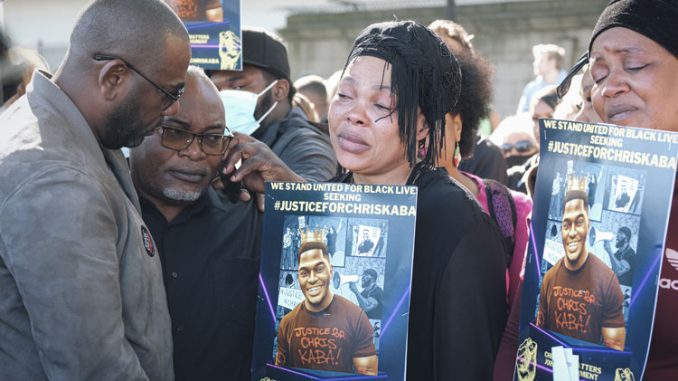
Image: Lee Lawrence (left – who’s own mother was shot inside her home by the police in 1985) consoles Chris Kaba’s parents (centre) outside New Scotland Yard in central London; Author Alisdare Hickson; licensed under the Creative Commons Attribution-Share Alike 2.0 Generic license; cropped.
The above article was originally published here on the For Liberation, Against Racism blog.
.jpg)