
By Steve Bell
The purpose of this article is twofold. Firstly, to demonstrate that the oppression of the Palestinians is, above all, a direct product of imperialism’s hegemony in West Asia, rather than a simple result of Israeli state policy. Secondly, to demonstrate that the admirable contribution of the international, popular movement in support of the Palestinians should not be counterposed to the support offered by governments and states, often in crucial economic and military forms, which popular movements cannot offer.
The dominance of imperialism
The most effective support for the Palestinian people arises from the most complete understanding of their pivotal location within imperialism’s intervention in West Asia and North Africa. Imperialism’s intervention is hegemonic in character; it attempts to organise the broadest range of state and non-state forces under its domination. The oppression of the Palestinians is one element of that domination – pivotal because imperialism’s ability to sustain their oppression is synonymous with maintaining the Zionist state, imperialism’s most reliable instrument in the region.
Imperialism is the highest stage of capitalist development, where the world has been divided up under the direction of a small number of states. Lenin in 1920 put it thus: “The characteristic feature of imperialism consists in the whole world, as we now see, being divided into a large number of oppressed nations and an insignificant number of oppressor nations, the latter possessing colossal wealth and powerful armed forces.” (1)
This feature of imperialism is consistent in its history. The classic initial studies of imperialism – J. A. Hobson’s “Imperialism: a Study”, Rudolf Hilferding’s “Finance Capital”, and Lenin’s “Imperialism: the Highest Stage of Capitalism” – were all published more than a century ago. Since then, there have been substantial modifications in its operation. A century ago, it was assumed that the net export of capital was an essential feature. Today, the hegemonic imperialist power, the U.S., is also the world’s largest debtor, and hence a net importer of capital.
But the feature of a small number of states utilising economic, military and diplomatic methods to coerce the activities of most nations remain evident. Indeed, the actual imperialist powers remain identical to the imperialist powers of the post-Versailles world. The biggest change is that a growing number of oppressed nations have secured their independence, some by overturning capitalism and others by unremitting national struggles.
Today’s “Hyper-imperialism”
In the first period of the imperialist era, the rivalries between imperialist powers created two world wars before the definitive, extended hegemony of the US became apparent. Since 1945, US imperialism has ensured that inter-imperialist rivalry has been subordinated to common efforts to stifle the emancipatory struggle of the international working class and oppressed nations. The global emancipatory movement thus encounters an international alliance of capitalist powers under the hegemony of US imperialism.
At the heart of this alliance is the “insignificant number of oppressor states” who maintain an aggressive, super-exploitative stance towards most oppressed nations who constitute the developing world, or Global South. A detailed informative analysis of contemporary imperialism is to be found in the document “Hyper-imperialism: A Dangerous Decadent New Stage”, where we read: “The Global North is an integrated military, political and economic bloc composed of 49 countries. These include the US, the UK, Canada, Australia, New Zealand, Israel, Japan, and secondary Western and Eastern European countries. In the military arena, Turkey (as a NATO member), the Republic of Korea and the Philippines (de facto militarised colonies of the US are included in our definition of the ’US-led Military Bloc’, even though they are part of the Global South.” (2)
Of course, the document does not suggest that all 49 countries are imperialist. Most of the countries involved are incapable of making any global impact outside of their alignment to the actual imperialist countries. It is relatively few countries that can impose an exploitative clamp upon other states. Although most of the states in the Global North are incapable of leveraging the world market to their benefit, the capitalist classes in these countries benefit from subordinating their economies and state power to the few states that can.
However, the decisive fact is that the whole Global North is undergoing a period of relative economic decline, including the US which is the hegemon within the alliance. This problem is at the centre of the geo-political strategy of the US, a concern shared by its allies.
At the end of the Cold War in 1993, the Global North accounted for 57.2% of world GDP – while the Global South accounted for 40.6% of world GDP. By 2022, the Global North accounted for 40.6% of world GDP – while the Global South accounted for 59.4%.
In 1993, the G7 countries – US, UK, Canada, France, Germany, Italy, and Japan, (who are all classic imperialist powers), accounted for 45.4% of world GDP. The BRICS countries – Brazil, Russia, India, China and South Africa (who are all developing countries – part of the Global South), accounted for 16.7% of world GDP. In 2022, the G7 accounted for 30.3% of world GDP – the BRICS countries accounted for 31.5% of world GDP.
And at the heart of these remarkable shifts is the qualitative change in the balance between the US and China. In 1993, the US accounted for 20% of world GDP, while China accounted for 5%. In 2022, the US accounted for 15.5% of world GDP, while China accounted for 18.4%. (3)
This decline is not accepted by US imperialism and its key allies. They are using whatever means they believe are necessary to wrench control of the world economy back in their favour.
We are living through a period when the US led alliance is attempting to impose a series of severe defeats upon the oppressed nations of the Global South and the international working class to restore imperialist super-exploitation. This direct, international conflict will dominate world politics for many years to come. The fate of humanity resides in the determination of the oppressed nations and international working class.
From it beginning the Palestinian struggle is integral to the struggle against imperialism
At first glance, the Palestinian national struggle appears to be a struggle against the founding, consolidation and continuation of the Israeli state. It is not surprising then that the common temptation is to define that struggle in contradiction to the Israeli state.
Certainly, for societies in the Global North the dominant, institutional narrative begins with a defence of the right of the Israeli state to exist, and then, as a subordinate issue references Palestinian national rights, to a greater or lesser extent. This narrative hides the central, constitutive role of imperialism.
British imperialism had been the hegemonic power in the nineteenth century, with a vast empire. In the Arab world of West Asia and North Africa it was contending with other imperialist powers – particularly French imperialism, and later German imperialism. The first inter-imperialist war began in August 1914 with Britain and France allied against Germany and allies, including the Ottoman Empire from October 1914. The Ottoman Empire had very substantial colonial possessions in West Asia, including the areas of contemporary Lebanon, Syria, Palestine/Israel, Jordan, plus parts of Iraq, Saudi Arabia and Yemen.
Preparation for the seizure of Ottoman colonial possessions, and their restructuring began during the war. War, being the continuation of politics by other means, enables political initiatives to secure hegemony in a post war world.
For Britain, as the dominant power, the prime concern was to secure the support of the broadest sections of the Arab and nationalist elites against the Germans and Ottomans. Its second major concern was to secure an agreement with the French imperialism over the post war division of victor spoils. These initiatives were underway before the 1917 Balfour Declaration for “a national home for the Jewish people”.
The complexity of this is well summarised by the Palestinian historian, Rashid Khalidi: “Britain primarily desired control over Palestine for geopolitical strategic reasons that antedated World War I and that had only been reinforced by wartime events. However important the other motivations may have been, this was the central one: the British Empire was never motivated by altruism. Britain’s strategic interests were perfectly served by its sponsorship of the Zionist project, just as they were served by a range of regional wartime undertakings. Among them were the commitments made in 1915 and 1916 promising independence to the Arabs led by Sharif Husayn of Mecca (enshrined in the Husayn-McMahon correspondence) and a secret deal with France – the Sykes-Picot Agreement – in which the two powers agreed to a colonial partition of the eastern Arab countries.” (4)
From the beginning, the Zionist project was dependent upon imperialism as a colonial settlement. Theodor Herzl in his 1896 pamphlet “The Jewish State” wrote that it would “form a part of a wall of defence for Europe in Asia, an outpost of civilization against barbarism.” Initially the project was taken to German imperialism, where it was rejected. It was British imperialism that grasped the value of the instrument for its intervention in West Asia. Ronald Storrs, British governor of Jerusalem between 1917 and 1926, stated that Zionist colonisation was “forming for England ‘a little loyal Jewish Ulster’ in a sea of potentially hostile Arabism.” The Zionist state was an instrument for imperialism, not an end in itself.
British imperialism moved quickly to implement the Balfour Declaration. British occupying forces took Jerusalem in December 1917 after the Ottomans surrendered the city without a fight. Almost immediately increased Jewish immigration from Europe was allowed.
British military rule was replaced by a civil administration, overseen by Herbert Samuel. Samuel, a Zionist by conviction, built up the pro-Zionist presence in the civil administration. He reformed land legislation which led to Palestinian peasants losing land to Zionist settlers and landlords. The British also made deals with the Hashemite rulers in Jordan, and the Saudi royal family which led to their immediate deference to British policy.
The other imperialist powers fell into line. Palestinian writer and activist, Mazin B. Qumsiyeh explains: “After the Zionist movement secured US backing in the form of a congressional vote on June 30, 1922, the League of Nations voted on July 24, 1922, to approve the British Mandate of Palestine. The resolution reiterated the language of Balfour… With this resolution and Samuel’s Zionist administration in Palestine, the Great Powers had given legitimacy to the project of separating Palestine from its native people. Much had already changed before July 24, 1922. At this point, most Palestinians came to realize that the Zionist project and the British Mandate were inseparable: resistance to one meant resistance to the other.” (5)
With such an international alliance against them, the struggle of the Palestinians was always against an unfavourable balance of forces. The British built up the Zionist proto state in the Yishuv.
“The policy of ‘Jewish labour only’ in Zionist enterprises, combined with the British policy of essentially giving all industrial concessions to Jewish Zionist capitalists, meant that more than 90 percent of the industrial base in Palestine (capital and labour) came into Jewish Zionist hands by 1937.” (6)
Against this, the Palestinians fought with great tenacity, particularly in the Great Revolt of 1936-39. But the British colonial power was successful through repression and promises of co-option to elite leaders. As it was, ten percent of the adult male Arab population were killed, wounded, imprisoned, or exiled. Without the imperialist intervention, the Israeli state would never have been founded against such indigenous resistance.
Imperialism consolidates the Israeli state against the Palestinians
British imperialism’s mandatory power fell because it could not reconcile the cross currents in its policy. It attempted to maintain control of the Arab national movement, inside and outside of Palestine – while trying to bring to fruition the “homeland” state for the Zionist movement.
It was the growing inter-imperialist tensions that fractured the mentorship of the Zionists by Britain. At the start of 1939, the key policy for the British government was to secure its position in Egypt and neighbouring Arab states. The German Axis powers were making a propaganda offensive towards Arabs which prominently featured atrocities from the 1936-39 Great Revolt. The British government then suppressed Jewish immigration into Palestine.
Over the course of the subsequent World War, the Zionists continued to take what advantages they could from Britain, but increasingly sought support elsewhere. Most notable was their effective political work in the United States. This was accelerated by the arrival of US troops and bases in the region – in North Africa, Iran, and Saudi Arabia from 1942. This was due to military necessity, but it deepened US imperialism’s engagement and initiated its rise to regional hegemon.
For the duration of the war, the alliance between the US, UK and USSR meant that tensions on the issue of Israel/Palestine were subordinated to military strategy. The political relationship that most interested President Franklin Roosevelt was that with the Saudi royal family. The award of the 1933 oil exploration concessions to the US firm, Standard Oil, marked a US gain at Britain’s expense. This opening was consolidated by the 1945 meeting between Ibn Saud and Roosevelt.
Shortly after the Yalta Summit of the wartime allies, Roosevelt died replaced by Harry Truman. Truman was much more pro-Zionist, having moved a pro-Zionist motion while just a senator, before becoming Vice-President. Upon assuming the Presidency, his explicit sympathies became clear. He spoke against British policy, demanding unrestricted access for Jews wishing to enter their “ancient homeland.” US deference to British policy was at an end.
British imperialism, now heavily indebted to the US had to recognise the approaching end of the mandate, after its proposal to secure a five-year extension was rejected by Arab politicians. In February 1947, Foreign Secretary Bevin announced the end by handing the matter over to the recently formed UN and stating that Britain would leave on May 15, 1948.
In November 29,1947, the UN voted to partition Palestine into two independent states. The partition plan gave 55% of the land to the proto-Israeli state despite Jews owning just 7% of the land and making up just 33% of the population.
The plan was carried by thirty-three votes in favour, thirteen against and ten abstentions. All the imperialist powers and major allies voted for the plan – except Britain which abstained. With that exception, those voting against or abstaining were developing nations and ex-colonies. The USSR and its European sponsored states voted in favour. The only workers’ state dissenting was Yugoslavia, which abstained.
As the Arab states could not accept the US-led carve up of Palestine, war became inevitable. The Zionist forces were now confident because of the favourable balance of international forces, the obvious divisions among the Arab leaders and the existence of a nascent Israeli state, including trained militias. When war commenced as the British left in May 1948, the Palestinians were dependent upon external armed forces led by unreliable external state actors. There was no proto-Palestinian state.
In the words of the critical Israeli scholar, Avi Shlaim: “The war was accordingly depicted as one between the few against the many, as a desperate, tenacious, and heroic struggle for survival against horrifyingly heavy odds. The desperate plight and heroism of the Jewish fighters are not in question. Nor is the fact that they had inferior military hardware at their disposal, at least until the first truce, when illicit arms supplies from Czechoslovakia decisively tipped the scales in their favour. But in mid-May 1948 the total number of Arab troops, both regular and irregular, operating in the Palestinian theatre was under 25,000, whereas the Israel Defence Force (IDF) fielded over 35,000 troops. By mid-July, the IDF mobilised 65,000 men under arms, and by December its numbers reached a peak of 96,441. The Arab states also reinforced their armies, but they could not match this rate of increase. Thus, at each stage of the war, the IDF outnumbered all the Arab forces arrayed against it, and, after the first round of fighting, it outgunned them too… In this war, as in most wars, the stronger side prevailed.” (7)
So, who armed the Israeli forces? Undoubtedly a key source was the British mandatory power. 15,000 Israelis had been trained by and worked with the occupying army. Zionist military formations had operated openly against the Great Revolt when they had received arms and training from British forces. A Jewish brigade in the British army was set up by Winston Churchill in 1944, a privilege not accorded Palestinians in the army. Some British officers also aided the Zionist war, General Stockwell assisted in the removal of Haifa’s 50,000 Palestinians in April 21-22, 1948.
In addition, French imperialism, jostling for influence in the Levant, provided arms to Zionist militias, after the breakdown of Britain’s relations with the Zionists.
Early in the war, as referenced by Shlaim above, the Soviet bloc shipped arms to the Israelis, despite a UN embargo on shipments to either side. Given the historic opposition of the Third International Communist Parties to Zionism, the vote of the USSR at the UN, and the arming of the Zionists needs an explanation.
On a subjective level, the Red Army’s defeat of Hitler’s armies led to the liberation of Auschwitz. Undoubtedly the shock of witnessing the camps had a tremendous impact in creating support for the traumatised Jews of central and eastern Europe. The armies of Britain and the US who also encountered the camps had a wider social impact, contributing to the persistence of support for Zionism in the international labour movement.
For reasons of statecraft, the estimates of the Soviet leadership were that the decisive obstacle to progress in West Asia and North Africa was the dominant role of British imperialism. Most of the reactionary Arab regimes were seen as pro-British, even while they “supported” the Palestinians. The establishment of the Zionist state would appear to be the most efficient way of weakening British influence in Palestine and the region.
In the longer term, the USSR would need positive relations with the more numerous and populous Arab states. So, in the UN debates it appeared more balanced, expressing a preference for a bi-national or federated state of Jews and Palestinians. That policy was supported by neither Zionists, nor Arab states. But at least, in the halls of diplomacy the USSR attempted a more neutral stance.
“Even as Moscow expressed support for the Jews, its propaganda and official spokesmen were conciliatory towards the Arabs, arguing that the UN partition decision was in the national interests of both peoples. Moscow defined the decision as an opportunity to create two states, including an Arab state, and to achieve independence from the British. During the 1948 war, following the attack by the Arab states on the newly declared State of Israel, Soviet propaganda attributed Arab hostility to British provocation designed to thwart partition and provide a pretext for the British to remain. The British were said to be aiding Arab reactionaries against the creation of an independent Arab state despite the fact, according to Soviet propaganda, that such a state was in the interests of the Arab peoples, and the Arabs of Palestine. Partition, as portrayed by the Soviet Union, was to mean the end of British imperialist exploitation of the Arabs.” (8)
Such verbal acrobatics were resolved in significant practical support for the establishment of the Israeli state. While both the US and USSR immediately recognised Israel de facto, the USSR was the first government to accord Israel de jure recognition. As well as providing arms, the USSR authorities permitted the emigration of 200,000 Eastern European Jews to Israel.
The short-term effort to gain from British imperialism’s embarrassment aided Israel in securing 78% of historic Palestine by 1949, made possible through the expulsion of 750,000 Palestinians. There was no gain for the USSR.
As Rashid Khalili explains:” … the support of the two superpowers for Israel was different in motives, duration, and nature. Stalin and his colleagues in the Soviet leadership soon soured on a state that they had assumed would be a socialist protégé of the USSR. They had expected that Israel would serve as a progressive counterweight to what Moscow saw as Britain’s pawns, the reactionary-aligned Arab monarchies of Jordan, Iraq, and Egypt, and that it would fully align with the USSR. By 1950, however, when Israel chose neutrality during the Korean War while moving closer to the United States, it was clear that this would not happen. It did not take long for relations between the two countries to cool considerably. By 1955, the Soviet Union had developed close links with several Arab states, while Israel had secretly aligned itself with the old colonial powers, Britain and France, against one of the USSR’s new Arab allies, Egypt. Thus the Soviet honeymoon with Zionism and Israel proved to be ephemeral.” (9)
It was not possible for Stalin’s government was to revive the co-operation with the US as displayed at the wartime summits of Tehran, Yalta and Potsdam. US imperialism was in an expansive mode and wanting to fill the gap opening from British imperialism’s weakening.
As the Egyptian scholar, Anouar Abdel-Malek writes: “An empire was waiting to be carved out, from the Euphrates to the Nile, under the protection of hegemonic imperialism and with the almost unanimous open or tacit connivance of the West. But it could only come into being by uprooting and dispersing a nation, by condemning the Palestinian people to live out their lives in refugee camps. The terrible and implacable bloodletting finally destroyed all faith in outside help or intercession. The form of coexistence agreed upon at Yalta weighed down upon the Middle East and the Mediterranean like a pall of iron.” (10)
The catastrophic result of 1948 is reinforced by imperialism
The US’s West Asian “empire” was not “carved out” in one go. It was a process of successive shifts in US commitments in response to, the continual decline in British power; the rise and fall of Arab nationalism; the Cold War proxy clashes with the USSR in the region; and the growing effectiveness of the Israeli settler state as an instrumental ally of imperialism.
Israel’s victory over the Arab armies was a catastrophic defeat for the Palestinian people. The leadership of the Arab armies was compromised by their relations with British imperialism. While the Palestinians irregulars were hampered, by the legacy of the defeat of the Great Revolt when their leaders, Hajj Amin el Husseini and the Palestinian High Council had compromised the struggle with Britain, leaving no independent leadership.
After 1949, the Israeli state had the capacity to consolidate its internal structure and functioning without any serious challenge from the defeated Arab states.
For the Palestinians, dispersed and dispossessed, there was now no project but the struggle for survival. The West Bank was annexed by the thoroughly compromised Emir Abdallah of Transjordan, while Gaza fell under the equally compromised King Farouk of Egypt – both monarchies were pro-British.
The defeat of the Palestinians was such that there was no international expression of Palestinian national rights. Instead, the issue was treated as a refugee issue, not an issue of national oppression. The main UN resolutions before 1967 reflected this. Resolution 194 (1948) resolved on the right of return of refugees to their homes, never yet implemented.
Resolution 302 (1949) established the United Nations Relief and Works Agency for Palestinian Refugees in the Near East (UNRWA) – an agency to provide direct relief and works for Palestinian refugees. The Israeli’s had insisted that Palestinian refugees must not be serviced through the same agency as European refugees, the United Nations Relief and Rehabilitation Administration (UNRRA), later to become the United Nations High Commissioner for Refugees (UNHCR). As we see today, even separating the administration of Palestinian refugees simply resulted in their greater vulnerability.
The growing Cold War inevitably overlaid developments in the region. The US secured its dominant position with the oil producing states in the Arabian Peninsula and Persian Gulf. Here, British influence slid into insignificance after losing its oil monopoly in Iran through the US engineered coup in 1953; followed by the successful national liberation struggle in Aden and Yemen leading to withdrawal in 1967. Revolutionary nationalist coups against British backed monarchies in Egypt in 1952, and in Iraq in 1958 saw these states align more closely with the USSR. Most significant was the fiasco of the British/French/Israeli attack upon Egypt in 1956 – the “Suez Crisis” – when the US clearly demonstrated its hegemony by forcing the allies to end their assault.
Syrian nationalism was strong enough to secure independence from France in 1945, with imperialist troops leaving in 1946. The Syrian military played a crucial role in the first years of the Syrian Republic. An orientation towards the USSR was adopted, and the Pan-Arab impetus led to Syria’s merger with the Egyptian Republic in 1958.
The period after the 1948 Nakba (“Catastrophe” – the dispossession of the Palestinians), until the renewed general outbreak of hostilities in 1967 is summarised by the Egyptian French Marxist, Samir Amin, thus: “Russian diplomacy enjoyed some considerable success during the period: Egypt, Syria, and to some extent Iraq, were detached from the Western system. Little by little a new status quo was established in the East. The Russians got the two or three states mentioned, the Americans got the oil producing states of the Arabian Peninsula. The equilibrium was maintained by the Arab-Israeli modus vivendi: Israel, supported by Western imperialism, was to refrain from aggression; in exchange, the Arab states were to prevent the Palestinian people from challenging Zionist colonisation.
“From 1947 to 1967 the Arab states actively sought to keep their side of the bargain: to prevent the Palestinian people from carrying on a struggle which could only be revolutionary. The Jordanian and Egyptian administrations in Arab Palestine fulfilled this function. From 1948 to 1955 silence was imposed on the Palestinian victims of the defeat. But Ben Gurion, on returning to power in 1955, declared that he only accepted to form a Cabinet on condition that all possible efforts be made for an expansion to the South. Threatened directly, Egypt was forced to react. It attempted to do so in the manner which would least upset the modus vivendi: by organising commando groups, the fedayeen, under Egyptian command, in order to put pressure on Israel to renounce expansionism. But Egypt clearly did not want this means of pressure to escape its control: the Palestinians were not allowed to organise themselves for their liberation: they were kept a herd of refugees.” (11)
The defeat of the Palestinians important allies in the region
Prior to the 1967 war, US imperialism operated as a hegemonic power, but one still cautious in the face of rising Arab nationalist forces, and Soviet influence. While supporting Israel, US governments were wary of the instability that would follow from a renewal of war between Israel and Arab states.
This was expressed in the modest balance of US aid and support offered to Israel. In turn, this reflected the apparent incapacity and unwillingness of the Arab states to even attempt to reverse the defeat of 1948. Whatever the Cold War tensions were, prior to the 1973 war, the consensus was that the immediate security of the Israeli state was not in doubt for US imperialism.
After 1948, Truman approved loans for Israel and offered the sale of surplus commodities to the new state. In 1951, Congress voted for aide to assist with the economic burden of Jewish refugees from Arab countries.
“Israel has received more direct aid from the United States since World War II than any other country, but the amounts for the first half of this period were relatively small. Between 1949 and 1973, the US provided Israel with an average of about $122 million a year, a total of $3.1 billion (and actually more than $1 billion of that was loaned for military equipment in 1971-73). Before 1971, Israel received only $277 million in military aid, all in the form of loans as credit sales. The bulk of the economic aid was also lent to Israel. By comparison, the Arab states received nearly three times as much aid before 1971, $4.4 billion, or $170 million per year.” (12)
Before making the last comparison, the researcher should have noted that the combined population of Egypt, Iraq, Jordan, Lebanon, Palestine and Syria is eighteen times that of Israel.
This muted level of direct aid, economic and military, meant that Israel played an important role in consolidating US power – with little cost. The political weaknesses of the Arab regimes was a factor in this cost effectiveness.
On June 5, 1967, the Israelis launched the unprovoked attack upon the United Arab Republic (UAR – Egypt and Syria). The US government was aware that the war was about to take place. The CIA told President Johnson on June 2 that the war would start within days. No attempt was made to block the war.
A CIA estimate made at the end of May was given to the President and proved highly accurate. “Israel could almost certainly attain air supremacy over the Sinai Peninsula in less than 24 hours after taking the initiative or in two or three days if the UAR struck first. It would lose a third to half of its air force. Armoured striking forces could breach the UAR’s double defence line in the Sinai in three to four days and drive the Egyptians west of the Suez Canal in seven to nine days. Israel could contain any attacks by Syria or Jordan during this period. 1. General Assessment. The Israeli Defence Forces (IDF) are at a numerical disadvantage to the combined strength of its Arab neighbours in terms of aircraft, armour, artillery, naval vessels, and manpower. Nonetheless, the IDF maintain qualitative superiority over the Arab armed forces in almost all aspects of combat operations.” (13)
Within six days Israel seized the Sinai Peninsula, Gaza Strip, West Bank, East Jerusalem and the Golan Heights in Syria. This was a horrendous defeat for Egypt, Jordan and Syria, who all lost territory. For the Palestinians it deepened their dispossession – a further 300,000 became refugees, whilst those living in Gaza and the West Bank came under Israeli occupation.
As well as the military defeat, it was a fatal blow to the Pan-Arabism that Nasser had pioneered. This defeat, “Al-Naksa” (“the Setback”), registered across the Arab world – the most advanced nationalist project, the UAR, had been crushed.
Although the US had not needed to directly intervene, it did mobilise. Soviet premier, Alexei Kosygin contacted the White House on June 10th and threatened military action if the Israelis did not halt their advance across the Golan Heights. President Johnson turned the Sixth Fleet towards the eastern Mediterranean, a move immediately understood, and a ceasefire was established later in the day, ending the war.
The revered Lebanese historian Albert Hourani interpreted the significance of the war: “The war was a turning point in many different ways. The conquest of Jerusalem by the Israelis, and the fact of Muslim and Christian holy places were now under Jewish control, added another dimension to the conflict. The war changed the balance of forces in the Middle East. It was clear that Israel was militarily stronger than any combination of Arab states, and this changed the relationship of each of them with the outside world… At a very deep level, the war left its mark on everyone in the world who identified himself as either Jew or Arab, and what had been a local conflict became a worldwide one.” (14)
For US imperialism it could now confidently assert its hegemony in the region. Johnson reset US policy away from the diplomacy of balance. The new policy was a conditioned diplomacy based on Israel’s security being guaranteed, and US domination being accepted. The US would support Israel against being forced to withdraw without a peace agreement. Here the Cold War moved from US containment of Soviet influence to directly shaping the regional order against them. The new orientation was codified in UN Security Council resolution 242 in November 1967 which established the “land for peace” principle – occupation ends with recognition of Israel and its security.
From states at war to wars of resistance
After 1967 the US increased its military support for Israel, following the ending of arms sales by France and others. All diplomatic efforts to implement the policy of UN resolution 242 failed. The conflict between Israel and the Arab states then broke out again when Egypt and Syria co-ordinated a surprise attack to regain lost territory on 6 October 1973. This time there was no early warning from the CIA.
Territorial gains were immediately made in both the Sinai and the Golan Heights, By 9 October Israeli forces rallied, and the Egyptian forces consolidated its position instead of assisting Syria. On 10 October the US began a huge airlift, “Operation Nickel Grass”, delivering tens of thousands of tons of tanks, ammunition and aircraft parts, enabling the Israelis to begin a counter-offensive regaining much ground. The USSR rushed arms to Egypt and Syria.
Arab members of the Organisation of Petroleum Exporting Countries (OPEC) launched an oil embargo against the US. Despite a UN ceasefire on 22 October, the Israeli government continued the war. The USSR threatened to send troops to support Egypt, the US issued a nuclear alert before forcing Israel to observe the ceasefire.
The Palestinian contribution was primarily from a few hundred fighters on the two fronts. The independent organisations of the Palestinians, Fatah and the Palestinian Liberation Organisations (PLO) had gained momentum after the defeat of the Arab states in 1967. However, they were weakened by the repression of the Jordanian government in September 1970. After the war the PLO secured recognition at the 1974 Arab League Summit as the “sole legitimate representative of the Palestinian people”. This ended the ability of the Egyptian and Jordanian governments to represent or negotiate for the Palestinians; and returned to the Palestinians notional sovereignty over the occupied territories of the West Bank and Gaza. This was counter to US efforts to negotiate with Jordan as representing the Palestinians.
Post-war marked the new period when Arab states moved away from direct confrontation with Israel. Egypt negotiated disengagement agreements in 1974 and 1975, followed by the 1979 Peace Treaty which recognised Israel and ended the belligerent status in place since 1948, and the Sinai was returned in 1982. This effectively removed Egypt from the Soviet sphere of influence, as Sadat now prioritised relations with the US and Saudi Arabia. Syria signed a disengagement treaty in 1974, which held until the renewed Israeli/US war which led to Assad’s overthrow in 2024. Jordan’s disengagement took the form of its administrative and legal disengagement from the West Bank in 1988 which surrendered sovereignty to the PLO. Later Jordan ended its state of belligerence with Israel in the 1994 Peace Treaty.
Effectively, the period of the Arab States in armed conflict with Israel passed with the 1973 war. While governments and states made peace, the oppressed and occupied people opened a new period of armed and mass resistance to the US and its Israeli client.
The resistance rises
Disappointment followed the failure of “Pan-Arabism” to either unite the Arab peoples, or to liberate the Palestinians. Popular aspirations found new channels in investigating Islamic theology as a guide to overcoming oppression. Those channels had activist or quietist courses. The activist influence of the Ikhwan (Muslim Brotherhood) substantially increased, backed by devoted supporters and welfare outreach initiatives. So too did the quietist influence of the Saudis and Gulf regimes, petrol-dollars fuelling production of publications, mosques and schools offering a conservative, “authentic” practice. Arab leaders breaking with the radical nationalist past joined the shift – Anwar Sadat stressed his status as “the Believing President” on his route to the 1979 peace treaty.
At the same time the expansive understanding of Arab nationalism gave way to a less radical interpretation. The Lebanese American academic, Fawaz A. Gerges writes: “It is worth stressing that as a guide to foreign policy (a practised ideology, not just as a “theory or narrative”), Arab nationalism shifted throughout the 1960s between two competing formulations: the minimalist “unity of ranks,” Withdat al-Saf, implied finding the lowest common denominator amongst Arab regimes with heterogeneous social dispositions and political agenda. The other view, a more radical “unity of goal,” Withdat al-hadaf, implied radicalization of conservative Arab regimes and called for a minimum degree of homogeneity between the Arab countries for any joint Arab action to bear fruition. The 1967 defeat tilted the balance in favour of the “unity of ranks” formula, which manifested in the forced reconciliation of President Nasser and King Faisal in the famous Khartoum summit in 1967. Such transformation rendered the post-1967 subsystem more conservative, and thereby both less attractive to the injured pride of the Arab people (many of whom sought an alternative in the then-glorified “Palestinian Armed Struggle”) and more vulnerable to attacks from a host of “conservative” ideologues – pre-1952 “liberal and Westernised” elite and Islamists alike.” (15)
It does not take too much of an imaginative leap to see that if an activist interpretation of Islam is being sought while national oppression remains then a new synthesis of religious, revolutionary nationalism will arise. This explains the slightly later development of the Khomeinist/Shariati trends in Iran, Hezbollah in Lebanon, Hamas in Palestine, and Ansarallah in Yemen.
In the meantime, the revolutionary nationalism of Fatah and the PLO continued to serve a direct purpose in maintaining the goals of the oppressed Palestinian nation. The growing international recognition of the PLO, and the inspirational role of the armed fighters meant their popularity increased at a time when elsewhere in the region forces of revolutionary nationalism were in decline. However, it lacked active state allies in its struggle with the now heavily US backed Israeli state.
The Palestinian scholar and activist, Tareq Baconi writes: “The PLO’s revolution had a liberating effect on the Palestinian psyche. But its practical ability to achieve its stated goals of liberation and the creation of a Palestinian state was less obvious. Given the power disparity with Israel, it became clear even as early as the 1970s that liberation through armed struggle was unlikely. Nonetheless, the PLO’s revolution persisted as a means of asserting Palestinian identity, developing political legitimacy, and broadcasting the Palestinian plight globally. For an American administration in the midst of the Cold War, and its view that the Palestinians were allied with the USSR, the PLO’s actions were branded an international terrorism and all forms of diplomatic engagement with the group were banned. The PLO’s revolutionary tactics also had severe repercussions on the group’s relations with its host countries within the Arab world. In 1970, the PLO was expelled from its base in Jordan and moved to Lebanon. In 1982, Israel invaded Lebanon, then in the throes of a civil war, and ousted the PLO which had become a “state within a state” inside the country. The Palestinian leadership was exiled to Tunis, where its ability to maintain the insurgency against Israel and to lead the Palestinian struggle now had to contend with geographic distance from its homeland.” (16)
The occupation of Lebanon and the new Axis of Resistance allies for Palestine
The 1982 invasion of Lebanon may have forced the PLO into exile, but it also created a new force of resistance to imperialism allied to the Palestinians. It also created new alliances with state powers committed to the Palestinians – this time in part outside the Arab nation, but within the Muslim Ummah.
The 1979 Iranian revolution had global impact. It wrecked the US policy of “twin pillars” – the Shah of Iran and House of Saud – staunch supporters of US hegemony. It provided an example of mass involvement inspired by a revolutionary interpretation of Shia Islam. It created an Iranian state genuinely independent of imperialism, for the first time in modern Iranian history. It is then no surprise that it also impacted inside the Arab nation, where radical religious currents were rising.
Within two weeks of the June 6, 1982, invasion of Lebanon a split occurred in Amal. It had been hitherto the main resistance party based in the Shia community. Amal’s leader, Nabih Berri joined a bloc with forces who were prepared to compromise with the occupation. The secessionists from Amal aligned with other Islamic groups who opposed the occupation and together issued a manifesto.
In his study, written as Deputy General Secretary, Naim Qassem writes: “Various Islamic groups then adopted the manifesto, dissolving their existing organizations in favour of one new framework, which later came to be known as ‘Hizbullah’ [‘The Party of God’]. Its founding leadership was chosen following much deliberation, and the first steps towards capitalizing on the Party’s potential were taken… These developments occurred at a time of Iranian solidarity with Lebanon and Syria. Ayatullah Khomeini ordered the Iranian Revolutionary Guard to support Lebanon’s confrontation with Israel, primarily through military training and the provision of the necessary infrastructure. A delegation of high-ranking Iranian military officials visited Syria for coordination. Syria agreed to the passage of the Iranian Revolutionary Guard into Lebanon, and training camps were set up in the Western Bekaa district. An advanced system of training, religious practice and personal as well as moral cultivation was devised, and large numbers of young men joined these camps. Hizbullah’s participation was marked, and the Party had by then attracted many more believers in its goals.” (17)
Hezbollah remained a constant factor in Lebanese opposition to occupation, and support for the Palestinians. It played a decisive role in the long struggle that culminated in the Israeli withdrawal of 2000. It forced an early end to a further Israeli war of occupation in 2006. Forty-four years later it continues its active opposition to renewed Israeli occupation and the US sustained genocide in Gaza.
Equally long lasting were the state alliances offered to the Palestinians by Iran and Syria. Today, Iran has endured the June 2025 Israeli/US war, and the 2026 US/Israeli war – maintaining not just its opposition to imperialist belligerence, but also its practical support for the Palestinian struggle by many practical means.
The Syrian nationalist state maintained its support for Palestine until the overthrow of the Assad government in December 2024. Before that, the Syrian state acted as a hub for sustaining the struggle from Lebanon. The Syrian government hosted the exiled leadership of Hamas, some from the end of 1992 until 2012. It allowed Palestinian armed forces to organise and train in the country. These fighters were allowed to cross the borders to Lebanon and Iran with arms, and without using formal immigration channels.
The host relationship broke down when the Hamas leadership in exile refused the government’s request to publicly support it against the imperialist backed armed opposition. Hamas’s position was to “refuse to take sides.” Actually, the leadership was in agreement with the aims of the Syrian Ikhwan forces involved in military action to effect “regime change”. In January the Hamas leadership left Syria for Qatar – which backed the Palestinians financially but without any military engagement against Israel, or the US.
Despite this, the Syrian government continued with all other forms of logistical and practical support for the Palestinian movement inside and outside Syria. The storage of Hezbollah’s heavy weaponry in Syria, and the transit of Iranian weapons to Hezbollah through Syrian territory was maintained.
The armed opposition led by the Al Qaida/Al Nusrah leader Mohammed al-Julani (now President al-Sharaa) came to power with the direct support of imperialism. The movement to Damascus was accompanied and completed by a determined US/Israeli bombing campaign which destroyed all the heavy weaponry belonging to the Syrian army, air force and navy. The Israelis extended their occupation well beyond the Golan Heights and imposed a military exclusion zone over large areas of southern Syria. The newly appointed President stated that Syria’s only enemy was Iran and Hezbollah – ending Syria’s role as a revolutionary hub. He closed all Palestinian training camps and disarmed the existing Palestinian forces. With this the new Syrian state ceased active support for the Palestinian resistance.
The two paths of the Palestinian resistance leaderships
After 1982 a divergence emerged within the Palestinian resistance that continues to today. Fatah and the PLO maintained their tactics and nationalist orientation, albeit it in increasingly difficult circumstances.
Rashid Khalidi, in his work “The Iron Cage” writes: “There was a particularly noticeable lack of progress in achieving Palestinian goals during the decade after the expulsion of the PLO from Beirut in 1982 following the Israeli invasion of Lebanon. Not even a sequence of events that initially appeared positive could stop the slow decline in the PLO’s fortunes. These events included the boost to Palestinian hopes and a striking change in the image of the Palestinians provided by the first intifada of 1987-91 and the beginning of an American dialogue with the PLO after the 1988 Palestinian Declaration of Independence, and after the PLO thereafter renounced terrorism. The PLO-U.S. dialogue was soon broken off following the failure of the PLO to discipline one of its factions … The dialogue had not, in any case, changed official American opposition to Palestinian self-determination and the creation of an independent Palestinian state.” (18)
This lack of progress was despite a very big concession made by the PLO in its Declaration of Independence. The founding goal of 1964 was the elimination of Israel; this was changed to a single “secular democratic state” for the territory of Palestine in 1969. The 1988 Declaration accepted coexistence with the Israeli state for a Palestinian state in the West Bank, Gaza Strip and East Jerusalem.
Supporters of the Ikhwan in Palestine began a process of breaking from the PLO’s line. After the 1967 defeat, the Ikhwan in Palestine had concentrated on welfare and assistance to the Impoverished population. There was sustained and steady progress in the outreach which was seen as an extension of religious obligation. A major advance in Gaza was the foundation of the Islamic University.
In response to the invasion and occupation of Lebanon dissatisfaction arose amongst Ikhwan activists. Palestinian academic and activist, Azzam Tamimi, writes: “Amidst all these dramatic events, pressure was mounting on the Ikhwan in Palestine to take action on behalf of their cause. Their social reform program had seemed to absorb all their efforts at a time when developments in and around Palestine called for a more drastic response. Having successfully outflanked the nationalist and leftist forces within Palestinian society the Islamists now faced the criticism that while others had been making sacrifices resisting occupation they had restricted themselves to social and educational services. Their detractors went as far as to accuse them of brokering a deal with the Occupation Authorities, as a result of which their activities were tolerated and their projects were licensed.” (19)
The initial break came from Palestinian Islamic Jihad (PIJ) which first established military cells in late 1981 and early 1982. Its first actions were very restricted, not transitioning to an armed group until 1984. All this was done in secrecy, with no claiming of responsible for the limited actions engaged in. With the outbreak of the First Intifada in 1987 PIJ published its first communique, naming its organisation and claiming responsibility for its armed actions.
From its beginning PIJ concentrated on armed action. It largely abstained from involvement in political structures, including not participating in the subsequent elections for the Palestinian Legislative Council.
The leader of the Ikhwan in Gaza, Sheikh Ahmed Yassin, also became the founder of Hamas. Although himself a quadriplegic, he had received a thirteen-year sentence from Israel in 1984. Released in a prisoner exchange deal in 1985, he attempted, unsuccessfully, to steer the Ikhwan towards armed action before the outbreak of the 1st Intifada. The outbreak of the Intifada, and the actions of the PIJ meant that if the Ikhwan didn’t move it would be surely outflanked.
“The intifada was for the most part a popular uprising. Palestinians used the means at their disposal to disrupt the occupation. Facing a largely civilian uprising, Israel’s response was often brutal. Israeli defence minister Yitzhak Rabin in famously called on the army to “break the bones” of the protestors to deter their actions, sanctioning the use of plastic-covered bullets and live ammunition. The Israeli military imposed crippling curfews and carried out large -scale administrative detention against Palestinians… Initially, Israel did not alter its policies toward the brotherhood, continuing to view it primarily as an apolitical social institution. This changed when Hamas formalised its nature as a resistance movement with the publication of its charter. As Hamas became a key player in the uprising, its relationship with Israel turned confrontational.
“In early 1989, Hamas captured and murdered two Israeli soldiers. Despite the military nature of Hamas’s targets, this prompted Israel to declare Hamas a terrorist organization as it moved to arrest three hundred members, including Sheikh Ahmad Yassin, who was sentenced to a lifetime plus fifteen years in prison.” (20)
The turn at Oslo
At the start of the 1990s the momentum between the two Palestinian trends was shifting. The PLO was losing substantial ground, while Hamas and PIJ were gaining popular support. The PLO’s adapted to supporting UN Resolution 242 and a two-state solution, while Hamas and PIJ opposed this move.
Another more immediately practical difference occurred with the Iraqi invasion of Kuwait. The PLO supported the Iraqi government seizure of Kuwait. Hamas insisted upon maintaining a neutral stance. The predictable defeat of Saddam’s adventure had catastrophic impact upon Palestinians in the Gulf, around 250,000 lost their employment in Kuwait. The other GCC states snubbed the PLO, and important funding was now directed towards Hamas.
Attempts were made by the Fatah leadership, under Yasser Arafat, to draw Hamas into membership of the PLO. Hamas proposed the leadership of the PLO be elected, or that Hamas receive a 40% quota on the Palestinian National Council (PNC). Arafat offered 5%, and the discussions failed.
From these positions, negotiations were opened by the US with the PLO in Madrid in 1991. Hamas would not take part, and the US would not meet with them either. After intensive and exhausting negotiations between the US, PLO and Israel an agreement was signed off in Oslo in August 1993.
The Palestinian legal expert and activist, Noura Erakat outlines the main features: “The PLO would finally obtain Israel’s recognition of its juridical status. In exchange, it accepted ghettoized sovereignty across the West Bank and Gaza without any guarantee of independence.
“The final document was an agreement to agree. It reified Israel’s control and did not guarantee a single national right for Palestinians. It did not mention the right to Palestinian self-determination nor the possibility of establishing a Palestinian state. The only mention of eventual Israeli withdrawal from the territories in the Declaration of Principles (DOP) was a vague commitment that the transitional period shall lead “to a permanent settlement based on Security Council Resolutions 242 and 338 [for a ceasefire and peace negotiations].
“…the DOP placed no outer boundaries on Israel’s existing or future territorial ambitions. The DOP paved the way for the de facto legitimacy of Israel’s settlement enterprise.”
Even the autonomy for Palestinian self-government was highly circumscribed: “The DOP established that authority would be transferred to the Palestinians only in a select number of enumerated spheres, including “education and culture, health, social welfare, direct taxation, and tourism”. The DOP also established that even after withdrawal from Jericho and Gaza, Israel would maintain responsibility for “external security, and for internal security and public order of settlements and Israelis,” meaning that the Palestinians would be left to police only themselves in coordination with the Israeli army. In effect, Palestinians could not protect themselves from settlers or Israeli military offensives, they would never be able to prosecute Israelis, and they would have no control over their own movement into and out of the territories.
“In response to Israel’s negotiating demands, the PLO also agreed to amend its National Charter to remove the commitment to armed struggle. It also rescinded the 1975 resolution finding that Zionism is a form of racism. In addition to these concessions, the PLO accepted Israel’s preference to exclude reference to any international law or norms, not just Resolution 242 but also Resolutions 181 [the 1947 recognition of partitioning and establishing two independent states] and 194 [rights of refugees], the Fourth Geneva Convention concerning occupation, and all of the PLO’s remarkable legal achievements at the United Nations during the 1970s.” (21)
The agreement gave de jure recognition for the PLO, and an unsteady presence in Palestine. That was enough to win a majority vote at the PLO Central Council. The PLO’s leadership and 9000 Palestinians returned from exile.
The agreement would reshape the whole Palestinian movement, with the institutional forms of limited autonomy surviving to today. Thirty-three years later the independent Palestinian state is no closer to realisation. The controversial issues which were supposed to be resolved in “final status” negotiations by 1998, remain as unresolved now as then.
The initial limited popularity of the agreement has long disappeared. “Negotiations” in a “Peace Process” have been consistently raised by successive US administrations, usually to admonish Palestinians refusing to submit to national oppression. Sometimes there has been some process, but never peace.
Hamas then appears to be entirely vindicated by non-participation. Certainly, it has avoided the ugliest aspects of what Edward Said, renowned Palestinian intellectual, called “an instrument of Palestinian surrender, a Palestinian Versailles”. It is hard to forget the image of the Palestinian leader, Yasser Arafat, besieged in a compound largely destroyed by the missiles of his partner in peace.
But Hamas’s growth, also forced it to establish its own negotiating position towards the Israeli state. Nothing Hamas could do would be sufficient to physically defeat the strongest army, navy and air force in the region, backed by the power of US imperialism. Its struggle could defend its population in a limited way, but it too needed the politics of manoeuvre to survive.
Fatah and the PLO use secular language in their functional documents. Hamas uses religious terms and references to distinguish its unique practice because of pious observance. This led to its founding Charter utilising the term Jew as synonymous with the term Israeli. Hamas’s opponents took advantage of this terminology to falsely claim that Hamas’s aim of destruction of the Zionist state or apartheid regime means it is seeking the destruction of the Jewish people.
Posing the conflict, in the Charter, as one between religions including references to the notorious Tsarist anti-Semitic forgery “the Protocols of the Elders of Zion” has given ammunition to Hamas’s opponents. These were attempts to explain the colonisation of Palestine in religious terms, rather than as an outgrowth of European colonialism in the age of imperialism. The Charter had very little practical use for Hamas – but it is cited as an obstacle to any genuine dialogue towards peace.
At the same time, for Hamas to engage in some form of peaceful cooperation or coexistence with Zionist forces required a tactical explanation of under what conditions it could end the armed struggle. As Hamas could not accept the Oslo Accords, it had to explain under what conditions engagement was possible.
The first references by Hamas leaders to the possibility of a structured ceasefire, “hudnah”, were in 1994. This included being raised by the then imprisoned leader, Sheikh Ahmad Yassin. Oslo optimism was at its height, and Hamas needed to offer a path to peace, not simply restate the necessity to struggle.
The conditions under which a hudnah could be made do not, by necessity, require the recognition of the Israeli state. For Hamas it is a principle that it refuses to recognise the seizure of Palestinian land by Israel. Equally it regards itself having no authority to remove the right of return for those who have been dispossessed. At present the best that can achieved is that some of the land can be returned, and the prisoners released. Subsequent events can reveal the path to complete liberation, if no fundamental rights are conceded.
Once a hudnah is concluded, fulfilment of its obligations becomes a sacred duty for Muslims. The precedent invoked is the hudnah secured in 1192 between Saladin and Richard the Lionheart which lasted for more than three years and accept a degree of crusader presence during the hudnah.
With this justification and precedent in mind, it was merely a matter of finding the most feasible time to present the position. This occurred after the opening of the Second Intifada in 2000, by which time optimism in Oslo was at a minimum in Palestine. The uprising was much more militarised than the 1st Intifada.
So, during 2001, Hamas published the conditions for a general and long term hudnah with Israel for a set period, such as ten years. In exchange there would be a Palestinian state based on Israeli withdrawal to the June 1967 borders; the return of land lost in the war including East Jerusalem; release of all prisoners and removal of settlements.
Although there was no positive response from either the US or Israeli government, the move demonstrated a significant development in Hamas’s politics. Equally there was a move on the founding Charter. The influential leader Mahmoud Zahhar gave an interview to Haaretz in 2005 prior to the Palestinian Legislative elections. He replied to the question of the Charter by stating that with dialogue revision was possible. Again, there was no positive response from the US or Israeli government.
In negotiations with Fatah in 2006 on the possibility of a post-election unity government, Hamas proposed agreement on the formation of a fully sovereign Palestinian state with Jerusalem as its capital, accepting the parameters of statehood as defined by mediators seeking a two-state solution. The legitimate rights of resistance to remove the occupation beyond the 1967 borders would remain, but the government (including Hamas) would deal with signed agreements with a high level of responsibility. That is, the principles of the hudnah would operate and armed resistance would cease while it remained in place.
At the same time, in an interview in Moscow, Khaled Meshaal, the leader of Hamas in exile, when asked whether the Charter could be altered, replied that if Israel withdrew to the 1967 borders: implemented the right of return; released prisoners; destroyed the separation wall and settlements, then Hamas would “take steps that would produce a real peace in the region”.
Despite the refusal of US imperialism or the Israeli government to engage with the dialogue and peace process offered by Hamas, this remains the basis of Hamas’s position today.
The US engineered coup and division
2006 also marked a further turning point which has conditioned the Palestinian struggle up to the present. The appeal of a policy of effective coordination of resistance along with offers of critical engagement with the US and Israel, meant that Hamas secured victory in the 2006 Legislative elections.
Despite the clear endorsement of the free and fair character of the election by international observers, US imperialism absolutely refused to recognise the result. Instead, they organised a coup to prevent the formation of a Hamas led government, with or without PLO involvement.
Baconi writes: “… convinced it could reverse the election results, the Bush administration decided to focus on its support of President Abbas and began a secretive “train and equip” program aimed at bolstering Fatah’s arms and capabilities. This initiative raised worries within some corners of the American establishment that weapons might ultimately fall into the wrong hands and be used against Israel. But the administration pushed forward. To circumvent congressional obstacles against arming Palestinians, the United States leveraged networks in Saudi Arabia and the United Arab Emirates to fund the arms that were then delivered to Fatah through Egypt and Jordan. A financial blockade was also instituted against the Palestinian government.” (22)
The intervention of the US resulted in fighting between the two Palestinian trends, resolved only by the de facto separation of the West Bank under Fatah, from the Gaza Strip under Hamas. A siege was imposed on Gaza; it has never been lifted. The US thus reasserted the conditions of systematic oppression against the Palestinian people. Every move from both trends within the Palestinians had been rebuffed, whether these were peace-making, engagement, dialogue or direct democracy.
The extraordinary extent of US support for Israel
Although the aftermath of the 1973 war saw a process of deescalation between Israel and its Arab neighbours, US imperialism systematically increased the military aid it provided to Israel. This was not just the shock of Egyptian/Syrian gains in the first days of the war. It was also, in the words of the Congressional Research Service: “… since the 1973 Yom Kippur War, advocates for Israel have engaged in organized, broad based domestic efforts to foster bipartisan support in Congress for the bilateral relationship, including for U.S. aid to Israel.” (23) Israel’s practical use for US foreign policy was now indisputable.
In 1981, US Secretary of State, Alexander Haig testified to Congress that US policy since the 1973 war was to ensure that Israel maintained “a qualitative military edge”. This meant that the US must ensure that Israel has better equipment and training than its potential adversaries.
This “edge” is achieved in several ways. Israel receives first regional access to US defence technology. Where Israel and an Arab state receive access to the same US “platform”, Israel will receive a more advanced version or will have the ability to customise it. If Israel objects to a transfer of US material to a regional state, then Congress has legislated conditions on usage and transfer before and after sale. When major defence items are sold to Arab states Israel receives an “offsetting” weapons package or military aid.
Further, in 1987, Israel was granted the status of a “Major Non-NATO Ally” – a status shared by Egypt, Japan, South Korea and Australia. This status involves greater military cooperation and can entail US funding for joint research and development in the production of US military equipment. In practice, Israel also has access to US and NATO intelligence. These policies demonstrate how the US is determined to have Israel available as an effective instrument, always.
The size of the aid provided by the US should also be measured against the size of Israel’s population and economy. Today, Israel has a population of 10.24 million – representing 0.12% of the world’s 8.31 billion people. As an economy, the IMF estimates that the Israeli economy, in purchasing power parity, has a 0.27% share of global GDP in 2026.
Between 1946 and 2024, Israel received approximately $320 billion in economic and military aid. Of this, around $235 billion has been in military aid. The nearest comparators, in total aid, have been Egypt $175 billion, Afghanistan $160 billion, and South Vietnam $153 billion. (24)
Since October 7, 2023, the US has provided Israel with $16.3 billion in direct military aid.
Throughout it has been demonstrated that the US has provided Israel with a unique level of political and diplomatic support. Here is one final example: “Since 1972, the U.S. has used its veto power at the UN Security Council to shield Israel from forty-four resolutions criticising its behaviour or calling on it to comply with international law and UN resolutions. That is by far the highest total of vetoes for any country over that time span, and it doesn’t account for resolutions that countries abandoned or withdrew because of the threat of a U.S. veto. That would be a far greater number.” (25)
Support the Palestinians and their allies!
The Palestinians are clearly an oppressed nation in a world divided by “an insignificant number of oppressor nations.” Everything in this study is an attempt to illustrate that the conditions of the Palestinians are not a simply results of actions by successive Israeli governments, but of a conscious policy implemented first by British imperialism, then by US imperialism. Without imperialism’s support the Israeli state could not exist or continue.
The relationship between imperialism and Israel is one of master and servant. Of course, the Israeli state has a degree of independence. But as presently constituted that independence is subject to its alignment with US policy. When Israel aligned with British and French imperialism against US policy in the “Suez Crisis” it found the chain was also around its throat.
Those who believe that Israel directs US imperialism have left the ground of evidence. “The power of the lobby” is an expression of Israel’s potential influence, but it is also an expression that important decisions are made outside the lobby.
As the document “Hyper-imperialism” demonstrates, US imperialism maintains its hegemony by marshalling its allies in concerted action. Israel is one of the instruments in that concert. As are the main states in Europe, including Britain. Supporters of the movement in solidarity with the Palestinian grasp this connection. Pressing the British government to break its complicity in the oppression of the Palestinians, and the current genocide, is an everyday part of Palestinian solidarity actions.
What is not so well understood is that to counter the united imperialist bloc requires a united front including states, governments and political parties to take action in support of the Palestinians and against imperialism’s oppression of them. The most powerful solidarity bloc is necessary. Within that the solidarity movement in the Global North, such as since the start of the 2023 genocide has its role to play.
From the beginning, Palestinians were supported by Arab soldiers dying alongside them, despite poor leadership. Palestinian refugees were helped both by the generosity of neighbours but also by governments providing aid. Palestinian fighters were trained in camps under the watchful, or benevolent, eyes of Arab and West Asian governments. The resistance received arms, and finance for arms, from governments. Palestinian activists collaborated with lawyers from around the world, some sponsored by governments, to present their case before the world’s courts and fora like the UN. Inside the UN Security Council, the Chinese and Russian diplomats vetoed or abstained on resolutions, thereby binding the imperialist offensive, or alerting the world to unjust initiatives.
The role of Russia and China extends beyond the UN. Daud Abdullah’s study of Hamas offers some illustrations. “Hamas’s 2006 election success posed an immediate challenge to the Middle East Quartet, and to Russia in particular. As a Quartet member, Moscow had to decide whether to follow that body’s isolationist stance or to engage with the democratically elected government in Palestine instead. To the chagrin of its partners (the USA, the EU and the UN), Russia opted for the latter. By engaging with Hamas, Russia indicated to the world that it was prepared to oppose Washington’s unilateralism in the region.” (26)
Russia’s refusal to go along with the characterisation of Hamas as a terrorist organisation was important in maintaining effective support for the Palestinians. Like Russia, China refused to support attempts by the US at the UN to marginalise Hamas. This was part of China’s general policy of supporting oppressed nations against imperialism.
“As far back as 1964, China established relations with Fatah and the PLO, thereby becoming the first state outside the Arab world to establish formal diplomatic ties with the latter. Subsequently, in 1988, after the PLO’s 1988 Algiers Declaration, China recognised the State of Palestine.” (27)
An international anti-imperialist united front
For some in the solidarity movement these state initiatives seem secondary, or even a diversion from building the “mass movement.” Yet all the above examples are an expression of genuinely massive support for the Palestinians. These are acts of solidarity that help the Palestinians and are deeply appreciated by the Palestinians.
In practice, there is only the single struggle between the global majority versus imperialism over the survival, and national life, of the Palestinian people. If the allies of the Palestinians take a blow, the Palestinians suffer. If the allies secure a victory, the Palestinians will benefit.
The international features of the struggle are incredibly complex, but there is a unifying dynamic because at its heart is one fight. The imperialist bourgeoisie wants to maintain its grip on West Asia and North Africa – where a strong Israeli state is the best guarantee of the regional effectiveness of imperialism.
The peoples of the region are subject to US domination. Of course there are families, tribes and classes who can benefit from the intervention, some of which hold state power. But the popular majority reject the oppression of the Palestinians, struggle against it. This support is also expressed in institutional and state powers defending the Palestinians.
It is vital that activists in the solidarity movement grasp the outline of the anti-imperialist united front. It makes no difference to the Palestinians that you may have a different policy to that of the Iranian government. It does make a difference to the Palestinians if the Iranians are defeated by the US in the current war. The Palestinians will lose their most dependable state sponsor in West Asia if the US wins. Many Iranians and Palestinians will be numbered amongst the victims if the US breaks the independent Iranian state.
Equally, the actions of Hezbollah in Lebanon, and Ansarallah in Yemen are of material assistance to the Palestinians. Imperialism’s calculations and initiatives are frustrated by its inability to create a stable, pro-US, pro-Israel order in Lebanon. Imperialism’s freedom of movement, commerce, the economy of its military resources, and exploitation of the Arabian Peninsula have been limited by Yemeni resistance, lightening the burden upon the Palestinians. Imperialism consolidating its power in Lebanon or Yemen would be a blow to the prospects of the Palestinians. Again, it should be noted that China and Russia provide critical assistance by opposing US-led initiatives against these forces.
None of this is an argument to change the justifiably conditioned and limited basis of solidarity actions within the Palestinian movement in Britain. But it is an argument for conditioning the perspectives of activists to an understanding that they are part of a movement which links them to parties, governments and states also supporting the Palestinians.
Maintaining unity with such allies is entirely possible without abjuring whatever “programmatic” differences activists believe exist. It simply means respecting and following the actual contributions of powerful forces in support of Palestine.
The struggle for Palestinian freedom is one of the world’s most vital fights against national oppression. We must continue to do everything possible to broaden it.
Notes
(1) “Report on the National and Colonial Questions,” V.I.Lenin, in “Workers of the World and Oppressed Peoples, Unite! – Proceedings and Documents of the Second Congress, 1920”, Vol 1, John Riddell (editor), Pathfinder Press 1991, Page 212.
(2) “Hyper-imperialism: A Dangerous Decadent New Stage,” Published by Studies on Contemporary Dilemmas & Tricontinental Institute for Social Research, January 2024, Page 11.
(3) All figures are based on IMF figures using Parity Purchasing Prices, and are taken from “Hyper-imperialism,” Pages 117-120.
(4) “The Hundred Years’ War on Palestine,” Rashid Khalidi, Profile Books Ltd, 2020, Page 25.
(5) “Popular Resistance in Palestine: A History of Hope and Empowerment,” Mazin B. Qumsiyeh, Pluto Press, 2011, Page 61.
(6) Ibid, page 77.
(7) “Israel and the Arab Coalition in 1948,” Avi Shlaim, in “The Modern Middle East”, Albert Hourani, Philip Khoury & Mary C. Wilson (eds.), I.B. Taurus, 2004, Pages 536-7.
(8) “Soviet Policies in the Middle East: From World War II to Gorbachev,” Galia Golan, Cambridge University Press, 1990, Pages 36-7.
(9) Ibid, Pages 78-9.
(10) “Contemporary Arab Political Thought”, Anouar Abdel-Malek (editor), Zed Press, 1983, Page 19.
(11) “The Arab Nation: Nationalism and Class Struggles”, Samir Amin, Zed Press, 1978, Page 56.
(12) “History & Overview of U.S. Foreign Aid to Israel”, Jewish Virtual Library, accessed July 2026, Page 2. It is unclear whether the figures are inflation adjusted.
(13) “Getting it Right: CIA Analysis of the 1967 Arab-Israeli War”, David S. Robarge, in Studies in Intelligence Vol62, No.2, June 2018, Page 32.
(14) “A History of the Arab Peoples”, Albert Hourani, Faber and Faber, 2002, Pages 413-14.
(15) “The Transformation of Arab Politics: Disentangling Myth from Reality”, Fawaz A. Gerges, in “The 1967 Arab-Israeli War: Origins and Consequences”, Wm. Roger Louis and Avi Shlaim (eds.), Cambridge University Press, 2012, Page 288.
(16) “Hamas Contained: The Rise and Pacification of Palestinian Resistance”, Tareq Baconi, Stanford University Press, 2018, Page 16.
(17) “Hizbullah : The Story From Within”, Naim Qassem, Saqi, 2010, Pages 65-6.
(18) “The Iron Cage: The Story of the Palestinian Struggle for Statehood”, Rashid Khalidi, Beacon Press, 2006, Pages 156-7.
(19) “Hamas: Unwritten Chapters”, Azzam Tamimi, Hurst & Co., 2007, Page 42.
(20) Ibid, Baconi, Pages 25-6.
(21) “Justice for Some: Law and the Question of Palestine”, Noura Erakat, Stanford University Press, 2019, Pages 160-63.
(22) Ibid, Barconi, Page 98.
(23) “US Foreign Aid to Israel”, Congressional Research Service, Updated March 1, 2023, Page 1.
(24) “US Aid to Israel in Four Charts”, Jonathan Masters and Will Merrow, Council of Foreign Relations, October 7, 2025. All figures are in constant 2024 dollars.
(25) “Except for Palestine: The Limits of Progressive Politics”, Marc Lamont Hill and Mitchell Plitnick, The New Press, 2021, Pages 84-5.
(26) “The Making of Hamas’s Foreign Policy”, Daud Abdullah, AMEC. 2020, Page 149.
(27) Ibid, Abdullah, Page 156.
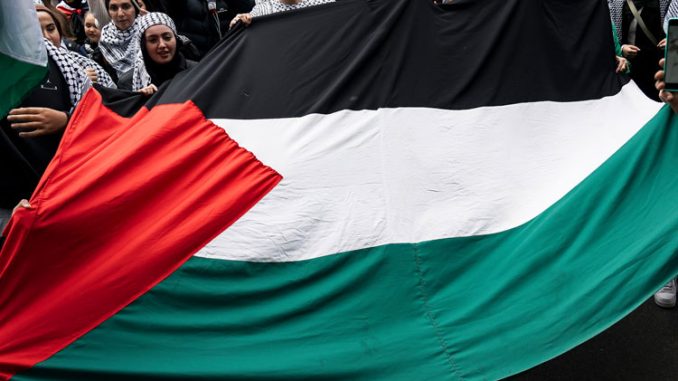
Image: People in their tens of thousands rally in Melbourne in support of Palestine and in solidarity with the Palestinian people as the State of Israel continues its bombing attacks of Gaza, resulting in the killing of thousands of civilians and displacement of hundreds of thousands more – with no means of escape; Palestine Rally: End The Siege, Stop the War on Gaza; author Matt Hrkac; Licensed under the Creative Commons Attribution 2.0 Generic license; image cropped.