
By John Ross
[At the U.S. mid-term elections on 3 November the American people expressed overwhelming condemnation of Israel’s atrocities in Gaza, a demand the U.S. stop its support making possible these genocidal actions, and a demand to stop the war against Iran because of its cost to their living standards. This produced one of the largest tidal waves against a U.S. government in U.S. electoral history – comparable to the post World War I elections of 1920 and the post-World War II elections of 1946. But U.S. imperialism has no intention of either abandoning its support for Israel or of giving up its attack on Iran unless it is driven out of West Asia (the “Middle East”) by the resistance of the Iranian people and the continuing opposition to paying the price of this aggressive war by the American people.
On 7 November the China media outlet guancha.cn (“Observer Network”) carried out an interview with John Ross on the results of the U.S. mid-term elections. This English edition of the second part of the interview deals with the consequences of the U.S. elections for Israel, Gaza and the war against Iran. The first part, analysing the economic forces compelling this U.S. policy, were dealt with on this substack in “U.S. elections – the people say no to war and cuts in living standards, capital says we won’t accept that answer”]
Is the Conflict in West Asia Nearing an End?
Guancha.cn: Let’s pivot to two geopolitical questions that the Chinese strategic community cares deeply about. First, the war with Iran. As you mentioned, anti-war sentiment was clearly a major factor behind the GOP’s crushing defeat. Does this Democratic “blue wave” mean that the pro-Israel hawks in Washington have suffered a major setback? Will this result pave the way for a swift ceasefire or compromise with Iran?
John Ross: This contains two distinct though interconnected questions: one regarding Israel, and one regarding Iran.
On the Israel issue, I do not believe America’s fundamental policy will change. The U.S. ruling class, the political establishment—or whatever you want to call the group that actually runs America—will try every trick in the book to ignore the will of the voters. It is true that the American people have clearly stated their opposition to Israel’s policies and U.S. support for Israel, representing a huge shift in public opinion (and I know Guancha.cn recently published an article by Ms. Helena Cobban analyzing this historic shift).
Yet the U.S. ruling elite has absolutely no intention of changing its policy toward Israel. Right now, the main thing, in this regard, they are racking their brains over is: under conditions where the American public no longer supports—and even fiercely opposes—this pro-Israel policy, how can we covertly keep pushing it forward?
Why are they so obsessed over this? Because the U.S. must control the oil resources of West Asia and embedded within this is a strategic calculus aimed at China. America’s highly aggressive policy toward Iran is also squarely aimed at China. For decades, an open secret has been that the U.S. calculates China’s strategic vulnerability lies in energy—despite the explosive growth of renewable energy, China will remain a massive importer of energy for a significant time to come. Therefore, Washington’s calculated plan is that in the event of a conflict with China, it will sever China’s energy supplies.
In the past, the U.S. envisioned executing a naval blockade close to China’s shores, such as in the Strait of Malacca. Today, however, China’s military and naval power is now far too formidable for this, meaning a near-shore blockade stands zero chance of success. Consequently, the U.S. has been forced to push its projected blockade line thousands of kilometers away from China to cut off its oil sources—because while China possesses three aircraft carriers, it does not yet have the long-range power projection capabilities required to wage a massive conventional military showdown against the U.S. Navy thousands of kilometers away. [Note – this has been extremely well and exhaustively analysed by Brian Berletic – JR]
This is precisely why, even though the U.S. itself no longer relies on energy imports from West Asia, it has launched more wars there in recent years. This is also a fundamental reason behind U.S. actions targeting Venezuela and Iran—the U.S. doesn’t need this oil for itself, but it must firmly control the life-and-death power over “who this oil can be sold to,” with a primary objective of ensuring it can cut off oil supplies to China if necessary. Because of this, and other reasons, the core U.S. state policy of protecting Israel at all costs will not change; Washington will simply seek to find ways to hide it from the American public and keep pushing.
As for the specific trajectory of the war with Iran, it is far more complex because the actual combat capabilities of the Iranian military have vastly exceeded U.S. expectations—even without nuclear weapons, Iran possesses the capacity to inflict severe blows on Israel and U.S. forces. (Parenthetically, the claim that “Iran is attempting to develop nuclear weapons” is a pure and unadulterated lie, backed by zero evidence. Furthermore, as this conflict demonstrates, Iran does not need nuclear weapons to inflict severe damage on Israel; moreover, if Iran went nuclear, Saudi Arabia and Egypt would follow suit, and the whole situation would become immensely more complicated.)
At this very moment, as we carry out this interview, I have been watching U.S. television news and major media reports (such as The Wall Street Journal and The New York Times). A fierce argument is raging inside Washington regarding the next step toward Iran. Immediately after the election concluded, Trump called a meeting with top military brass. According to his original script, at worst he anticipated that the GOP might lose the House by a narrow margin (say, around 10 seats) but hold the Senate. Under the expectation of such a “minor defeat,” every serious strategic expert I know judged that Trump would rapidly launch a massive military offensive against Iran post-election to win the war. Instead, the Republicans were hit with an historic rout.
This plunged Washington into an extreme dilemma: from a domestic political standpoint, launching a large-scale offensive against Iran at this time would be intensely unpopular, completely destroying the GOP’s immediate political future (they could effectively say goodbye to the 2028 election). Yet from a strategic perspective, if they do not completely dismantle the Iranian regime, America’s strategic ambitions cannot be realized. As a result, the White House is locked in an internal dispute: should they gamble on a military campaign to overthrow the Iranian regime, or do they negotiate a public or hidden compromise with Tehran. Perhaps by the time this interview is published, Washington will have made its choice.
[Note – I apologise, for knowingly using the imperialist terminology of “Middle East” to describe West Asia in the headline of this article. It is simply that, as yet, most people in the West do not yet recognize what is meant by West Asia, and I think it more important that the maximum possible number of people immediately understand this article is about the genocidal activities of the Israeli regime and the war of aggression against the Iranian people. Hopefully, one of the effects of rapidly rising understanding of people in the U.S. and elsewhere will be that soon West Asia will be universally understood and any concessions even in terminology to imperialo- centric visions of the world will be replaced]
The above article was originally published here on John Ross’s Substack.
Image
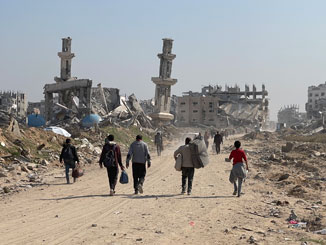
Forced Displacement of Palestinians in the Gaza Strip devastated by Israeli bombing, January 29, 2025 Jaber; Source Jehad Badwan; Licensed under the Creative Commons Attribution-Share Alike 4.0 International license; image cropped.