
By John Ross
[All progressive forces celebrated the stinging rebuttal the American people delivered to Trump and his racist, exploitative and imperialist administration at the mid-term elections. But U.S. capital will not accept this verdict of the U.S. people but is compelled to return to the attack. On 7 November the China media outlet guancha.cn (“Observer Network”) carried out an interview with John Ross on the results of the U.S. mid-term elections. The first part of the interview follows below and in the next paragraphs is the English version of the introduction published to it by guancha.cn.
[Guancha.cn: The results of the U.S. midterm elections are now settled, and the ruling Republican Party has suffered a very severe defeat. Not only do they trail the Democrats by approximately 90 seats in the House of Representatives, but they have also lost traditional “red states” like Texas, which they have dominated for decades. What exactly triggered this political upheaval? Now that the Democrats have regained control of Congress, where will the conflicts in West Asia (the Middle East) and Russia-Ukraine, America’s protectionist policies, and its containment strategy against China head next?
[To discuss this, Guancha.cn sat down with John Ross, British economist and Senior Fellow at the Chongyang Institute for Financial Studies at Renmin University of China. Ross points out that because the U.S. net capital formation rate has fallen almost to zero, “Trump 2.0” forced a massive domestic transfer of resources to the capitalist class while launching a war against Iran externally to maintain the inflow of foreign capital. While this shielded the U.S. from a deep economic crisis, it directly triggered a profound domestic political crisis.
[At the same time, profound shifts are occurring within both the Republican and Democratic parties. Inside the GOP, because its core megadonors have shifted from traditional multinational capitalists (such as Tim Cook) to Silicon Valley tech oligarchs, obsessed with securing monopoly super-profits (”techno-fascists”), the party’s anti-China impulse has become more intense than ever. Meanwhile, within the Democratic Party, though traditional Cold War establishment politicians remain at the helm, the rising left-wing generation (such as the Democratic Socialists of America, or DSA, and the broader base of “progressive” voters) has sent an unmistakably powerful message: the American people refuse to continue footing the bill for foreign wars and major power confrontations.
[Facing a United States bogged down on its periphery and increasingly polarised at home, Ross asserts: “You can never turn a tiger into a vegetarian, but a tiger understands the language of strength.” As long as China maintains its strategic focus and grows stronger, time is on China’s side.]
The root of the Republican defeat: a profound political crisis, not a deep short-term economic one
Guancha.cn: Let’s jump straight into the historic defeat of the Republican Party. There are already many analyses out there, but I would like to hear your assessment: over the past two short years, what truly drove American voters to deliver this result in the midterm elections?
John Ross: This was an extremely severe defeat. As many commentators have noted, this is by no means a normal swing of the political pendulum. In the history of U.S. congressional elections, only two other seat shifts match this scale—specifically in 1920 and 1946, both of which occurred immediately after the conclusions of world wars (WWI and WWII). The Democrats lead the Republicans by about 100 seats in the House, and the GOP has lost traditional red states that it ruled for decades, including Texas and many others.
This is a major event, and the American media universally recognises the sheer weight of these election results. Therefore it is necessary to give a precise characterisation of the situation.
It is crucial to understand that this is merely the beginning of a historical process, not its conclusion. Let’s dissect exactly what happened. I will call Donald Trump’s second term “Trump 2.0.” The Trump 2.0 regime launched a dual offensive domestically and internationally. Domestically, it attacked ordinary Americans by forcefully transferring massive resources from the working class and oppressed to capital. Internationally, it pursued a highly aggressive foreign policy—the most dramatic recent symbol of which was, naturally, the making possible of Israel’s genocide in Gaza and launching the war against Iran.
On November 3rd, the American people answered in a decisive manner: “We disagree with both of these policies!” It wasn’t a mild dislike; it was a fierce opposition to these policies and the bitter fruits they brought, demanding an immediate halt. But the reality is that American capital will absolutely not back down; it will merely shift its tactics and push forward, because it simply has no alternative.
Let me explain why American capital has no choice from both the domestic and international dimensions:
First, look at the domestic level. It may sound shocking, but on a net basis, the capital generated purely within the United States is practically zero—accounting for just 0.5% of GDP. In other words, once you subtract fixed asset depreciation, the increase in capital stock formed from domestic U.S. funds has seen almost no growth. This sort of situation has not occurred since the Great Depression of the 1930s. If I were to show you a century-long chart of U.S. capital formation, you would see it hit rock bottom during the Great Depression, soared to its highest level during World War II and the 1960s (the post-World War II boom era of U.S. capitalism), and has now plunged back down to nearly zero. (This chart is shown in Figure 1 below)
Figure 1
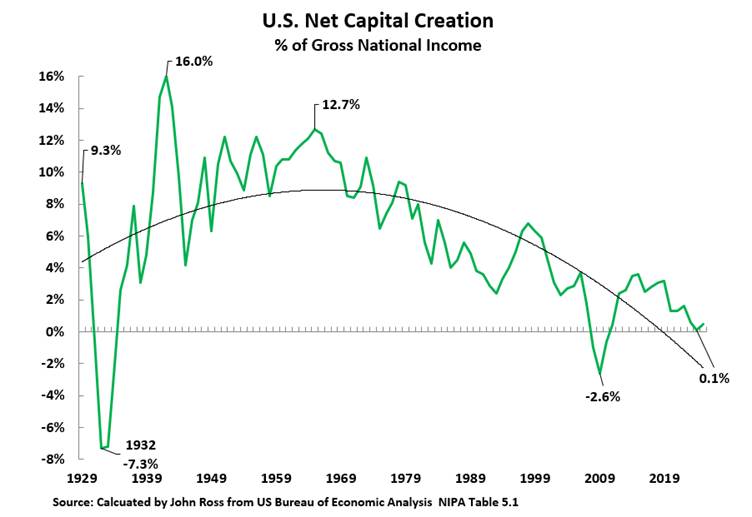
How, then, does the U.S. economy manage to maintain a growth rate of around 2% given such a low rate of capital creation? The reason is that it currently absorbs a colossal amount of capital resources from abroad every year—equivalent to roughly 3.6% to 4% of U.S. GDP. It is by relying on the capital creation resources of other nations that U.S. capitalism sustains its growth.
The attempt to reverse this rests on two preconditions: First, the U.S. must reverse the situation where domestic net capital formation is near zero. (I stress again this is “net” rather than “gross”; America’s annual gross investment remains massive, but like all advanced economies, its depreciation rate is extremely high, meaning the vast majority of investment merely replaces worn-out capital). To reverse this, the U.S. must execute a massive transfer of resources from the working class to capital domestically. Second, it must maintain the international conditions that allow a continuous, massive influx of foreign capital. But this inevitably generates international tensions because it harms other countries—instead of using those resources to develop their own economies, they transfer them to the U.S., which naturally triggers serious internal domestic problems within those countries.
In this process, Trump’s squeezing of ordinary Americans was actually quite “successful” from the point of view of U.S. capital: vast amounts of resources were transferred from the working population to capital, resulting in a year-on-year profit surge of over 20% for S&P 500 companies. This also brings up a slight disagreement I had over the past year and a half with certain Western and Chinese media outlets: I never believed the U.S. was undergoing a deep economic crisis.
The situation is simple: the U.S. is a capitalist economy. When a tidal wave of resources is transferred to capital, causing corporate profits to skyrocket, why should a deep short-term economic crisis break out? Granted, there is an AI share market bubble right now, and a normal business cycle recession will strike at some point (the business cycle has existed for 250 years and no one can abolish it), but a deep crisis, like the 1929 Great Depression or the 2008 global financial crisis, is not what is posed under conditions of a large-scale transfer of resources to capital. Some Western and Chinese media outlets, and commentators, made incorrect analyses regarding U.S. debt and other issues, ignoring this fundamental process.
Yet this exact same process, while saving the U.S. from a deep short-term economic crisis, created a deep U.S. political crisis—because forcibly transferring wealth from the working class to capital was bound to ignite political turmoil. You might recall that a year and a half ago, I published an article on Guancha.cn examining why the U.S. economy had not collapsed into a major crisis. In early August of this year, just before the meeting between the Chinese and U.S. heads of state, I also wrote an internal reference report titled “The U.S. Will Continue Low-Speed Growth and Will Not Suffer a Major Economic Crisis, But the Political Crisis Will Worsen.” The latest data released by the U.S. validates my judgment: the latest U.S. GDP grew by 2.2% year-on-year—not fast, but certainly no economic crisis. However, politically, the November 3rd mid-term election is undeniably a full-blown political crisis.
Next, look at the foreign policy level. The U.S. must receive roughly $1 trillion in capital from abroad every year; it has no choice but to keep pushing this foreign policy. But it is clear that the U.S. took a severe beating in Iran. Iran’s capacity for resistance far exceeded Washington’s expectations, and this directly backfired at home—it caused crude oil prices to spike and diesel prices to skyrocket, unleashing the exact kind of rising inflation that the American public detests.
The political processes triggered by this will continue to simmer post-election, manifesting as the rise of two new fundamental political currents within the U.S. (which, though not yet in full control, are steadily expanding).
The first force is what is rather accurately referred to in the U.S. as “techno fascism.” Its core consists of the titans of the U.S. tech sector—popularly represented by figures like Elon Musk and Peter Thiel. With trillions of dollars, this represents a project for the dismantling of American democracy.
The November 3rd election results were a sharp blow to this but the conclusion that will be drawn by such a project is: “Since the American people do not want the policies we are pushing and have expressed their resistance through their ballots, they should not be allowed to vote.” Although they have met with a severe tactical setback, such a project has trillions of dollars in resources and will not let the matter rest. It will simply recalibrate tactics and keep pushing; besides, they are not overly concerned about the short-term, as they know the leadership of the Democratic Party will not adopt a radically unacceptable policy in the short term.
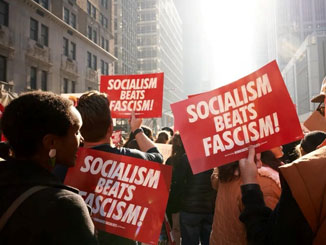
The second force is the rise of the left wing within the Democratic Party, most notably the Democratic Socialists of America (DSA). There is now an astonishing fact: the mayors of America’s first- and second-largest cities, New York and Los Angeles, are now both self-proclaimed “socialists” and DSA members!
Zohran Mamdani assumed office as New York’s mayor last year, and on 3rd November a DSA candidate won the mayoral seat in Los Angeles. Of course, I don’t want to exaggerate—this does not mean the DSA is about to take over the Democratic Party. The DSA’s seats in the House of Representatives increased slightly, but the gains were modest, likely ending up with 7 to 8 House members, alongside a few senators who, though not formal DSA members, carry its strong endorsement (most notably the newly elected senator from Michigan, Abdul El-Sayed).
The centrist establishment will not lose control of the Democratic Party anytime soon, but the trend of the GOP radicalising toward the far right and the Democrats radicalising toward the left has significantly intensified.
Therefore, the November 3rd election answered a decisive question: previously, Trump tried to instil the narrative that “your life hardships are caused by immigrants or communists,” but the American people answered categorically: “We don’t buy your lies. We refuse to accept the plundering of the working class, and we refuse to accept foreign wars and their bitter consequences.” This is no longer a matter of opinion polls or guesswork; it is an established political fact. Precisely because of this, this is by no means the end of the process, but rather the start of a great turmoil. Therefore hugely celebrate this first victory of the American people, but also understand that U.S. capital cannot, and will not accept, the verdict of the U.S. people delivered at the mid-term elections.
The implications of this economic and political imperative of U.S. capital to attempt to overturn the verdict of the American people elections will form the next parts of this interview.
[The implications of the outcome of the mid-term elections for U.S. domestic politics, for its wars in West Asia, for the war in Ukraine, and for U.S. attacks on China will be carried in future articles on this substack]
The above article was originally published here on John Ross’s Substack.