
By Mike Martin
Introduction
This article describes the UK’s historic relationship with Japan from the nineteenth century to the present and Japan’s current military expansion.
It should be borne in mind that the US relationship with Japan in the contemporary period dwarfs that with the UK in terms of importance. Japan hosts approximately 53,000 to 55,000 permanently stationed US military personnel in around 120 US military facilities, representing the largest concentration of US forces deployed in any overseas country. Of these the small Okinawa Prefecture hosts approximately 25,000 to 30,000 US military personnel in 32 US military facilities. Okinawa has a land area of 2,281 km2 with US military installations occupying roughly 15% to 18% of the total land area on the main island of Okinawa. Despite making up only 0.6% of Japan’s total landmass, Okinawa hosts over 70% of all exclusive-use US military facilities in the country.
British foreign policy imperatives in the nineteenth century
Rivalry with Tsarist Russia was a central and defining axis of British foreign policy throughout the nineteenth century as it viewed Tsarist Russia as a major imperial threat to British ruled India and British interests in East Asia.
Britain took an interest in Japan to expand its trade routes, counter Russian imperial expansion in Asia, and protect British colonial interests in the Pacific. However, during the Edo period (from 1603 to 1868), relations and trade between Japan and other countries were severely limited under the Sakoku isolationist foreign policy under which almost all foreign nationals were banned from entering Japan, while most Japanese people were kept from leaving the country.
In 1852, Commodore Matthew Perry was assigned a mission by US President Millard Fillmore to force the opening of Japanese ports to US trade, using gunboat diplomacy if necessary. On his second visit to Japan in mid February 1854 with eight warships and 1,600 men, Perry was able to manoeuvre the Tokugawa Shogunate into signing the Convention of Kanagawa treaty on 31 March 1854. The treaty effectively meant the end of Japan’s Sakoku policy by opening named ports to US vessels, establishing a US consul as well as other provisions. The treaty precipitated the signing of similar treaties establishing diplomatic relations with other Western powers.
The first Anglo–Japanese Friendship Treaty was signed on 14 October 1854 by Britain and representatives of the Tokugawa shogunate. The treaty saw the ports of Nagasaki and Hakodate opened to British vessels, and Britain was granted most favoured nation status with other western powers.
The Anglo–Japanese Treaty of Peace, Amity and Commerce of 26 August 1858 largely superseded and greatly expanded upon the limited scope of the 1854 treaty. While the 1854 agreement only opened specific ports for shelter and supplies without formal trade rights, the 1858 treaty established full commercial relations and legal privileges.
The treaty was one of the five 1858 Ansei Treaties which also ended the exclusive trading monopoly of the Netherlands after approximately 214 years.
Britain was the midwife of the Meiji era Japan
Britain assisted the industrial and military rise of the Meiji era Japan which developed into a powerful regional buffer against Russian ambitions. By fostering a friendly, capable ally, Britain could reduce its own onerous and expensive naval deployment needs in the Pacific Ocean. This flourishing relationship culminated in the Anglo–Japanese Alliance Treaty of 1902.
The Russo–Japanese War broke out in 1904, as Japan sought to halt the expansion of the Russian Empire’s colonies in China. Although Britain did not officially join the war, it supported Japan in espionage, ship design, finance, and diplomacy throughout the war.
On 7 August 1914, just days after the start of the First World War, the British government asked Japan for naval assistance against German armed merchant vessels operating in the East China and Yellow Seas. Japan used the Alliance’s mutual defence provisions as the legal and diplomatic basis to enter the War on the Allied Powers side. The Treaty made possible the Japanese seizure of German possessions in the Pacific north of the equator during the War, including the port of Qingdao in China’s Shandong province.
Outside of the Treaty and at the request of the Japanese government, the British government permitted the dispatch of the Sempill naval aviation technical mission which arrived in Japan in September 1921, with the objective of helping the Imperial Japanese Navy develop its aeronaval forces.
The demise of the Alliance was signalled by the 1921 Imperial Conference, in which British and Dominion leaders convened to determine a unified international policy. One of agenda items of the conference was the renewal of the Alliance which saw the Canadian Prime Minister Arthur Meighen argue for its non-renewal. The decision to replace the Alliance was made at the Washington Naval Conference and was officially terminated on 17 August 1923 upon the formal ratification exchange of the Four-Power Treaty consisting of the US, the UK, France and Japan.
Post Second World War
After the Japan surrender on 15 August 1945, the Allied Powers set up the Supreme Command for the Allied Powers (SCAP) under US general Douglas MacArthur. The US took the lead in SCAP and oversaw the demilitarisation of Japan as well as crafting a new Constitution which was promulgated on 3 November 1946 and came into effect on 3 May 1947. Article 9 of the Constitution enshrines the renunciation of war as a sovereign right and bans the maintenance of a military with war potential.
The onset of the Cold War led by Washington saw a SCAP strategy reappraisal towards rebuilding and strengthening Japan as a potential ally, a process known as the “Reverse Course“.
On 1 July 1950, just days after the outbreak of the Korean War, the first US occupation forces were airlifted from Japan to South Korea. The US needed Japan to rearm to assist with regional security and therefore on 8 July General MacArthur authorised the establishment of a National Police Reserve (NPR). The NPR was initially built up to 75,000 personnel equipped with sidearms, carbines, rifles, submachine guns, bazookas and mortars. It was subsequently expanded in size and ultimately reorganised into the National Safety Agency on 1 August 1952.
The Security Treaty Between the United States and Japan was signed on 8 September 1951 and came into force on 28 April 1952. The treaty allowed the US to maintain military bases in Japan and explicitly allowed US military forces based in Japan to put down “internal riots and disturbances”.
The process of gradually reinterpreting Article 9, that started in 1950, cleared the way for the creation of a Defense Agency and the transformation of the National Safety Agency into a “Self-Defense Force” culminating in the creation of the Japan Self-Defense Forces on 1 July 1954.
The 1960 Treaty of Mutual Cooperation and Security codified the US–Japan foundational military alliance which pairs the US nuclear umbrella and global forces with Japanese host-nation base support and Self-Defence Forces. The Treaty commits Japan to host US military bases and personnel, and the US to defending Japan including the administration of disputed territories such as the Senkaku Islands, known as the Diaoyu Islands in China.
Growing UK Japan cooperation
Anglo–Japanese relations were restored in 1952 with the Treaty of San Francisco and normalised in the 1960s with cultural exchanges, state and royal exchange visits, and industrial cooperation such as the design of Japan’s first Nuclear Power Plant which commenced operation in 1966. In the 1980s industrial and government alignment facilitated the ramping up of large-scale corporate manufacturing and direct investments. Although the UK does invest in Japan, the flow of capital is much smaller than the massive investment Japan puts into the UK.
In April 2012 Prime Minister David Cameron led a trade delegation replete with major UK defence contractors to Japan which resulted in an agreement to jointly develop and produce weapons systems.
In May 2022 the Prime Ministers Fumio Kishida of Japan and Boris Johnson of the UK met in-person in Downing Street and confirmed in principle a Reciprocal Access Agreement (RAA). The agreement, which was made in response to the Russo-Ukrainian war and China’s rise in the Indo-Pacific region, enables shared military training and military operations such as joint military exercises as well as allowing both nations to deploy troops in each other’s countries.
In December 2022 Japan, the UK and Italy, signed an agreement to create the Global Combat Air Programme (GCAP) to jointly develop a sixth-generation, multi-role, stealth fighter aircraft with its first jets to be produced by 2035. The programme strapline is “merging the three nations’ costly existing research into new aerial war technology, from stealth capacity to high-tech sensors”.
In January 2023 the Prime Ministers Fumio Kishida of Japan and Rishi Sunak of the UK signed the RAA making the UK the first European country to have such an agreement with Japan, with the UK Government describing the pact as the most important of its type since the 1902 Anglo–Japanese Alliance.
In addition, the UK and Japan have signed several major economic agreements, notably the Comprehensive and Progressive Agreement for Trans-Pacific Partnership (CPTPP) in July 2023 which deepens free trade ties with Japan and other Pacific nations but not China despite its application which remains pending.
The UK’s “tilt” to the Indo-Pacific
The 2021 Integrated Review saw the UK’s military and foreign policy pivot toward the Indo-Pacific in the form of a strategic posture comprising several core initiatives:
AUKUS: The trilateral defence partnership with the US and Australia, primarily focused on equipping the Australian Navy with conventionally armed, nuclear-powered submarines and collaborating on advanced military technologies.
Forward Deployments: The Royal Navy maintains a regional presence using two permanently deployed offshore patrol vessels, supported by logistical hubs in Singapore, Brunei, and Diego Garcia.
GCAP: The trilateral agreement with Italy and Japan to co-develop a next-generation stealth fighter aircraft by 2035.
Bilateral Alliances: The UK has solidified interoperability with allies through agreements such as the RAA with Japan and the Downing Street Accord with South Korea.
The most extravagant aspect of the tilt were the deployments to the Indo-Pacific of UK Carrier Strike Groups, namely Operation CSG21 from May to December 2021, and Operation Highmast from April to November 2025. Operation Highmast covered 40,000 nautical miles (74,000 km) and included a defence and security summit at Tokyo port. Whilst Ministry of Defence (MoD) figures are not yet available, the total additional operating costs for a deployment of this scale are estimated at £73.5 million, a substantial portion of which is accounted by marine diesel and aviation fuel whose burning creates prodigious quantities of greenhouse gas emissions.
In early 2026 UK was assigned new duties as part of NATO’s Arctic Sentry mission with the UK Carrier Strike Group deployed to the North Atlantic
Japan’s Strategic Shift, the diminishment of Article 9 and rearming
In December 2011 the Japanese Cabinet partially relaxed its strict post-war ban on arms exports for co-development projects with security partners.
Japan is executing its largest military expansion since the Second World War and is moving away from a strictly passive defence posture and adopting an active, long-range “counterstrike capability” to deter or pre-empt alleged threats from missile bases in China, North Korea, and Russia.
This growing capability comprises several missile and standoff programmes:
The Type 12 Surface-to-Ship Guided Missile (12SSM) is a subsonic, domestically developed cruise missile designed to strike ships and land targets. With a range exceeding 1,000 km the missile can reach coastal areas of neighboring countries such as China and North Korea from the primary Japanese home islands.
The 12SSM has been deployed to Camps Kengun and Yufuin on Kyushu Island and Camp Fuji on Honshu Island with further deployments planned for Okinawa.
The Hyper Velocity Gliding Projectile (HVGP) is a ground-launched hypersonic glide missile system. The missile is launched from mobile ground platforms that allow for rapid repositioning and follows unpredictable, high-altitude trajectories during its glide phase to evade air defense systems.
The initial Block 1 variant has a range scale of 500–900 km, and the upgraded Block 2 variant a specified range scale of 2,000–3,000 km with a planned deployment for the 2030s.
Tomahawk and Advanced Missiles: Japan has signed a contract to acquire 400 US Tomahawk cruise missiles. However, the contract may face delays following extensive Tomahawk usage in recent West Asia military actions.
Air and Missile Defence: Cooperation with the US includes plans to quadruple domestic production of SM-3 Block IIA interceptor missiles to counter notional threats from ballistic and hypersonic missiles.
In parallel, Japan has fortified its southwestern Ryukyu Islands chain with surface-to-air and anti-ship missile systems and plans a further deployment by March 2031 on Yonaguni Island which is located just 110 km from Taiwan province.
Reviving colonial aspirations and provoking China
In 1971 the United Nations adopted their General Assembly Resolution 2758 which recognises the People’s Republic of China (PRC) as the sole legitimate representative of China to the UN. The UN Secretariat aligns its administrative stance with the view that Taiwan is a province of China.
The 1972 Japan–China Joint Communiqué states that Japan “fully understands and respects [China’s] stance” that Taiwan1is part of the PRC, whilst maintaining a distinct position of diplomatic recognition for the PRC and keeping unofficial ties with Taiwan.
However, in the twilight days of Fumio Kishida prime ministership on 25 September 2024 Japan sent a Takanami-class destroyer along with warships from Australia and New Zealand through the Taiwan Strait for the first time since the JMSDF’s creation. The fourth such “freedom of navigation” transit took place in April 2026.
Notably the global north media omit any reference to Imperial Japan’s colonisation of Taiwan from 1895 to 1945 and the many such transits which took place in that period.
The significant residue of the colonial period in the province of Taiwan is reflected in the close, informal political ties of Japan’s conservative politicians with the Pan-Green Coalition, one of the two main political camps on the island.
Sanae Takaichi
The ascent to prime ministership of the hard-line conservative Sanae Takaichi has seen a dramatic deterioration of Sino–Japanese relations starting with her statement in November 2025 in the parliament that a military “contingency” in relation to Taiwan could potentially constitute an “existential crisis for Japan” under the Legislation for Peace and Security, allowing Japan to take military action in collective self-defence.
In December 2025 Japan’s Cabinet approved a record defence budget exceeding $58 billion and accelerated plans formalised in December 2022 to spend 2 percent of its GDP on defence.
The February 2026 House of Representatives election saw the Liberal Democratic Party (LDP) secure a historic supermajority, winning 316 of the 465 seats on 49.09 percent of the popular vote and a turnout of 56.26 percent. In this voting system 289 of the seats are elected by a first past the post system and 176 seats via proportional representation (PR). The voting system results in the splintering and frequent recombination of smaller parties thus diluting the strong pro-peace sentiments in the population.
In April 2026 the Cabinet further loosened its decades-old restrictions on exporting lethal military hardware internationally.
End Note
In both Britain and more so in Japan, the public are in the majority pro-peace and against wars of intervention, however these sentiments are not sufficiently finding their expression via the political process. It is vital to build the largest possible global majority for peace. We are already in the foothills of a possible Third World War which could ultimately be fought with nuclear weapons and pose an existential threat to human civilisation. Mass opposition to the Vietnam War in the US and the deployment of US cruise missiles in Europe pressured governments to change their policies. Now more than ever, it is imperative that the global majority for peace prevails.
Readers may find these related articles of interest from the Tricontinental: Institute for Social Research and the New Cold War campaign:
The New Cold War Is Sending Tremors through Northeast Asia
Japan: Abe’s landslide in seats based on no increase in votes
Sanae Takaichi and the LDP’s Pseudo-Democratic Elections
Briefing: The US and NATO Militarise Northeast Asia
Hands off Asia! A People’s Call for Sovereignty and Solidarity on the conference which took place in Colombo from 16-18 July 2026.
Not a Matter of Fate: Okinawa under US-Japanese Rule
Mike Martin is a member of Scottish CND’s trade union network.
Notes
1 Tokyo itself does not explicitly adopt the phrase “Taiwan province” in its official diplomatic stance or bilateral treaties.
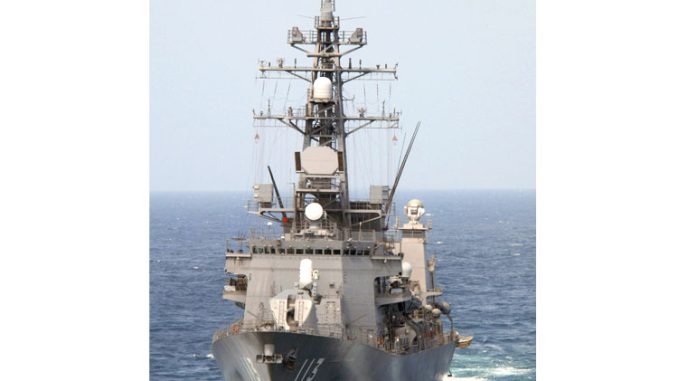
Image: Aboard USS IWO JIMA LHD 7 (Sept. 4, 2006) — The Japanese Destroyer Sauza Nami (DD 113) steams behind USS Iwo Jima (LHD 7) during a Replenishment at Sea (RAS) with the Japanese supply ship Mashu. Iwo Jima recently deployed from here homeport of Norfolk, Va., and began a regularly scheduled six-month deployment to the U.S. European Command and U.S. Central Command (CENTCOM) areas of responsibility (AOR) in support of Operation Enduring Freedom (OEF). U.S. Navy photo by Mass Communication Specialist Christopher L. Clark; Source Navy Visual News Service (NVNS); Public domain
_in_the_Arabian_Sea,_-4_Sep._2006_a.jpg)