
By Claudia Sanchez
The attacks on diversity, equity and inclusion in the United States are part of a wider offensive against the gains of the Civil Rights Movement. That offensive is now having a direct impact in Britain.
The aim is to discredit the idea that racism is structural, to roll back even limited measures intended to counter racial inequality, and to present the existing racial order as the natural outcome of merit.
Professor Jason Arday warned about this pattern before the latest public attacks against him. On 8 April 2026, speaking at the British Sociological Association’s 75th anniversary conference, he described what he called “the playbook” being used against black academics in the United States: allegations of misconduct are taken up by right-wing media, amplified on social media and used to build pressure on universities. The individual case is then turned into an attack on DEI and anti-racism more generally. He warned that the same methods were appearing in Britain.
The present offensive developed rapidly after the Black Lives Matter uprisings of 2020. The murder of George Floyd brought millions of people onto the streets, not only in the United States but internationally. It forced the issue of institutional racism into the centre of political debate.
The US right responded by making “critical race theory” a major political target. American conservative activist Christopher Rufo helped popularise and coordinate the use of critical race theory as a catch-all label in right-wing media and political messaging. It came to cover a wide range of attempts to discuss structural racism, white privilege, black history or racial inequality.
It has a clear political purpose. Measures intended to address racism were redefined as discrimination against white people. The existing inequalities were no longer the problem. The problem was said to be the attempt to change them.
In 2020, Trump restricted certain forms of race and sex-related training in the federal government and among federal contractors. The order was revoked by Biden when he took office in 2021. When Trump returned to office in 2025, the offensive was pushed much further, with federal DEI programmes dismantled and pressure applied to universities, contractors and private companies.
In January 2025 Trump revoked Executive Order 11246, signed by Lyndon Johnson in 1965, which had required federal contractors to take affirmative action to ensure equality of employment opportunity. One of the measures created during the Civil Rights era was dismantled in the name of restoring “merit”.
Government policy determines funding, employment and institutional practice. Programmes are closed, jobs are removed, recruitment policies are changed and universities are warned about the consequences of pursuing policies the administration defines as DEI.
This campaign also has an institutional and financial infrastructure. Rufo is a senior fellow at the Manhattan Institute, one part of a much wider conservative network of think tanks, foundations, media organisations, lawyers and political operatives. Tax records show that the Lynde and Harry Bradley Foundation and the Bradley Impact Fund together gave $510,050 to the Manhattan Institute in 2022 and almost $530,000 to the Heritage Foundation. The Bradley Foundation later awarded Rufo one of its 2025 Bradley Prizes. This does not mean that a particular grant paid for a particular campaign. It does show that the anti-DEI offensive operates inside a wealthy political infrastructure capable of sustaining research, communications, legal work and campaigning over many years.
The campaign against Claudine Gay illustrates this. Gay became Harvard’s first Black president in 2023. After her appearance before Congress at a hearing on antisemitism on university campuses, plagiarism allegations were promoted against her. Harvard’s December 2023 review found inadequate citations which required correction, but did not find that she had breached its standards for research misconduct.
The campaign continued regardless. Rufo later described the pressure applied to Harvard as “narrative, financial and political” and called the campaign a successful strategy and a “team effort” involving media, donors and politicians.
We do not need to debate about whether an organised political strategy exists. Its organisers have said that it does.
Since Gay’s resignation, allegations of academic misconduct have repeatedly been used against black academics for simply existing beyond their station, and white academics for being associated with progressive causes.
One person’s conduct is made to represent DEI, anti-racism and black advancement. A case concerning an individual academic becomes evidence that standards have supposedly been lowered because institutions have tried to increase black representation.
The same argument is now appearing in Britain.
Britain did not need the United States to introduce racism. But what is being imported is a tested political campaign for reversing anti-racist gains.
In Britain the equivalent institutional language is usually EDI, equality, diversity and inclusion, rather than the American DEI. What is obviously under attack is the equality in EDI. The American anti-DEI offensive provides the political framework through which EDI, anti-racist work, widening participation and other measures intended to address inequality can be recast as unfair advantage, lowered standards or discrimination against white people
The path from the United States to Britain was visible early. On 20 October 2020, less than a month after Trump’s executive order on race and sex-related training, the then Equalities Minister Kemi Badenoch told the House of Commons that the government stood “unequivocally against critical race theory”. In the same debate, Conservative MP Andrew Lewer pointed to the teaching of critical race theory in the United States “and now even in some schools in the UK”. A term that had been turned into a major political weapon in America was rapidly incorporated into British political debate.
By 2025 an article published by the Higher Education Policy Institute was already warning British universities about the effects of the US anti-DEI backlash. British companies began adjusting their own policies in response to developments in the United States. Research among senior legal officers at major UK organisations found widespread changes to DEI and related policies. Barclays removed gender and ethnicity targets for its US workforce. Separately, British financial regulators abandoned proposals for mandatory diversity rules.
This year the Trump administration has begun developing State Department funding for conservative-aligned “free speech” projects in Europe, including proposed multimillion-dollar support for organisations linked to Britain. American state funding is now being offered and proposed for projects capable of building sympathetic political infrastructure in Europe.
The British media have also played their part in legitimising the central argument of the anti-DEI campaign. Diversity and merit are increasingly presented as opposites. Measures aimed at correcting racial inequality are called preferential treatment, while the inequalities produced without such measures are treated as neutral. This is the framework through which the small progress of black pupils can be put against white “working-class” underachievement as though one came at the expense of the other.
Recent coverage of prominent black academics shows how easily separate disputes can be folded into this wider argument about “woke” institutions, standards and merit.
Professor David Olusoga has faced repeated attacks over his work on empire and colonial history. In late 2025 the Telegraph published an article reporting accusations that his BBC series on the British Empire was biased and “relentlessly negative”. It later described his account of the Mau Mau Emergency as a “travesty” and argued that it should make the BBC reconsider giving him further commissions. Last month, another article called his account “deeply skewed and error-strewn” and a “diatribe”. On 13 August, the day before Jason Arday was found dead, the paper ran a review asking: “Is it time for the BBC to find a history star other than David Olusoga?”
Olusoga’s work places slavery, empire and colonial violence at the centre of British history. The repeated attacks on him form part of a wider political struggle over whether Britain’s imperial history should be confronted at all, or whether doing so is itself evidence of ideological bias.
Similarly, The Telegraph has described Professor Kehinde Andrews as one of the “most toxic voices” in British race relations and previously reported on him under the label of an “anti-white professor”. On 3 August, at the height of the attacks on Arday, one article titled “Jason Arday is merely a symptom of academia’s moral disease” pulled Andrews into the same argument as the “equally ludicrous Kehinde Andrews”.
This was happening as the institutional base for Black Studies that Andrews helped to build was itself being dismantled. Birmingham City University closed its undergraduate Black Studies course in 2024 and is withdrawing the MA in Black Studies and Global Justice from September 2026. Andrews has since been made redundant. Kimberlé Crenshaw warned in June that the closure had a “dangerous parallel” with the attack on Black Studies and DEI in the United States.
In October 2025 the Telegraph also published a major profile of Nathan Cofnas under the headline that he was on a mission to “end the tyranny of wokeism”.
Cofnas’s own writing leaves little ambiguity about his political project. In his February 2024 essay, A Guide for the Hereditarian Revolution, he describes “race realism” as the scientifically correct position and argues that defeating what he calls the “equality thesis” is necessary to defeat “wokism”. He predicts that under what he considers a meritocracy the number of black professors at Harvard would approach zero and black people would disappear from almost all high-profile positions outside sport and entertainment.
A white academic whose published argument is that black representation in elite institutions would collapse under his version of meritocracy became a central figure in the public campaign against Jason Arday. A Telegraph article described Arday as Cambridge’s “diversity poster boy”; another presented him as “merely a symptom of academia’s moral disease”. Across the wider British media the allegations were increasingly tied to questions about DEI, merit and whether Arday’s rise was itself evidence that academic standards had been lowered.
The limits of corporate diversity are obvious. Greater representation at the top of a company does not alter who owns it or how its workers are exploited. A business can promote black executives while profiting from war and imperialism. A government can promote diversity in public appointments while pursuing racist immigration policies.
Cambridge’s own figures show how limited even that representation remains. In 2024–25 it recorded 2,234 academic staff, of whom just 0.7 per cent were black, around 16 people. Of 795 professors, only 0.4 per cent were black. Hiring Jason Arday as Cambridge’s youngest-ever black professor in 2023 did not amount to a significant expansion in the number of black academics.
There is therefore a necessary left criticism of the way the politics of black liberation has often been reduced to representation, managerial training and changes in elite recruitment. None of this removes the economic structures that reproduce racial inequality.
But this is not the criticism being made by the right. The right is not arguing that DEI is inadequate because it leaves capitalism untouched. It objects to the much more limited proposition that racism is structural and that institutions should take measures to counter its effects.
The anti-DEI offensive therefore has to be understood as part of a wider racist reaction. It seeks to reverse gains made under pressure from the black struggle and other movements of the oppressed.
In the United States this campaign has already passed from right-wing agitation into state policy. In Britain it is being promoted not only by explicitly right-wing activists but through sections of the mainstream media which have accepted its basic framework: that diversity threatens merit, that anti-racism threatens academic standards and that the tiny increased presence of black people in elite institutions is itself something requiring intense scrutiny.
Until it’s no more.
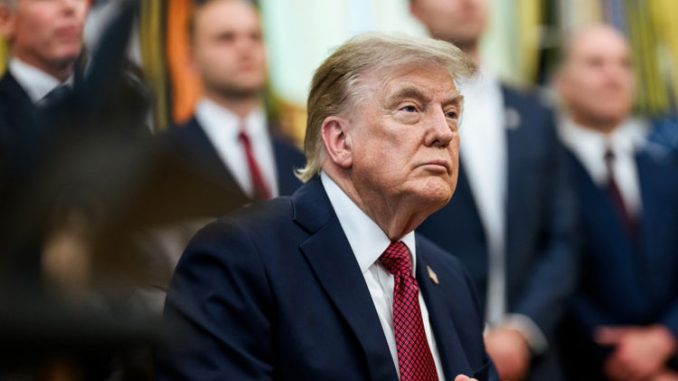
Image: President Donald J. Trump makes an announcement on American nuclear innovation; Official White House Photo by Molly Riley; cropped.
The above article was originally published here on the For Liberation, Against Racism blog.