
1 November 2026
Welcome to the first weekly update from For Liberation Against Racism, rounding up the week’s developments on race, racism and the fightback.
This week: reparations dominate the Commonwealth summit as it opens in Antigua, the UN mission in Western Sahara collapses, and the man who started the campaign against Professor Jason Arday gets a platform at Oxford University while the journalism behind the attack is shortlisted for a prize.

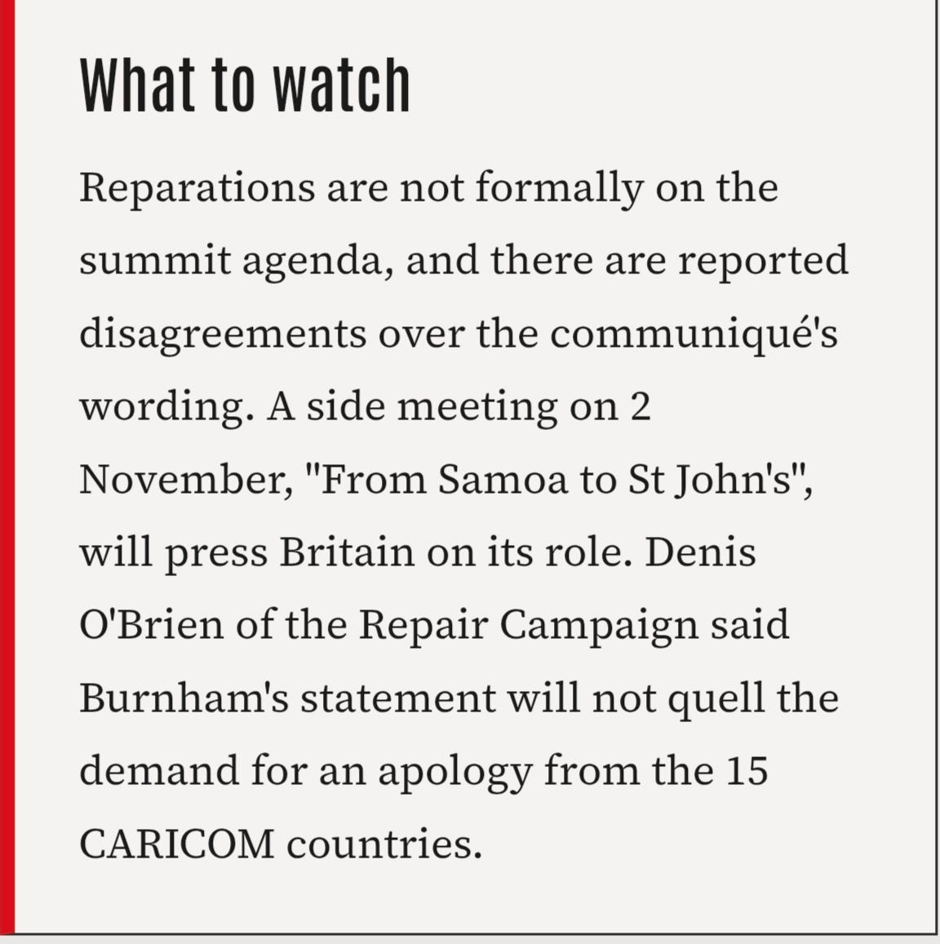
The Commonwealth Heads of Government Meeting opens today in St John’s, Antigua, and runs to 4 November. The CARICOM Reparations Commission has named it the “reparations CHOGM”. It follows the UN General Assembly’s March vote declaring the slave trade the “gravest crime against humanity”, on which Britain abstained.
Burnham: sorrow, dialogue, no money
Days before the summit, Andy Burnham wrote in the Guardian that he is “open” to a formal state apology. He expressed personal “sorrow and regret” and offered a “structured dialogue” with those affected. He ruled out financial reparations. In their place, he offered debt restructuring for the poorest Commonwealth countries, renewable energy support, and work on girls’ education and poverty. Restructured debt is still debt, paid back to the same creditors over a longer period.
Badenoch: “another navel-gazing distraction”
Kemi Badenoch’s answer, posted on 31 October, was the standard defence of empire. Slavery, she said, was “an evil in which people from every continent and region participated”. She asked whether the Caribbean would also seek apologies from the descendants of African kings and merchants. The argument is meant to dissolve responsibility. It was British capital that built the trade into an industry, financed and insured it through the City, and when slavery ended, Britain compensated the slave owners (a debt we only finished payin off in 2015!)
The King’s tour
The King toured the Bahamas and Guyana this week on his way to Antigua. The Palace made clear there would be no apology. In the Bahamas he acknowledged “the great suffering and injustices of the past”, while protesters outside carried placards reading “Pay us what you owe us”. Guyana’s President Irfaan Ali said an apology is “the next step”. In Antigua, Dorbrene O’Marde of the national Reparations Support Commission said the “no apologies” line had inflamed the host country.
The pressure is building at home too. More than 900 people registered for the UK Reparations Conference in London on 17 October, hosted by Bell Ribeiro-Addy MP. It launched the process for an All-Party Parliamentary Commission of Enquiry on reparations.

The journalism is up for a prize. Jack Grove of Times Higher Education, who ‘investigated’ Prof Arday’s PhD thesis, has been shortlisted for Specialist Journalism at the British Journalism Awards. The Voice said the shortlisting sends a deeply troubling message to Black Britain. On the same shortlist, The Times columnist Alice Thomson is nominated for a piece headlined “Jason Arday was failed by the system — and by me”.
Cofnas gets an Oxford platform.
The Oxford University Reform UK Society has invited the self-described ‘race realist’ Nathan Cofnas, who first went public with the plagiarism claims, to speak at Oriel College on 17 November. On Friday BLM UK and Stand Up To Racism published an open letter demanding the event is pulled. Signatories include Diane Abbott, Afua Hirsch, Gary Younge, Beverley Knight, and the heads of the UCU, NEU and Unison.
Share it, and get your union branch to back it.
Another “inquiry“
The Committee for Academic Freedom has launched its own inquiry into Prof Arday’s appointment and into supposed DEI in recruitment. Byline Times reports that no outlet covering it disclosed CAF’s links to the groups behind the original campaign. Cambridge’s own review, led by Nazir Afzal, is confined to the support the university gave Prof Arday before he died.
Background
Prof Arday died on 14 August, nine days after resigning from Cambridge. Since then, a Taylor & Francis investigation has failed to substantiate the plagiarism claims, and a review of a 2018 paper found no plagiarism or fabrication. The Voice Newspaper counts this as the fourth time he has been cleared.

The fightback
Around 1,000 anti-racists, trade unionists and campaigners attended the Together Against the Far Right organising summit in London on 24 October. The same day, unity marches took place in Sheffield, Cardiff and Newcastle.
On 25 October, around 120 anti-racists counter-protested as several hundred anti-migrant protesters marched through Gosport.
Labour puts Zionism before local government.
Two weeks on, Labour’s ultimatum to the Greens is still unresolved. Party chair Bridget Phillipson ordered Labour groups on 18 councils to end power-sharing with the Greens unless they disowned the conference motion declaring Zionism a form of racism. Labour is prepared to bring down local administrations to defend Israel.
Greens in Sheffield have refused. Their leader, Angela Argenzio, stated that “conflating Zionism with Judaism is itself antisemitic”
The motion separates Judaism from Zionism and carries no disciplinary force. Labour’s ultimatum is about policing what can be said about Palestine.

The asylum bill in committee
MPs continued line-by-line scrutiny of the Immigration and Asylum Bill this week. The bill would charge refugees up to £10,000 for the support they received while waiting for a decision, and would narrow the right to family life.
Western Sahara: the referendum mission falls
The UN mission set up in 1991 to organise a referendum for the Sahrawi people expired at midnight on 31 October. The United States had tabled a resolution that would have dropped “Referendum” from the mission’s name. It also built on last year’s resolution, making Morocco’s autonomy plan the basis for talks. Russia vetoed it, and China, Pakistan and Somalia abstained. Russia’s alternative, a straight one-year renewal, won only three votes, with the US voting against. Russia’s delegate said the US text “could have reversed” the whole settlement process.
Oxfam warned that Sahrawis’ right to self-determination has gone unfulfilled for five decades.
Russia-Africa summit
The third Russia-Africa summit met in Moscow on 28 and 29 October, co-chaired by Putin and the African Union chair, Burundi’s Évariste Ndayishimiye. Delegations from around 48 African countries attended. Leaders adopted a declaration, an action plan for 2027 to 2029, and a declaration on civilian uses of AI. Putin said Russia-Africa trade passed $27 billion last year and that 85% of it is now settled in roubles. He also reported grain shipments of over 18 million tonnes to Africa in 2025, and plans to make Russian medicines and vaccines on the continent. He welcomed the UN’s recognition of the slave trade as the gravest crime against humanity.
The above article was originally published here on the For Liberation, Against Racism blog. To follow the For Liberation, Against Racism blog – subscribe here .