
By John Ross
Introduction
China has accomplished something no other Global South country has ever previously achieved—that is, to become the technological leader across a wide range of industries, including electric vehicles, drones, batteries, renewable energy, telecommunications, and increasing areas of pharmaceuticals and AI. Such technological achievements, and the independent national development it sustains, are a strategic goal every Global South country would aspire to as a culmination of its own development process.
There have been a number of excellent studies of the history and technological aspects of this development in China—particularly recommendable is “Breaking the Stranglehold: How China is Shattering U.S. Technological Hegemony” by Bappa Sinha, published by the Tricontinental Institute for Social Research. But underlying this technological development, indispensable to making it possible, are macroeconomic processes, policy, and strategy, which form the subject of this article.
National independence and a socialist path of development
The People’s Republic of China’s fundamental aim, from the revolution in 1949 onward, was advanced national development and independence, which would be achieved by a socialist path of development. This meant a refusal to accept the paradigm created by imperialism, and perpetuated in practical policies advocated by the IMF, that Global South countries should pursue policies to fit into a global system in which they would be producers of low-value products, commodities and low- or medium-technology manufacturing, while the high-end, high-technology parts of the value chain remained within the Global North.
On the contrary, China’s post-1949 national development, from the beginning, aimed strategically at achieving high technological and high value-added levels—no matter how remote that goal might have appeared at the beginning of the development process when China, after a century of foreign interventions, was one of the world’s poorest countries, with one of the world’s lowest per capita GDPs. Given the extremely low starting point—in relative terms below most other countries of the Global South at that time—it took decades to achieve this economic goal, but the strategic objective was set from the beginning.
In achieving this goal, as shown below, in China two macroeconomic processes were fundamental.
- China progressively raised the level of investment in GDP. From 1962 to 2013, China increased its percentage of gross fixed capital formation in GDP from 15.4 percent in 1962 to 44.1 percent in 2013—an average annual increase in the percentage of gross fixed investment in GDP of 0.57 percent sustained over a fifty-one-year period. The latest level is 39.9 percent, the highest of any major economy in the world.
- China progressively increased its percentage of research and development (R&D) in GDP. This was the indispensable prerequisite to achieve independent, innovatory, technological, and scientific development. For reasons analyzed below, such a macroeconomic objective can only be achieved over a period of decades. Indeed, it is a process still continuing in China.
The political development and socialist class relations that made this path of development possible will be considered below. For clarity regarding the specifically economic processes, however, these will be considered first.
The increasing socialization of labor
These two processes were interrelated, and driven, by a single underlying economic development—Marx’s analysis, which forms the basis of historical materialism, that the process of economic development, and via that of human society, is driven by the increasing socialization of labor. One key aspect of this increasing socialization of labor is the increasing development of science and technology and the increasing embodiment of this in investment. This was both investment in socialization of labor within a single production cycle, the development of circulating capital/intermediate products, and in fixed investment—that is the socialization of labor over time/numerous production cycles.
These are the economic processes underlying the increasing percentage of investment in the economy, the rising “organic composition of capital”, analyzed by Marx. The historical facts concerning this were analyzed in my article “250 Years of the Rising Organic Composition of Capital: The Factual Correctness of Marx, Smith, and Keynes.”
Science, production, and people-centered development
But this increasing socialization of labor does not only occur separately within the spheres of science/technology and production. Marx analyses the increasing interaction between the two—in particular in the embodiment of science and technology in fixed investment.
This explains why both economic aspects of China’s development were necessary for its success and their interrelation. It demonstrates the correctness of Marx’s analysis.
This Marxist analysis also explains other features of China’s development. The buildup of the level of China’s fixed investment in GDP was huge, cumulatively an increase of 28.7 percent of GDP, or a more than a doubling. But it was gradual—as noted below, an average increase of 0.57 percent of GDP a year. There was no sudden, extremely rapid and large increase in the percentage of investment in GDP.
In addition to technical/managerial reason for this, that is that huge sudden increases in investment cannot be managed optimally, it was for more fundamental reasons. In a Marxist analysis, as discussed below, development is “people centered.” That is, the goal of development is not abstract GDP growth, the development of “concrete and steel,” but the maximum possible sustainable improvement of the living conditions of the people. The people, most importantly the working class, are the most powerful instrument in the development of production.
Strategically, the most rapid development possible of GDP and of consumption, the material basis of the well-being of the population, are not contradictory goals. On the contrary, there is a strong positive correlation between the medium/long-term rate of GDP growth and the rate of growth of consumption. But in the short term there can be a contradiction.
Consumption and investment together constitute 100 percent of the domestic economy. Therefore, increasing the percentage of investment in GDP necessarily means reducing the percentage of consumption. It takes a period of time for the more rapid growth of consumption, created by the more rapid growth of GDP produced by this investment, to overcome such an effect and lead to a more rapid increase in living standards. This will occur in a short period if the initial reduction in the percentage of consumption in GDP is small.
Once this process is begun, then a virtuous circle is created—the increase in the percentage of investment in GDP leads to a more rapid growth in GDP, which leads to a more rapid growth in consumption and builds political support. However, if the increase in the percentage of investment in GDP is too large rapidly, this will lead to such a sharp fall in the percentage of consumption that it will reduce living standards and destroy short-term support.
China could not avoid these choices. Contrary to myths, spread even in sections of the left, China’s rapid economic development was overwhelmingly financed by domestic, and not foreign, investment. Therefore, China’s slow but prolonged increase in the percentage of investment in GDP was the correct political, as well as economic, strategy. It generated constantly rising average living standards, as well as poverty reduction, creating the political support for the government and for economic policy. This strategic emphasis on steadily increasing the percentage of investment in GDP, but in doing it in a moderate and controlled way, is a key issue which needs to be studied by any progressive government.
China and international development
Naturally, even at the most basic level, with political ones and their interrelated class ones being considered below, China has features which other Global South countries cannot mechanically copy—in particular its very large population, the world’s second largest, helps produce the sheer scale of its economy and the consequent advantage of the size of its domestic market. This has allowed China to overtake the U.S. not only in the percentage of investment in GDP but in the total amount of investment in the economy. But the fundamental dynamic in China’s economy, which can be studied by other economies, is its root in Marx’s analysis of the increasing socialization of labor.
Also, the level of R&D in China’s GDP, by far the largest of any developing country, cannot be rapidly achieved—it took decades to accomplish. But such a goal is indispensable for any country which wishes to achieve independent national development. Therefore, as with China, it will take a prolonged period to achieve, but it is a decisive strategic goal.
As will be analyzed below, the policies by which China realized this outstanding technological achievement are universal, not purely national in character. They are a striking confirmation of Marx’s analysis that the increasing socialization of labor is the driving force of historical economic development and that socialism is the most effective way to secure these gains.
The article below, the original Chinese version of which was published at guancha.cn, therefore takes as its example China’s remarkable technological achievements. But the processes involved, although not, of course, their specific combination, apply in all countries, including in particular the Global South. China is not only a gigantic material economic breakthrough for the Global South, but also founded in economic process, analyzed by Marx, which are general in character—although their specific combination, and therefore combination, is unique in each country. These macroeconomic processes, as noted, are:
- The aim must be to increase the share of R&D in the economy. For objective reasons this cannot be achieved rapidly and therefore this must be a prolonged policy maintained over decades.
- The aim must be to progressively achieve a high level of fixed investment in GDP—again a process which, for both economic and political reasons, as discussed above, cannot be achieved rapidly and which must therefore also be a prolonged strategic policy.
These are the macroeconomic fundamentals for a national, independent, path of increasingly high-quality development. This is a clear and practical conclusion that is shown by China’s development and technological achievement. The political conditions for this development will be considered below.
China’s unprecedented technological achievement
To understand the historic scale of significance of China accomplishing something no other developing country has ever previously achieved, to become the technological leader across a major range of industries, it should be noted that previously a few developing countries, such as the “Asian Tigers”, had achieved rapid quantitative growth— even if not as fast over a prolonged period as China. But this occurred within a framework where these countries did not achieve national independence, but remained subordinate to imperialism, and this had always occurred previously within an existing global technological frontier set from outside. But China has now emerged as setting the technological frontier in major economic sectors—electric vehicles (EVs), drones, solar power, wind power, key areas of telecommunications, expanding sectors of pharmaceuticals, batteries, major parts of the consumer internet, increasingly significant areas of AI and others.
Furthermore, those industries in which China’s technological leadership is being established are not only important today but represent key growth sectors for the future. For example, the entire world is transitioning to renewable energy and renewable-powered transportation to replace fossil fuels—a transition that will last several decades, given it represents a break with the pattern of development that has existed for the 250 years since the Industrial Revolution.
As the industries in which China has already achieved technological leadership expand their roles in the international economy, China will organically increase its weight in the global economy, while simultaneously expanding into new areas where it attains technological leadership for the first time. This necessarily transforms China’s relation to the world economy. Because it means China is no longer supplying mid-technology goods that can be produced elsewhere but as will be seen, is producing key parts of the economies of countries which cannot be replaced by other supplier states. This places China increasingly centrally within the world economy.
From a technological perspective, China has already successfully transitioned from purely quantitative to qualitative growth, and this trend continues. A decisive strategic task of the 15th Five-Year Plan, which started this year, is to extend China’s technological lead across a widening range of economic sectors.
What are the macroeconomic fundamentals by which this remarkable accomplishment has been achieved? What is necessary to maintain this progress in the entire period of development to achieve China’s 2035 goals?
As will be seen, this achievement is produced by two macroeconomic processes: (1) the high level of R&D spending in China’s economy, and (2) the high level of investment in China’s GDP.
The political and class relations which made this economic process possible will be considered at the end of this article. First, however, to make these as clear as possible, the macroeconomic processes which they made possible will be considered.
The first of these processes, development of R&D and technology, is fairly widely understood. The challenges in this field are, therefore, practical. That is, increasing the level of R&D in GDP is a process which, for objective reasons, can only be achieved over a long time period. However, on the second question, policies are advocated by the IMF and Western media, which, as will be seen, run directly counter to the decisive strategic task of technological upgrading.
This article, therefore, focuses on the macroeconomic aspects of this process. In Part 1, the strategic and theoretical framework will be considered. In Part 2 the more precise economic numbers required to implement this strategy will be analysed.
The inseparable connection between these two will be shown. As will be seen, the facts in the second part fully confirm the theoretical analysis of Marxism.
Part 1: Strategy–China’s technological advance
Marx’s analysis of the development of the productive forces
China has confirmed in practice the Marxist analysis of the characteristics of technologically advanced productive forces. The practical possibility of turning this strategy into success, in turn, relies on quantitative macroeconomic parameters which allow the practical integration of this theory’s twin pillars of science/technology and economic development. Their successful integration, in turn, requires that other macroeconomic features of development are consistent with this strategic task. However, these are best understood in the framework of Marx’s analysis of the process underlying the relation of science and technology and production.
Marx’s analysis of the increasing socialization of labor
The foundational starting point of China’s economic policy, as Xi Jinping has repeatedly emphasised, is Marxism: “our study of political economy must be based on Marxist political economy and not any other economic theory.”[1] The task is: “integrating it [Marxism] with the actual conditions of China’s economic development”.[2] That is, Marxism must be applied to a specific situation, both “geographically”—that is, in a specific country, and of “time”—in terms of a specific situation and stage of economic development.
Starting with the fundamental basis of Marx’s economics, Marx’s analysis, historical materialism, is that the development of human society is driven by increasing socialization of labor. This was first set out in his work with Engels, now known as The German Ideology, in 1845–46 and was maintained in all his subsequent works. Humanity’s history was, therefore, of its increasing social integration produced by this growing socialization of labor.
Starting in scattered family and tribal units, historically proceeding via the development of city states, nation-states, empires and other developments, passing through various modes of production, humanity progressively arrived at today’s globalized society. As Marx put it of humanity, in his famous 6th Thesis on Feuerbach: “the human essence is no abstraction inherent in each single individual. In its reality it is the ensemble of the social relations.” Marx’s economics, in Das Kapital, is the technical application of the implications of this analysis of the increasing socialization of labor under capitalism.
Turning this into specific economic terms, the foundation of this process was the increasing division/socialization of labor—Marx originally developed his analysis in terminology of “division of labor”, while later adopting a more comprehensive terminology of “socialization of labor”, without breaking with the original fundamental concept.
Economic development was then based on this increasing socialization/division of labor. As Marx noted: “How far the productive forces of a nation are developed is shown most manifestly by the degree to which the division of labor has been carried.”[3]
Scientific and technological development is part of the increasing socialization of labor
The development of science and technology, and the technological upgrading of the economy, is a specific part of this fundamental process of socialization of labor. In an advanced economy, among other processes, increasing division/socialization of labor has led to the development of a huge apparatus of scientific/technological research, involving millions of people in major countries and expenditure of hundreds of billions of dollars. Part of this is directly integrated with companies and production, while other large parts are carried out in universities, research institutes, specialised R&D departments, etc. As Marx notes of this latter development, in particular in large-scale advanced economies: “production leads to separation of science from labor.”[4]
Scientific/technological research, which is the process which creates innovation, is then integrated with direct production not only via managerial development but by becoming embodied in fixed investment—qualitative steps forward in machinery, new technological means of production, etc. As Marx put it: “development of fixed capital indicates to what degree general social knowledge has become a direct force of production, and to what degree, hence, the conditions of the process of social life itself have come under the control of the general intellect and been transformed in accordance with it.”[5] Therefore, to complete the quotation above: “production leads to separation of science from labor and, at the same time, to the use of science in material production.”[6]
Marx’s analysis, in a proper scientific fashion, leads to factually testable predictions. These are that increasing socialization of production means that the proportion of the economy used for scientific/technological research will increase, that the proportion of the economy used for fixed investment will increase, and that these will increasingly interact. Marx’s predictions are fully confirmed by the facts, as will be seen.
China is making the transition to a high-income economy
Turning to integration of this analysis of Marxism with the specific conditions of China, between the creation of the People’s Republic of China in 1949, and Xi Jinping becoming CPC General Secretary in 2012, China successfully made the transition from being almost the world’s poorest country, in the aftermath of a century of foreign intervention, to being an “upper middle income” economy, by international definition— the highest level of a developing economy. This was a tremendous historical achievement, but it meant that China faced a new and unprecedented task for itself: how to achieve the transition from a developing country to a high-income one?
It is objectively impossible to fully accomplish such a transition in a short period, it will necessarily take many years. China’s recent Five-Year Plans have clearly continued to state this, setting China’s goal as to become “a moderately developed country” by 2035. An economic analysis capable of successfully accomplishing this transition to a high income/developed economy must, therefore, include not only responses to the immediate economic situation, short-term economic trends, etc., but it must be the comprehensive strategic analysis of an entire period of economic development. This is what China economic policy achieved in the period since Xi Jinping became general secretary of the CPC in 2012—that is successfully integrating this fundamental analysis of Marxism with the specific conditions of China.
China’s people-centered development
From one fundamental angle, this issue is part of China’s framework of a “people-centered approach to development”. This is because “people-centered” means not only that the goal of economic policy must be to “serve the people” but that the most powerful force in national development is the people. That is, the most powerful productive force within China is the Chinese people.
Within that overall framework, Xi Jinping has stated, “we must make sure that the working class is our main force. The working class is China’s leading class; it represents China’s advanced productive forces and relations of production.”[7]
The reason for this is not any sentimental or romantic idealization of the working class but a strictly theoretical and scientific one. The working class is specific because it is the bearer, the embodiment, of socialized production. That is, it is the bearer of the largest-scale integrated production and the integration of this with science, education, and numerous other areas.
To understand this, it is necessary to have the correct scientific, as opposed to a “crude”, analysis of the working class. Marx did not define the working class as “only those who get their hands dirty at work”, or only those who did manual labor, or only the industrial working class—although, of course, it decisively included these. It was all those who sold their labor power. What were Albert Einstein or Tu Youyou, Nobel prize winner in medicine who saved millions of lives through her work in tackling malaria, who are responsible for breakthroughs in theoretical and applied science, or Theodore Harold Maiman (who invented the laser), or Jack Kilby and Robert Noyce (who invented the integrated circuit)—that is, those responsible for fundamental steps forward in technology? They were members of the working class—they lived by selling their (highly skilled) labor. Scientists and technologists, the core of R&D, are almost exclusively highly skilled and highly trained members of the working class.
This, therefore, directly relates to the tasks ahead. As Xi Jinping has defined these, it must include that “new-quality productive forces… must be given a more prominent strategic position. Guided by scientific and technological innovation and based on the real economy, we must simultaneously promote the comprehensive transformation and upgrading of traditional industries, actively develop emerging industries, and proactively plan for future industries, accelerating the construction of a modern industrial system. We must improve the national innovation system, stimulate the vitality of various innovators, target the world’s technological frontiers, continuously focus on strengthening basic research and improving original innovation capabilities, and accelerate breakthroughs in key core and cutting-edge technologies. We must comprehensively promote the integrated development of education, science, technology, and talent to lay a solid foundation for the fundamental and strategic development of new-quality productive forces.”[8]
The increasing integration of the direct process of production with science, technology, education, environmental science, and many other forces is precisely that process analyzed, as already seen, by Marx as the increasing “socialization of labor”. This is the integration of numerous aspects of society and production into processes that may be more specialized individually but are simultaneously increasingly interconnected, forming an overall advanced large scale socialized productive system.
The decisive advantage of China’s socialist system
This dynamic also makes clear why China’s socialist system, socialism with Chinese characteristics, has the decisive economic advantage, which it is showing in the present phase of development. The word “socialism” has the same root as “socialized” labor—that is, in its developed form, very large-scale production involving many specialized productive units, the integration of science and technology with direct production, etc. But, in capitalist society, where the overwhelming part of the largest-scale production is privately owned, there is no strategic coordinating mechanism to ensure the appropriate integrated development of all these different branches of production. The only exception is during extreme national emergencies, such as World War II, when even in the U.S. the state took over direct control of all essential branches of the economy. Instead, as is well known, a capitalist society relies almost exclusively on the “invisible hand”.
This can be seen at present in the U.S., for example, even in the development of such crucial sectors as artificial intelligence (AI). In the present development of U.S. individual large AI companies are attempting to create (damaging) large monopolies for themselves, against the interests of the most rapid development of the industry as a whole, no integrated development of the huge electricity power supply required for AI data centers is taking place, etc.
To understand the disadvantages this creates, take a recent example. The U.S. originally had a very large early technological international lead in renewable energy sectors, such as solar power. But this has now been entirely lost. Oil and other fossil fuel producers systematically and successfully lobbied and acted to block the large-scale development of renewable energy in order to attempt to protect their own profits from oil and gas extraction. The result is that the U.S. is now a low-level player in renewable energy, having entirely lost its lead in the field to China, and the U.S. is locked into polluting and high-cost fossil fuel extraction as a power supply—in 86 percent of cases worldwide of electricity generation, for example, renewable energy solutions are now the cheapest.
In contrast, as Xi Jinping formulated it, China has the advantage that it uses both the state and the market, that is both the visible hand and the invisible hand: “Our market economy is socialist, of course. We need to give leverage to the superiority of our socialist system, and let the Party and government perform their positive functions. The market plays a decisive role in allocating resources, but is not the sole actor in this regard. To develop the socialist market economy, leverage should be given to both the market and the government, with differentiated functions…. scientific macro control and effective governance are the intrinsic requirements for giving more leverage to the advantages of the socialist market economy.”[9]
CPC policies on the economy
But to be effective, this combination of the visible and invisible hands necessitates a correct central strategy, which creates the integration of all the different elements of this advanced socialized production.
Thus, the most advanced production requires processes involving hundreds of thousands, in the most advanced cases millions, of people not only in the direct work of assembling and developing products but also in the technology and science that underpin them. This is the process that China’s policy on the economy analyses and applies to its present stage of development, and allows the integration of all these different elements of advanced socialized production. Some of its practical applications, as well as the macroeconomic processes involved, are considered below.
The popular media myth spread in U.S. propaganda that the progress of high-tech production is due to inspired lone geniuses working in garages —the claim about the foundation of Apple Computer — is a silly fairy story. The core of U.S. Silicon Valley is Stanford University—one of the world’s largest and most powerful research institutions. Science and technology are produced by the cumulative work of numerous people—if Einstein had died, the Theory of Relativity would still have been created because it solved problems developed by numerous scientists, if quantum mechanics had not been founded by Planck in 1900, another scientist would have discovered it at about the same time, and if Maiman had died, lasers would still have been developed by someone else.
The same applies to China. China’s move from a technological follower to a technological leader is not due to the Chinese people becoming more intelligent! Or to the number of geniuses in China increasing for some miraculous reason. It is due to the extra resources being poured into science and technology.
Part 2: Quantitative factors in China’s technological leadership
China’s advances in R&D
Turning now, to numerical analysis of the precise stage of the integration of these fundamental strategic issues with the concrete conditions of China today, the first pillar of China’s success is that it has already far overtaken all other developing countries in terms of the percentage of its economy used for R&D—see Figure 1. On the latest OECD figures, China spends 2.5 percent of its GDP on R&D, almost twice the level of the second-placed developing country, Türkiye’s 1.3 percent.
China’s great lead in the percentage of the economy used for R&D compared to any other developing country explains why it is far ahead in terms of technology compared to these.
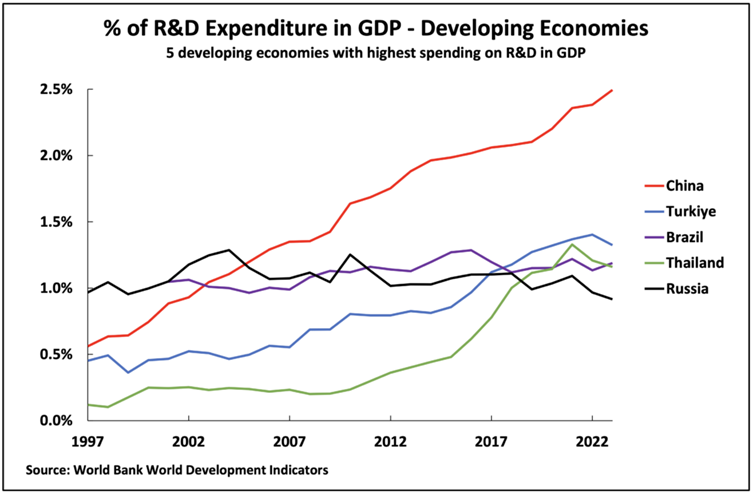
Figure 1
China has also overtaken three of the G7 advanced economies in the percentage of the economy spent on R&D—France, Italy, and Canada. However, despite steady progress, China’s percentage of R&D in GDP still remains behind the four most technologically advanced G7 economies—the U.S., Japan, Germany and the United Kingdom (see Figure 3). In particular, on the latest available OECD data, the U.S. percentage of R&D in GDP is a full percentage point ahead of China—3.5 percent of GDP compared to 2.5 percent of GDP.
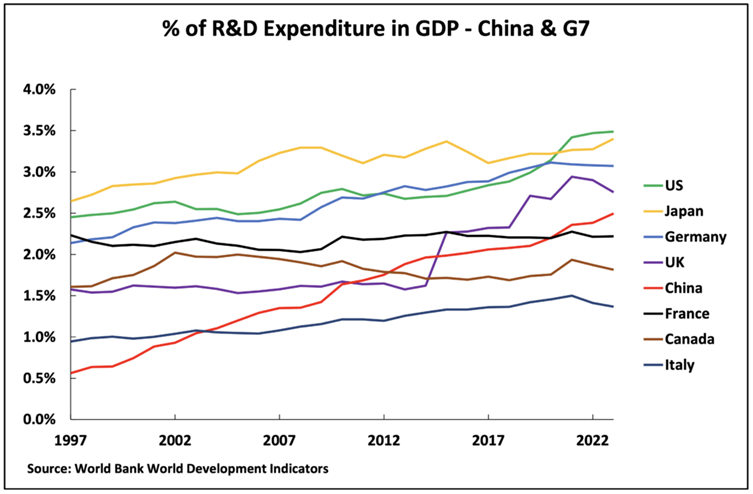
Figure 2
It should be understood that it will take a significant period for China’s percentage of R&D in GDP to catch up with the US. Over the last 30 years, on average, China’s percentage of R&D in GDP has risen by 0.07 percent annually compared to 0.03 percent for the U.S. At that rate, it would take 23 years, from 2023 to 2046, for China’s percentage of R&D in GDP to catch up with the U.S. China may be able to speed up this process, but it cannot be reduced to a very short period. The reason for this is that the build-up of R&D capacity is limited not only by finance but by people. It takes 20 years from someone entering school to emerging with a PhD in engineering or mathematics—the type of persons who are crucial for R&D. There is, therefore, no way to speed this process up beyond a certain point. It means that the macroeconomic policy of increasing the percentage of R&D in GDP in China must continue, not for a period measured as a few years but in decades.
But if China still has not reached the level of the most advanced G7 economies in terms of the percentage of R&D in GDP, why can it take the lead in the development of an increasing range of products? The reason is that the impact of innovation is not as “an idea”—if something remains merely an idea, it has little effect on production—but typically through its investment in fixed investment. Or as Marx, already quoted, put it: “development of fixed capital indicates to what degree general social knowledge has become a direct force of production.” That is the effect of R&D is not via simply ideas but through the process of the socialization of labor already analyzed—that is, the integration of science with material production via embodiment of these technological advances in fixed investment.
R&D and economic growth
The confirmation of the practical correctness of Marx’s analysis may be seen, firstly, by the fact that the connection between R&D and economic development is not direct. For large economies, there is a low direct correlation between the percentage of R&D expenditure in GDP and the rate of economic growth—for the world’s 10 largest economies, the correlation is a negative 0.37, which, with an R squared of 0.14, means essentially there is no significant correlation (see Figure 3).
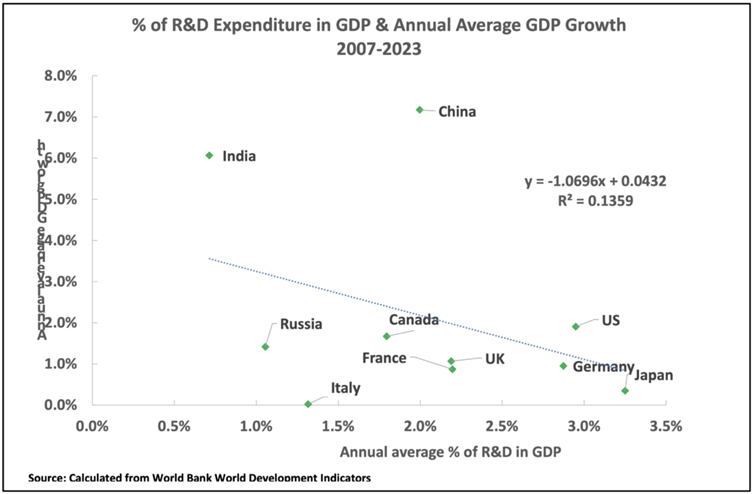
Figure 3
The correlation between science and technology and development is indirect and is carried out through the embodiment of R&D in the decisive role played by fixed investment in economic development. For the 10 largest economies, which of course includes China, the correlation between the percentage of net fixed investment in GDP and economic growth, as shown in Figure 4, is an astonishingly high 0.95—as close to a perfect correlation as is seen in any real phenomena.
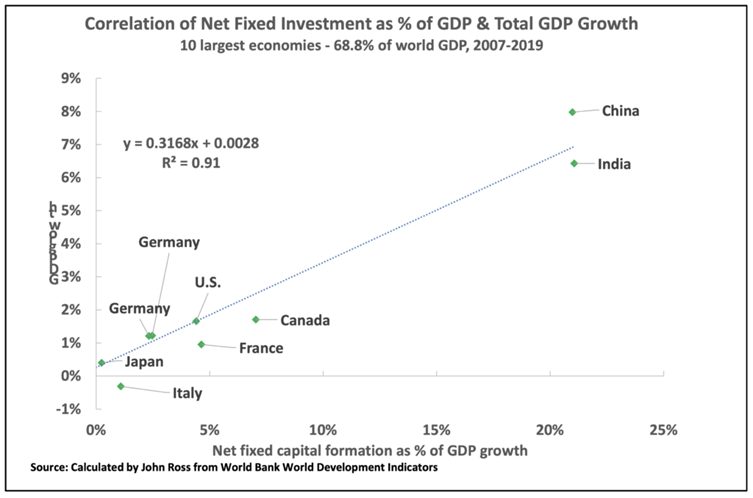
Figure 4
A high level of R&D and independent development
Although it is the high level of fixed investment in GDP, not directly R&D, which determines the economic growth nevertheless both parts of China’s development—a high level of fixed investment and high level of RAD—were decisive for its development path. Without a high level of R&D in the economy, China might, theoretically, have achieved a high growth rate—at lower levels of development this is the pattern seen in some Global South states, such as Bangladesh, Ethiopia and others, but it would not have achieved technological independence for China. It would have remained technologically dependent on other, imperialist countries. It is indeed a great effort, given both the financial and human requirements in the education system, etc. which are required for this. It can, therefore, only be achieved by a developing country over a long period of time, lasting decades. But such independent scientific/technological development was set by China as a goal from the beginning. It is also a precondition for any Global South country that aims at independent development. Otherwise, it will inevitably be condemned to remain in the low value-added parts of production, with the high value parts dominated by the imperialist states.
The reality of the U.S. internet revolution
The real relation between innovation/R&D and productivity, with its impact on GDP development, can be seen via the last huge wave of technology innovation—the development of the internet, as commenced in, and for a long period led by, the US.
As the ICT (information and communications technology) sector is crucial for a modern economy, there have been numerous studies of ICT development in the U.S. and its effect on economic efficiency. These arrive at clear conclusions showing why innovation in ICT and capital investment are inextricably interlinked in boosting economic development.
These illustrate why, from a fundamental economic perspective, it is important to understand that it is not the pure technology of the Internet and ICT by itself which increases productivity and economic growth. Nobel Economics Prize winner Robert Solow already noted, in a famous phrase in 1987, six years after the beginning of the mass introduction of personal computers into the economy, that computer technology was not speeding up productivity growth but that at that time productivity growth was actually slowing. There was, as Solow noted; “a slowing- down of productivity growth, not… a step up. You can see the computer age everywhere but in the productivity statistics.”[10]
This process is shown in Figure 5, which shows U.S. productivity growth from 1980, the year before introduction of the mass use of modern personal computers, to 2007, the year of the international financial crisis, which halted the initial development of the U.S. internet boom— taking a five-year average to remove the effects of short-term business cycle fluctuations. Looking at this informally with the eye, without using statistical measures, what immediately appears to occur is that U.S. productivity growth or decline follows the contribution of fixed investment to GDP growth, with a certain lag in time. That is, a surge in productivity growth follows an increase in fixed investment and a fall in productivity follows a decline in fixed investment.
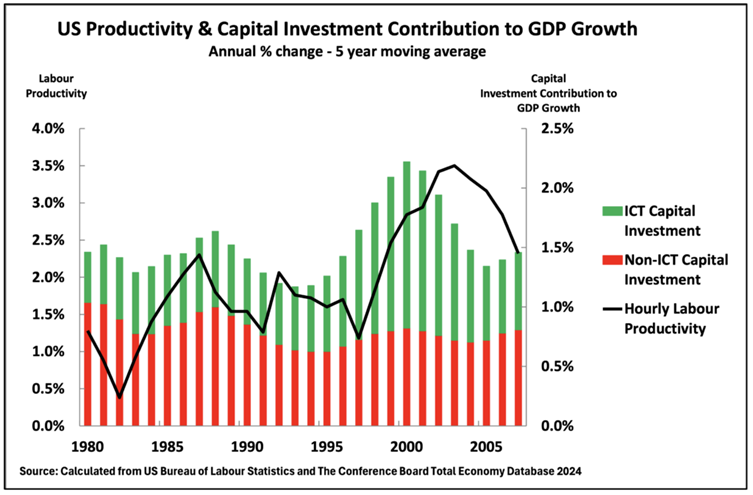
Figure 5
Statistical analysis entirely confirms this visual impression. The correlation between U.S. annual productivity growth and the contribution of fixed investment to GDP growth, with a two-year lag, is a high 0.70 and with a three-year lag, it is an extremely high 0.77. In short, it is a high level of investment which feeds through, with a delay of two to three years, into productivity growth.
Figure 6 shows this visually—illustrating productivity growth with a three-year lag to the contribution of fixed investment to GDP growth. There is no evidence or reason to suppose that technical innovation itself, in terms of discovery and ideas, was produced by and following a similar cycle. The impact of technological change/innovation was instead being mediated via the changes in fixed investment—precisely in line with Marx’s analysis.
As Dale Jorgenson, the primary U.S. analyst of the period of acceleration of U.S. growth in the 1990s and early 2000’s noted: “The unusual combination of more rapid growth and lower inflation in the United States from 1995 to 2000 touched off a strenuous debate among economists… This debate has now given rise to a …. Consensus that the role of information technology is the key to understanding the American growth resurgence…IT investment is the predominant source of this revival.”[11] In the period leading to 2003, U.S. annual labor productivity growth reached its highest level in half a century – 3.6 percent. U.S. investment, focused on ICT investment, rose from 19.8 percent of GDP in 1991 to 23.1 percent of GDP in 2000, fell slightly after the ‘dotcom’ bubble’s collapse, and then reached 22.9 percent in 2005. After this U.S. investment fell, leading to the sharp productivity slowdown.
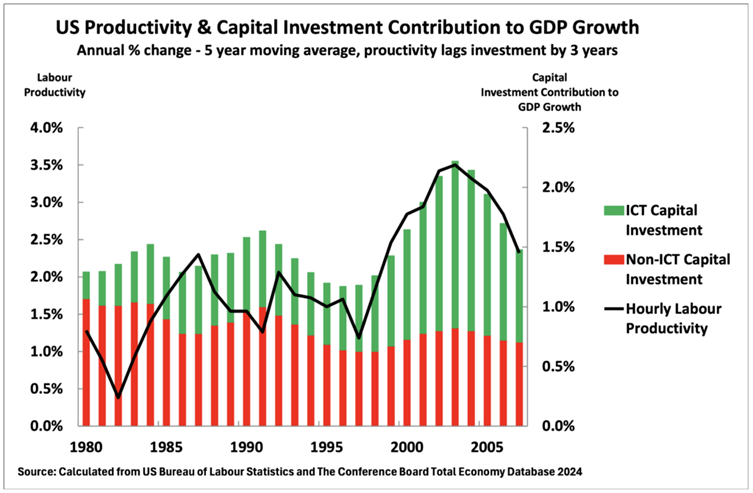
Figure 6
These economic lessons from the United States’ most advanced and innovative technological sector are, therefore, entirely in line with the general findings already analyzed—it was not purely the ideas of the internet that led to rapid economic efficiency growth but these had to be embodied in an investment wave focused on ICT to produce powerful effects in economic productivity.
The development of innovation in the economy will therefore not lead to the replacement of capital investment by TFP in economic growth but the embodiment of innovation and technological advances in capital investment. That is, investment will not be quantitative expansion of an existing technological level but the upgrading to a higher technological level. Indeed it was largely to explain the effects of this innovation that accurate modern econometric methods of measuring the causes of economic development were adopted.
The integration of R&D and investment
It is China’s high level of investment that means R&D and innovation can be turned into products much more rapidly than in the U.S. This is what has been seen spectacularly in green energy and EVs—which may be taken as an example of these general economic processes.
China’s fixed investment, on the latest available international comparable data, is 39.9 percent of GDP compared to the U.S.’s 21.7 percent. China’s lead in net fixed investment, that is, taking into account depreciation on the latest international World Bank data, is 15.8 percent of GDP compared to 5.1 percent for the U.S.
Translating these percentages into money, this means that China now has a great absolute annual lead in terms of investment over the U.S. Annual gross fixed capital formation in China is $7.4 trillion compared to the U.S.’s $6.2 trillion. In terms of net fixed capital formation, on the latest available international data, China’s lead over the U.S. is over 2 to 1 – $2.8 trillion compared to $1.2 trillion.
Scientists in China and the U.S. are of equal intelligence and skill. But this data shows that for every $1 available to turn a U.S. scientist/technologist’s innovation into a new product, $2 is available for a Chinese scientist or technologist. This high level of fixed investment in the economy is why China, although it still has a lower level of R&D in GDP than the most advanced G7 economies, in particular the U.S., has the ability to turn innovation/R&D into actual products more rapidly than the U.S.
This fact that the impact of R&D/innovation is not at the level of ideas but via fixed investment, explains why China can take such a lead, including in new productive forces. China’s very high level of investment in GDP, above any other major economy, is the latest stage of a process which has been taking place in the 250 years since the Industrial Revolution—for a factual analysis of this, see “250 Years of the Rising Organic Composition of Capital: The Factual Correctness of Marx, Smith, and Keynes.”
Consumption and production
This inseparable interrelation of R&D and investment in technological upgrading makes it clear why confusion on the question of consumption, and therefore of investment, is dangerous for economic strategy.
Investment and consumption together make up 100 percent of the domestic economy. Therefore, increasing the percentage of consumption in GDP, as advocated by the IMF for China, necessarily means reducing the percentage of investment in GDP.
Confusion over consumption itself has already been analyzed in detail in “误读提振消费策略,对中国应对美国竞争非常不利.” The facts, in line with economic theory, show that increasing the percentage of consumption in GDP will slow the rate of increase of consumption and therefore slow the rate of increase of living standards—both the facts, which are conclusive on this, and the theoretical reason of why this occurs are dealt with in the above article.
However, in regard to the present issue of China’s technological upgrading and development of new productive forces, increasing the percentage of consumption in GDP necessarily means reducing the percentage of investment. This is, therefore, directly contradictory to the goal of China’s technological upgrading. Those arguing for an increase of the percentage of consumption in GDP, such as the IMF, therefore lessen China’s ability to take the lead in the development of new productive forces—because China’s lead in this field precisely depends on its higher level of investment in GDP than the U.S. and other economies.
Therefore, to summarize again, China maintaining its lead in technological upgrading and development of new productive forces necessarily depends on its overall macroeconomic policy. The two decisive requirements for this are: (1) a high and increasing percentage of R&D in GDP, and (2) a high level of investment in GDP.
Both these processes are aspects of the socialization of production, and both are crucial for China’s technological upgrading. Increasing the percentage of consumption in GDP, by reducing the percentage of investment in GDP, is therefore a macroeconomic policy directly contradictory to China’s most rapid technological upgrading.
Imperialist criticism of China
The IMF, OECD, and Western media have relentlessly campaigned for China to increase its percentage of consumption in GDP and lower its percentage of fixed investment. The reasons for this, from the point of view of the self-interest of imperialism, are evident.
First, it reflects Western historical arrogance. Anyone looking at China’s economy immediately notes that its percentage of investment in GDP is much higher than the Western economies—data on the contrast to the U.S. was given above. Because of their assumption of imperialist superiority, the immediate assumption of the IMF et al is that this difference must be because China is wrong and the Western economies are “correct.”
But anyone looking at the facts without imperialist blinkers immediately sees the opposite. China has achieved the fastest sustained growth of any major economy in human history. Its growth rate continues to be much faster than the Western economies, producing a much faster increase in average living standards than the Western economies. Examining these facts objectively would lead to the conclusion China was right and the Western capitalist economies were wrong. But Western imperialist arrogance, both of organizations such as the IMF and companies such as Goldman Sachs. makes it impossible to admit this, and to argue that other economies should follow them and not China.
To make a comparison, this would be equivalent to, for example, Goldman Sachs being asked to advise a company on entering a new industry and it reporting the following: “We note in this industry one company is growing much more rapidly and successfully than the others. You should be careful not to learn from this company, but instead from lower growth and less successful companies.” Any company given such advice would laugh at it—just before cancelling the contract with Goldman Sachs. But when it comes to country development, including in the Global South, this is precisely the type of nonsense dished out by the IMF, Goldman Sachs, and the other bastions of Western imperialism.
Of course, if China did follow such advice to lower its percentage of investment in GDP towards Western level, it would slow down to the growth rate of Western economies—therefore remaining permanently behind them and removing any threat to their dominance. It would also, because of the close relation between the rate of growth of GDP and the growth rate of consumption, slow down the rate of growth of China’s living standards, therefore hopefully, from an imperialist point of view, creating social discontent in China. Serving such imperialist interests is precisely the role of such advice.
Class relations in China and imperialism
This building up China’s level of investment and high level of R&D required that China pursue and achieve independence from imperialism. It meant that resources, including profits, created in China be used for national economic development and not be exported to imperialist countries—the latter being what occurs in Global South countries under imperialist domination. Only using China’s national resources for its national development could achieve its high level of investment and developed R&D resources. To describe all the mechanisms which achieved this would require an article by itself, but the following were crucial.
- Strict capital account controls on international payments. China has progressively aimed at liberalization of international trade as more and more economic sectors have become competitive. This is to allow it to participate in socialization of international trade. But China has not carried out any such liberalization of the capital account. Export of capital from China is subject to strict controls. This is essential to ensure that capital created in China is used for China’s economic development, not, instead, for use by imperialist states.
- A state dominated banking system. China’s state banks, which are the largest banks by assets in the world, entirely dominate its financial system. This ensures that the financial resources produced in the country are used for national development, and can be directed to priority sectors, and are not exported.
- The state sector plays the dominant role in the economy, with also a private sector alongside this. Articles 6 and 7 of the Constitution of the People’s Republic of China state clearly. “The foundation of the socialist economic system of the People’s Republic of China is socialist public ownership of the means of production, that is, ownership by the whole people and collective ownership by the working people… In the primary stage of socialism, the state shall uphold a fundamental economic system under which public ownership is the mainstay and diverse forms of ownership develop together… The state sector of the economy, that is, the sector of the socialist economy under ownership by the whole people, shall be the leading force in the economy. The state shall ensure the consolidation and development of the state sector of the economy.” This is not words. The largest companies in China are state owned. Investment by state companies accounts for 50 percent of all investment in China and, because of the company structure, this is in the largest companies. Among large industrial companies, those with a turnover of more than 20 million yuan, approximately $3 million, only 31 percent of profits is from private companies and 69 percent from the non-private, stated owned dominated sector.
Confused left criticism of China
Unfortunately, confused criticisms from some sections of the Western left echo the practical calls from the imperialist powers for China to increase its percentage of consumption in GDP and lower its level of investment. These rely on a distortion of Marx.
These claim that an increasing proportion of investment in the economy leads to a problem of realization of capital. This parallels the error in vulgar Western economics of reducing demand to consumption, instead of demand being consumption plus investment. This “under-consumptionist” error in reading Marx was first put forward by Rosa Luxemburg, and in addition to being contradicted by Marx himself, was demolished by Lenin and Bukharin.
The famous reproduction schemas of Volume II of Capital shows the interrelation in the economy between Department 1, production of means of production, and Department 2, production of means of consumption. These two Departments show not only production but also its realization (sale). In this misunderstanding of Marx it is alleged that the increasing weight of Department 1, the increasing organic composition of capital, means there is a problem of realizing (selling) production. But this is simply false. Marx’s reproduction schemas show that the increasing proportion of production in Department 1 is realized by an increasing proportion of demand coming from Department 1 of the economy. There is, therefore, no problem for realizing (selling) production created by the increasing proportion of the economy accounted for by investment in China.
China’s green development
A fundamental example illustrating this socialization of production, and its impact on global development, is renewable energy. This is, of course, particularly important, as it directly interacts with another decisive challenge for this period of economic development.
Xi Jinping has stressed: “lucid waters and lush mountains are invaluable assets.”[12] And: “The ecological environment itself is the economy. Protecting the environment is developing productivity.”[13] Therefore, as China’s State Council Information Office white paper, titled “China’s Green Development in the New Era” stated, “Green development is development that follows the laws of nature to promote harmonious coexistence between humanity and nature, development that obtains the maximum social and economic benefits at minimum cost in resources and environmental impact, and sustainable and high-quality development that protects the eco-environment.”[14]
To see the extraordinary historical significance and scale of this, it is necessary to note that for 250 years since the Industrial Revolution, the entire development of an advanced economy has been based on energy produced by fossil fuels—first coal, then oil and gas, with other energy sources, such as electricity generation based on these. For most of that history, the fact was unknown which science has now made clear: that if this use of fossil fuels continues, with its atmospheric carbon build-up, the earth faces an ecological catastrophe. As Xi Jinping phrased it: “Since humanity entered the industrial age, rapid traditional industrialization, while bringing about great material wealth, has accelerated the consumption of natural resources, and broken the original cycle and balance of the ecosystems, resulting in a tense relationship between humanity and nature.” [15]
China’s leadership in the global energy revolution
This entire energy basis of the industrialized economy, which has existed for over two centuries, must be replaced with renewable resources. And it is China’s combination of science, technology, and manufacturing power which is making this possible. China accounts for over 80 percent of global solar power production,[16] over 70 percent of wind power installation,[17] and over 75 percent of battery cell production.[18]
The economic result of China’s integration of science and technology with production has been a total revolution in energy prices. In 2010, solar power was 710 percent more expensive than the cheapest fossil-fuel-fired solution, whereas by 2022, it cost 29 percent less than the cheapest fossil-fuel-fired solution.[19] For onshore wind power globally, in 2010 its cost was 95 percent higher than the lowest fossil-fuel-fired alternative but by 2022 it was 52 percent cheaper.[20] By 2022, 86 percent of all new renewable capacity in new electricity generation was cheaper than fossil-fuel alternatives—representing a complete reversal of the situation existing less than 20 years earlier.[21]
It is China’s technology and manufacturing achievements, the huge R&D and investments in renewable energy production, which is making it possible for the earth to avoid environmental catastrophe. These price figures doom the attempt of Trump to turn the planet back to a fossil fuel energy system—Trump is backing the U.S. into a dead end. China acquiring technological leadership means it is now an indispensable supplier of products which are increasingly at the center of other countries’ economies.
Renewable energy is only a particularly important example, illustrating the overall process whose macroeconomic features were in fundamental terms shown above.
Lessons from China for other countries
All these processes show the power, because of the correctness of its factual analysis, of Marxism. As Xi Jinping has stressed: “There are people who believe Marxist political economy and Das Kapital are obsolete, but this is an arbitrary and erroneous judgment.”[22] In reality it is China, which has been able to take the lead in the development of new productive forces.
China’s Marxist economic policy was developed to deal with a specific country, China, which was at a specific stage of development. But this does not mean that it is not relevant to other countries. It represents one of the latest developments of Marxism. Of course, precise policy proposals in China cannot be copied mechanically by any other country. But the fundamental forces analyzed operate in other countries—of course in different combinations. Other countries cannot copy China, but they can learn from it, and, in particular, its analysis of the fundamental forces explaining its success.
In summary, as Xi Jinping put it: “The Chinese nation, which since modern times began had endured so much for so long, has achieved a tremendous transformation: it has stood up, grown rich, and is becoming strong; it has come to embrace the brilliant prospects of rejuvenation. It means that scientific socialism is full of vitality in 21st-century China, and that the banner of socialism with Chinese characteristics is now flying high and proud for all to see. It means that the path, the theory, the system, and the culture of socialism with Chinese characteristics have kept developing, blazing a new trail for other developing countries to achieve modernization. It offers a new option for other countries and nations who want to speed up their development while preserving their independence; it offers Chinese wisdom and a Chinese approach to solving the problems facing mankind.”[23]
Conclusion
It may therefore be seen that China’s success in the development of new productive forces cannot be reduced to simply technological processes. It is inseparably connected to maintenance of two macroeconomic processes: (1) high and increasing percentage of R&D in GDP, and (2) a high level of fixed investment in GPP.
These two processes fully confirm Marxism’s analysis of economic development as being rooted in increasing socialization of labor.
Works Cited
BloombergNEF. (2025, March 17). Chinese Manufacturers Lead Global Wind Turbine Installations, BloombergNEF Report Shows. BloombergNEF: https://about.bnef.com/insights/clean-energy/chinese-manufacturers-lead-global-wind-turbine-installations-bloombergnef-report-shows/
Colthorpe, A. (2022, November 11). BloombergNEF: China dominates global battery supply chain again with followers in flux. Energy Storage News: https://www.energy-storage.news/bloombergnef-china-dominates-global-battery-supply-chain-again-with-followers-in-flux/
Global Times. (2025, August 15). ‘Two mountains’ concept illuminates a sustainable future for the world: Global Times editorial. Global Times: https://www.globaltimes.cn/page/202508/1340898.shtml
International Energy Agency. (2022). China currently dominates global solar PV supply chains. iea.org: https://www.iea.org/reports/solar-pv-global-supply-chains, Licence: CC BY 4.0
International Renewable Energy Agency. (2023a, August). Renewable Power Generation Costs in 2022. irena.org: https://www.irena.org/Publications/2023/Aug/Renewable-Power-Generation-Costs-in-2022
International Renewable Energy Authority. (2023b, August 29). Renewables Competitiveness Accelerates, Despite Cost Inflation. irena.org: https://www.irena.org/News/pressreleases/2023/Aug/Renewables-Competitiveness-Accelerates-Despite-Cost-Inflation
Jorgenson, D. W., Ho, M. S., & Stiroh, K. J. (2003). Lessons for Canada from the U.S. Growth Resurgence. chrome-extension://efaidnbmnnnibpcajpcglclefindmkaj/https://www.csls.ca/ipm/6/jorgensonetal-e.pdf
Solow, R. M. (1987, July 12). We’d Better Watch Out . chrome-extension://efaidnbmnnnibpcajpcglclefindmkaj/http://digamo.free.fr/solow87.pdf
The State Council Information Office of the People’s Republic of China. (2023, January 19). Full text: China’s Green Development in the New Era. The State Council Information Office of the People’s Republic of China: http://www.scio.gov.cn/zfbps/zfbps_2279/202303/t20230320_707666.html
Xi Jinping presided over a symposium on economic and social development in some provinces, autonomous regions and municipalities during the 15th Five-Year Plan period. (2025, April 30). https://www.ccps.gov.cn/xtt/202504/t20250430_166897.html
Xi, J. (2013 November 9). Explanatory Notes to the “Decision of the Central Committee of the Communist Party of China on Some Major Issues Concerning Comprehensively Continuing the Reform”. In J. Xi, The Governance of China (Kindle Edition) (2014 ed., pp. Location 1129-1503). Beijing: Foreign Languages Press.
Xi, J. (2014). Hard Work Makes Dreams Come True (28 April 2013). In J. Xi, The Governance of China (Kindle Edition) (2014 ed., pp. Location 749-819). Beijing: Foreign Languages Press.
Xi, J. (2017, October 18). Secure a Decisive Victory in Building a Moderately Prosperous Society in All Respects and Strive for the Great Success of Socialism with Chinese Characteristics for a New Era. Xinhua.net: http://www.xinhuanet.com/english/download/Xi_Jinping’s_report_at_19th_CPC_National_Congress.pdf
Xi, J. (2020). Principles to Apply in Protecting the Eco-Environment (18 May 2018). In J. Xi, The Governance of China (Volume III) (pp. 417-424). Beijing: Foreign Languages Press.
Xi, J. (2020). Speech at the 28th group study session of the Political Bureau of the 18th CPC Central Committee on November 23, 2015. Qiushi(16).
Xinhua. (2021, January 10). “Green growth generates gold as Xi’s iconic words on ecology put into practice.” http://english.scio.gov.cn/: http://english.scio.gov.cn/topnews/2021-01/10/content_77099494.htm
Notes
[1] Xi, Speech at the 28th group study session of the Political Bureau of the 18th CPC Central Committee on November 23, 2015, 2020.
[2] Xi, Speech at the 28th group study session of the Political Bureau of the 18th CPC Central Committee on November 23, 2015, 2020.
[3] Karl Marx and Frederick Engels, The German Ideology (1845), 31–36.
[4] Karl Marx , Theories of Surplus Value, Chapter XXIV: “Richard Jones.”
[5] Karl Marx, Grundrisse (Penguin Classics, Kindle edition, 706–07.
[6] Karl Marx , Theories of Surplus Value, Chapter XXIV: “Richard Jones.”
[7] Xi, Hard Work Makes Dreams Come True (2014), 759.
[8] Xi Jinping presided over a symposium on economic and social development in some provinces, autonomous regions and municipalities during the 15th Five-Year Plan period, 2025.
[9] Xi, Explanatory Notes to the “Decision of the Central Committee of the Communist Party of China on Some Major Issues Concerning Comprehensively Continuing the Reform” (2014), 1262–74.
[10] Solow, 1987.
[11] Jorgenson, Ho, and Stiroh, 2003.
[12] Global Times, 2025.
[13] Xinhua, 2021.
[14] The State Council Information Office of the People’s Republic of China, 2023.
[15] Xi, “Principles to Apply in Protecting the Eco-Environment (May 18, 2018),” 418.
[16] International Energy Agency, 2022.
[17] BloombergNEF, 2025.
[18] Colthorpe, 2022.
[19] International Renewable Energy Agency, 2023a.
[20] International Renewable Energy Agency, 2023a.
[21] International Renewable Energy Authority, 2023b.
[22] Xi, “Opening Up New Frontiers for Marxist Political Economy in Contemporary China,” 2020.
[23] Xi, “Secure a Decisive Victory in Building a Moderately Prosperous Society in All Respects and Strive for the Great Success of Socialism with Chinese Characteristics for a New Era,” Xinhua, October 18, 2017, http://www.xinhuanet.com/english/download/Xi_Jinping’s_report_at_19th_CPC_National_Congress.pdf
The above article was originally published here by Monthly Review.
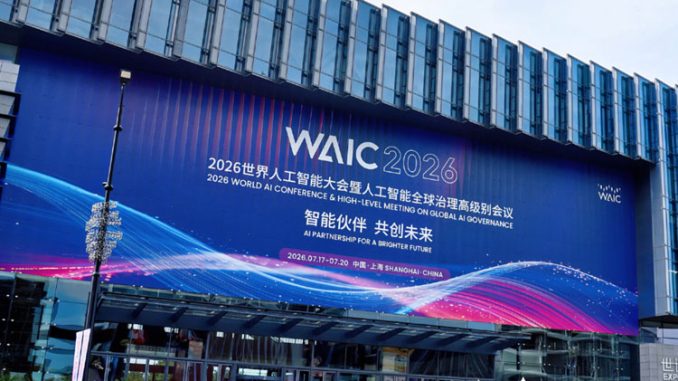
Image: The 2026 World Artificial Intelligence Conference and High-Level Meeting on Global AI Governance is held at Shanghai World Expo Exhibition and Convention Center, Shanghai Municipality, July 16, 2026; China Media Group.