
How Britain decides which racism counts
By Claudia Sanchez
When Misan Harriman, chair of the Southbank Centre and one of Britain’s most prominent black public figures, shared a post asking why the police and media were ignoring the Muslim victim of the Golders Green attacker, the response was immediate. The Telegraph ran two attacks on him within days. The Daily Mail followed. GB News amplified. David Taylor, Labour MP for Hemel Hempstead, suggested the Southbank Centre should “consider removing Mr Harriman from the board.” He was accused of spreading conspiracy theories and cheapening the Holocaust.
What Harriman had done was raise facts that appeared in open court documents: that Essa Suleiman had attacked a Muslim man, Ishmail Hussein, in Southwark that same morning before travelling to Golders Green; that the attack on Hussein was charged in the same proceedings as the attacks on two Jewish men; that the police and most media had not mentioned Hussein at all. Nearly 100,000 complaints were submitted to IPSO. The Voice described the campaign as “reputational warfare.” Afua Hirsch warned it sent a forbidding message about who is permitted to lead in British cultural life: black figures in high-profile positions can be removed if they step out of line.
This is not an isolated incident. Britain does not treat all racism equally, and the consequences for those who say so are becoming increasingly clear.
The hierarchy Labour named itself
The Forde Report, commissioned by Keir Starmer and published in July 2022, found that Labour was “in effect operating a hierarchy of racism or of discrimination” in which other forms of racism were being “ignored.” Martin Forde KC, the barrister Starmer appointed to conduct the inquiry, later told Al Jazeera he had heard almost nothing from the Labour Party since the report was published. Speaking publicly for the first time after its release, he said:
“Anti-black racism and Islamophobia is not taken as seriously as antisemitism within the Labour Party — that’s the perception that has come through.” On Labour’s claim that racism was a historical problem now resolved, he was direct: “It’s not in my view a sufficient response to say that was then, this is now.”
The report documented anti-black racism and Islamophobia among senior party staff. It found that in systematically prioritising antisemitism complaints, Labour had subordinated every other form of racial discrimination. black Labour MPs and councillors described a “deafening silence” from the leadership in response. The Labour Muslim Network stated publicly that Muslim members consistently felt Islamophobia “sits at the bottom of this perceived hierarchy.” In 2024, antisemitism still accounted for 28.3% of all Labour NEC misconduct reviews. Racism more broadly: 3.6%.
The hierarchy became policy
Labour adopted the IHRA definition of antisemitism under political pressure, created a standalone action plan, submitted to EHRC oversight, appointed external advisory bodies, and made antisemitism the defining domestic political issue of the Starmer project. A dedicated Jewish Community Police, Crime and Security Taskforce was created under the Conservative government, chaired by the then Home Secretary. Labour continued it without modification. In May 2026, when antisemitic attacks on Jewish institutions in London intensified, the government mobilised 100 officers and £18 million within days.
For Islamophobia, the record runs the opposite way. Labour backed the APPG definition while in opposition: “Islamophobia is rooted in racism and is a type of racism that targets expressions of Muslimness or perceived Muslimness.” After winning the 2024 election, it quietly shelved the definition. By September 2024, Labour’s faith minister was arguing the definition “is not in line with the Equality Act 2010.” By late 2025, it was gone entirely, rebranded as “anti-Muslim hostility,” a formulation that replaces structural analysis with the language of interpersonal grievance. As critics observed, if you call it hostility rather than racism, you don’t have to address the structures that produce it.
In the year to March 2025, anti-Muslim hate crimes rose 19%, figures that exclude London. Tell MAMA recorded 6,000 Islamophobic incidents in 2024, a record high since it began monitoring in 2012. Mosques were being set on fire. The government kept arguing about definitions.
The objection raised against the Islamophobia definition was that it might restrict legitimate speech. This objection was never applied to IHRA, which has been used to deselect parliamentary candidates, suppress pro-Palestine expression, and silence criticism of Israeli state policy. The asymmetry is political.
For anti-black racism, Labour promised mandatory training for staff, MPs and peers, scheduled for summer 2024. There was no task force, no EHRC referral, no accountability mechanism proportionate to what its own report found. Forde made 165 recommendations. The structural findings on anti-black racism received no urgency.
The treatment of Diane Abbott
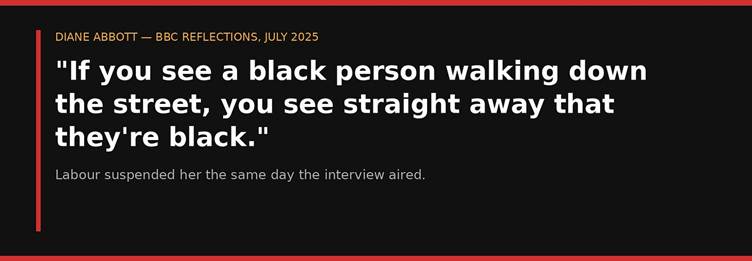
In July 2025, speaking to James Naughtie on BBC Radio 4’s *Reflections*, Diane Abbott said: “Clearly, there must be a difference between racism which is about colour and other types of racism, because you can see a Traveller or a Jewish person walking down the street, you don’t know. You don’t know unless you stop to speak to them or you’re in a meeting with them. But if you see a black person walking down the street, you see straight away that they’re black.” She added: “I just think that it’s silly to try and claim that racism which is about skin colour is the same as other types of racism.”
For black and brown communities, this needs no explanation. Anti-black racism does not wait for an introduction. Every black and brown person who has walked into a room and felt it, been stopped by police and felt it, been followed in a shop and felt it, understood exactly what she meant. Abbott was making a precise point about how anti-black racism specifically works — that its mechanism is visual, immediate and inescapable in a way that forms of oppression rooted in religion, culture or national origin are not, where passing and assimilation are at least possible.
The controversy was not that Abbott was wrong. It was that she said it out loud, in a setting where it would be heard, and refused to take it back.
Labour suspended her the same day the interview aired. Abbott was unambiguous: “My comments were factually correct, as any fair-minded person would accept.”
The leader who said Labour “must never accept that there’s some sort of hierarchy of racism” suspended his most senior black MP for making a structural analysis of anti-black racism, while running a party that its own report found was doing exactly that.
The electoral price
Labour’s share of the Muslim vote fell from 80% in 2019 to just over 60% in 2024. In constituencies where Muslims made up at least 10% of the population, Labour suffered a 12 percentage point drop, against a 1.6 point increase in its national vote share. Four independent Muslim MPs, Ayoub Khan, Iqbal Mohamed, Adnan Hussain and Shockat Adam, defeated Labour incumbents. Shockat Adam overturned a majority of 20,000 in Leicester South.
In the February 2026 Gorton and Denton by-election, in a constituency that is 28% Muslim, Labour’s vote share almost halved. The party came third, behind both the Greens and Reform UK, losing a seat it had held continuously since 1935.
The May 2026 local elections extended the picture. In Tower Hamlets, Lutfur Rahman’s Aspire party won the mayoralty with 38.75% of the vote against Labour’s 21%, and took 33 of 45 council seats. Labour was reduced to 5. In Hackney, the Greens won both the mayoralty and 42 of 57 council seats, wiping out a Labour group that had held the council for decades. In Redbridge, a new grouping of independents won 9 seats. Across London, black and brown communities continued to move away from Labour towards Aspire, Greens and independents.
Labour’s response has been to characterise Muslim electoral dissent as sectarian manipulation, pursue a harder immigration line, and maintain its refusal to adopt the Islamophobia definition. As Peter Oborne wrote during the 2024 campaign, Starmer’s Labour “already has a record of racism against Muslim and Black voters.” Nothing since has altered that record.
Anti-racist law turned against black people
The subordination of anti-black racism is not only a matter of what the state fails to do. It extends to what the state actively does, including the use of hate speech legislation against the communities it was designed to protect.
In August 2023, Jamila A, a 22-year-old black university student, used the N word in a friendly tweet responding to another black person. A data monitoring organisation flagged it. The Crown Prosecution Service charged her under s.127 of the Communications Act 2003 for obscene communications. Ife Thompson, barrister and linguistic justice activist, led the defence, instructing linguistic and cultural experts who established that the term’s use was rooted in black linguistic practice, not offensive language. The CPS dropped the charges in March 2025. In January 2026, a black man was recalled to prison for saying “my n*gga” to a black police officer while on licence. Charges were later dropped. Thompson described a pattern: the CPS and police “disproportionately penalise speakers of Black British English, largely due to the absence of clear and appropriate guidance when dealing with bilingual defendants.”
Then the coconut prosecutions. Marieha Hussain was charged for a placard at a pro-Palestine march depicting Sunak and Braverman as coconuts, intra-communal political language used to describe those from minoritised communities who enact racism against their own people. Nels Abbey, writer and broadcaster, was direct: “We’re at the point where the state is prosecuting already over-policed and under-protected people for common forms of political critique devices within their cultures. They are purposefully weaponising laws designed to enshrine anti-racism against victims of racism.”
In 1967, Michael X was prosecuted under the Race Relations Act, the legislation passed two years earlier to protect black people from racial discrimination. From Michael X to Jamila A, the law built to protect black communities has been turned against them. This is not an error in the system. It is the system.
The 2024 riots and the state’s response
The summer of 2024 made the hierarchy visible in the most direct way possible. Three children were murdered in Southport by Axel Rudakubana, a teenager born in Cardiff to a Rwandan Christian family. Within hours, far-right groups spread false claims online that the killer was a Muslim asylum seeker. What followed was the worst racially motivated disorder on British soil in decades: 29 anti-immigration demonstrations and riots across 27 towns and cities, mosques attacked, hotels housing asylum seekers firebombed, black communities living in genuine fear.
The government’s response was to frame the violence as “mindless thuggery” across the political spectrum, explicitly avoiding any analysis of its racist character. A study by the Institute of Race Relations, published in January 2026, examined 126 cases that went through the courts from August 2024 to December 2025. It found that policy and prosecutorial responses “delinked the violence from racism, paving the way for anti-immigration and Islamophobic protests and far-right vigilantism to form an infinite loop.” Of the sample, 67% involved people charged in relation to anti-migrant mobilisations. The remaining 33% were black and minority ethnic defendants, mostly young Muslims, who had not initiated the riots but had reacted to them, defending themselves, their communities, their mosques.
In some of those cases, judges told defendants they should have “simply risen above” the racist abuse directed at them. One Muslim man received an 18-month sentence for violent disorder after linking arms with others to form a protective barrier around a hotel housing asylum seekers under attack. He threw two missiles at his attackers. Neither hit anyone. The IRR report concludes that far too often, “the context within which defendants responded to racist provocation and racist violence was not sufficiently understood in the courtroom.” As Zrinka Bralo of Migrants Organise put it: “Hostility is not a failure of the system — the system is hostile by design, and it is doing exactly what it is meant to do.”
The government prosecuted people for defending themselves against racist attack with a speed and resource it has never applied to the structural racism those communities live under. That is the hierarchy made law.
Golders Green: what was buried
On 29 April 2026, Essa Suleiman, a 45-year-old British-Somali man, stabbed two Jewish men in Golders Green. The attacks on Shloime Rand and Moshe Shine were serious. Both were hospitalised with significant injuries.
Metropolitan Police Commissioner Mark Rowley confirmed Suleiman had “a history of serious violence and mental health issues.” He had been discharged from the Maudsley Hospital in the days before the attack and was living in supported mental health accommodation. A Prevent referral was made in 2020 and closed the same year. The court heard that Suleiman had a “medical episode” during his arrest and had to be taken to hospital before being transferred to custody.
Suleiman was charged with three counts of attempted murder, not two. The third was Ishmail Hussein, a Muslim man stabbed in Southwark earlier the same morning in what prosecutors described as a personal dispute with a long-time acquaintance. When the Metropolitan Police declared Golders Green a “terrorist incident,” they did not mention Southwark. BBC, Sky News and most other outlets focused on two Jewish victims. Hussein was buried or absent. His name appeared in court documents. It did not appear in the headlines.
Starmer used the attack to accuse Iran of wanting “to harm British Jews,” attributing a coordinated state logic to what every available indicator suggested was a man in psychiatric crisis, who had acted first against a personal acquaintance then against strangers nearby.
The Commissioner who announced 100 officers and £18 million for the Jewish community is the same Mark Rowley who, before the May 2026 local elections, made a series of interventions attacking the Green Party and Palestine solidarity protesters — claiming, without evidence, that march organisers had deliberately routed demonstrations past synagogues “to send a message.” He has previously spoken at Policy Exchange, where he attacked mainstream Muslim organisations and compared them to right-wing extremists. He endorsed a report by the Henry Jackson Society, a think tank with documented links to the US far right. Former Scotland Yard superintendent Nusrit Mehtab accused him of “blurring the lines of operational policing and political positioning.” Tribune described his recent interventions as “dropping his pretence of neutrality.” He is the head of the force that investigated Jamila A for a tweet and that declared Essa Suleiman a terrorist while not mentioning his Muslim victim.
Why the hierarchy exists
The hierarchy of racism in Britain is not an oversight and it is not primarily a function of poor politics within the Labour Party. It expresses the relationship between racism and the economic structures from which it arose. Anti-black racism and Islamophobia are not incidental features of British society. They are foundational to it. The hostile environment, the Windrush deportations, the current asylum regime that Labour has extended and hardened beyond its Tory predecessors: these are not departures from British political economy but continuations of it. Addressing them as racism, with the urgency, resources and legal framework applied to antisemitism, would require confronting what they are and what they continue to serve.
Antisemitism is real, and its history in Europe is long and murderous. But there is a distinction between antisemitism and ‘antisemitism’ — the latter expansive, politically weaponised, deployed through IHRA to place Israeli state policy beyond criticism, deselect candidates, criminalise a movement, and discipline black people who name their own oppression. The machinery is the same. It is the second version that has been institutionalised. The first is the justification. And it is the second version that can be addressed through contained institutional responses — a task force, a security grant, an EHRC process a party can pass through with sufficient administrative compliance — without disturbing anything. The other racisms cannot be treated this way. Taking them seriously would mean treating as racism the immigration regime, the policing of black communities, the citizenship-stripping powers the government is currently extending, the prosecution of black people for using black linguistic terms. It would mean confronting the state as a producer of anti-black and anti-Muslim racism, not merely as a potential remedy for it.
As Michael Richmond, co-author of Fractured: Race, Class, Gender and the Hatred of Identity Politics (Pluto Press) and contributor to Vashti Media, has argued, when mainstream institutions insist that antisemitism occupies a special position above other racisms, “it is NEVER to protect Jews today or to defend the sanctity of past atrocities against us, rather, it is to defend the current racial regime, to discipline Black and Muslim people, anti-Zionists, and the left in the metropole.”
Reform UK, consistently polling first ahead of both Labour and the Conservatives for well over a year now, has constructed its political project on anti-black and anti-Muslim racism.
The political establishment that mobilised so much support for the Jewish community days after an attack has spent years accommodating that project, because the racism Reform traffics in is the kind the hierarchy protects, not the kind it polices.
Labour’s black and Muslim voters are drawing their own conclusions. At Leicester South, at Gorton, across London, and at every point where communities have registered that this hierarchy has a cost, the political consequences are accumulating. The question is whether the left grasps that the hierarchy is not a problem to be corrected within the existing political framework but an expression of it.
The above article was originally published here on the For Liberation, Against Racism blog.