
By Steve Bell
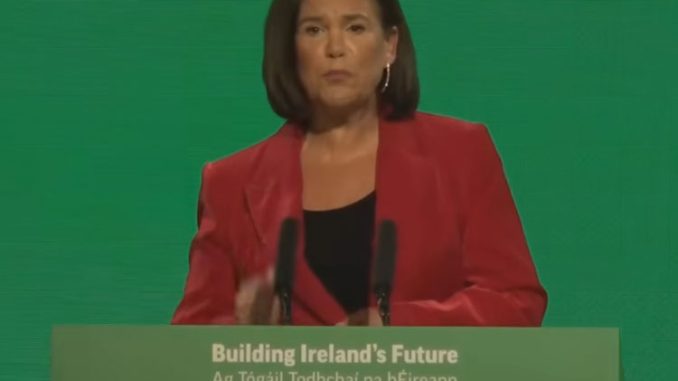
This year’s Ard Fheis was held in Belfast on the anniversary of the Easter Rising. Under the theme of “Building Ireland’s Future”, the conference registered the continuing strength of the party. It also registered the complexity of the tasks that the party now faces.
In general, the party has every reason to be confident. As John Finucane MP pointed out, “Sinn Féin is stronger now than at any time in the past hundred years. We are focused on driving forward real change to better the lives of workers, families and communities across Ireland.” Certainly, no honest observer of conference would dispute the extraordinary determination of the activists. At the same time, the complex nature of the tasks was equally clear.
The situation in the north
Sinn Féin is by some distance the strongest party in the north. It is the largest party at Westminster, despite its principled abstentionism. It is the largest party in the Assembly, with Michelle O’Neill holding the First Minister’s post. It is the largest party in local government. The most recent polls give Sinn Féin 24%, DUP at 18%, UUP at 13%, with the SDLP, Alliance and TUV all on 11%.
Under the peace process, Sinn Féin has gone from the fourth largest party on 17.6% in the first Assembly election in 1998, to the largest party in the most recent Assembly election in 2022, securing 29%. However, at the conference Breakfast Briefing for International Delegates, party Chairperson, Declan Kearney MLA highlighted the fact that “The Good Friday Agreement is a peace settlement, not a political settlement.” Despite the party’s powerful growth in the peace process, it still confronts all the inadequacies arising from continuing partition in Ireland.
These inadequacies are strongly expressed in the political economy. The Assembly lacks economic levers and has no tax raising powers. Consequently, the Assembly is dependent upon Westminster’s block grant allocation for the Assembly. These have been inadequate over the years since 2010, when austerity first prevailed at Westminster. It still prevails – as Declan Kearney put it, “Blue austerity has been replaced by Red austerity.”
Chris Hazzard MP in Belfast Live on 30th April wrote: “The Treasury’s preferred trick is to speak only in cash terms. An eighteen point two million pounds block grant sounds like a windfall until inflation is accounted for. The NI Fiscal Council has shown that while the settlement is 2.6 per cent larger in cash, it amounts to just 0.2 per cent growth in real terms. And even that microscopic increase is fragile. If the Executive is required to repay previous overspends, the budget would actually shrink by 3 per cent in real terms.”
This is all before the additional impact of President Trump’s war related inflation. The population in the north is facing a further deterioration in living standards, directly attributable to British government policy.
Michelle O’Neill told conference: “My message to Keir Starmer is clear. Our citizens are not second-class citizens. People here are entitled to good public services. They are entitled to a good quality of life. They deserve respect, investment in equity. We reject your underfunding and neglect. We reject your political choices that prioritise weapons of war over people.” Sinn Féin has to defend the population with faulty tools.
Westminster’s bipartisan mess
In addition, the Westminster parties appear to have a bipartisan attitude towards denying justice for the victims of the Troubles. The Labour government is committed to replacing the Tories’ Legacy Act. But the signs are that Labour still intends to offer preferential treatment for British state forces rather than the victims. Hence the recent announcement by Hilary Benn, Secretary of State for Northern Ireland, that the Legacy Bill will be delayed until October to allow amendments that are to protect British military personnel.
There is little danger that the Tories will start acting more respectfully towards Ireland. Kemi Badenoch recently issued a campaign video in defence of British military veterans which included footage from Bloody Sunday in Derry 1972. A junior member of staff was subsequently “blamed” – a graceless response in the Westminster bidding war to defend British imperialism’s legacy in the Troubles.
It was typical of the party’s commitment to the victims that present as guests were family members of Bellaghy GAA chairperson Sean Brown who was murdered in 1997. The party is campaigning for a full public enquiry into the killing.
Avoiding the border poll
Even more significant is that the Labour government appears determined to avoid a border poll on Irish reunification. This is despite this being an essential right contained in the Good Friday Agreement.
In December 2025, Hilary Benn said that a border poll “is a long way off.” In his view, the sole criterion for a poll is when the Secretary of State is of the view that in the event of a poll taking place it would result in a majority of people in Northern Ireland voting for a united Ireland. He refused to define any other criteria. “In the end it is a political judgement by the Secretary of State.” He especially ruled out using any polling to gauge public opinion, as this would encourage attempts to sway the surveys. He said he sees “no evidence at all” that a majority of people want to leave the UK. What that evidence looks like, were it to exist, is a secret held by the British Minister.
If opinion polls are excluded, then what about the activity of the population in actual elections? These popular acts form governments so can hardly be dismissed as inconsequential opinions.
In the last Assembly elections in 2022, the parties favouring the union (DUP, UUP, TUV, & PUP) secured a total of 348,845 votes. The parties favouring reunification (SF, SDLP, PBPA, Aontú, IRSP, & Workers Party) secured 353,905 votes. A narrow majority for unity. The parties who have a neutral position on the question (Alliance and the Greens) secured 133,114 votes. As neutral, these votes must be discounted in estimating the overall balance – although obviously winning these would be critical to any actual border poll campaign.
In the last Westminster election in 2024, parties favouring the union (DUP, UUP, TUV & Alex Easton independent) secured 336,435 votes. The parties favouring reunification (SF, SDLP, PBPA, Aontú) secured 313,656 votes. A narrow majority for retaining the union. Parties having a neutral position (Alliance & Greens) secured 125,883 votes.
Both these results indicate a closeness between the two positions. A simple majority of 1 vote larger than 50 per cent is all this is required. On the evidence of recent elections Benn cannot exclude the possibility that the unity majority already exists. There is one obvious way to be certain, allow the people their elementary right.
Post Brexit dynamics
Refusing to debate the criteria is also a refusal to assess the changes within the north. Prime amongst these is the impact of Brexit. Leaving the EU subjected the north to complete uncertainty about its relations with the south, which remained in the EU.
The torment from 2016 onwards reflected how little British governments were concerned with the interests of the north. The negotiations on withdrawal, on the Protocol, and the Windsor Framework proved exhausting and blurred all prospects for years in the north. The cumulative impact was a loss of respect for the DUP who supported withdrawal; and a loss of faith in the ability of the British government to deliver better living standards.
This expressed itself initially in the Alliance Party winning votes from pro-EU forces from the unionist community. But the impact has been much greater too. The poll, commissioned by the European movement, published last week, reveals that 73 per cent of those polled in the north would now vote for the UK to rejoin the EU, compared to 56 per cent who voted to remain in the 2016 referendum.
Even more extraordinary is the result for the question, “If a referendum was held tomorrow on a united Ireland in the EU?” – in the south 59 per cent would be in favour and 22 per cent against, while in the north 63 per cent would be in favour and 29 per cent against.
Clearly there is a fluidity in northern society with re-entry into the EU becoming an attractive factor in the constitutional debate. It should be borne in mind that in April 2017 the European Council leaders confirmed that in the event of Irish unification, “the entire territory of such a united Ireland would …be part of the European Union.”
This debate is not abstract, despite the airy “judgement” of Benn. The most recent report published by the Dublin based Economic and Social Research Institute makes chilling reading for those who believe the union remains impregnable. The report, “Who is better off”, by Adele Bergin, Seamus McGuinness and Conor Banahan examines a range of social indicators comparing the north and south. Perhaps most decisive is the fact that life expectancy in the Republic is now two years longer than the north – a combined result of superior health care, nutrition, etc. Equally, “…household disposable income was E35,300 in the Republic of Ireland compared to E29,900 in Northern Ireland, a gap of 18.3%.” The material advantage of living independently from the British government is evident, and likely to grow as British austerity continues to drag the north of Ireland down.
Still the challenges of the discussion must not be underestimated. A well-attended fringe, chaired by Lynn Boylan MEP, discussed a new book “For and Against a United Ireland”, by Fintan O’Toole and Sam McBride. Sam McBride addressed the meeting, demonstrating the complexity of the arguments – illustrating how the case for reunification must be worked through by its supporters. The whole fascinating dialogue that Sam offered can be viewed on the Sinn Féin YouTube channel.
Economic growth and political inertia in the south
The bank of Ireland has cut its growth forecast for the year and has recognized an “unwelcome squeeze” on household income. In its quarterly bulletin, it now predicts economic growth of 1.6% compared to the previous forecast of 2.8%. The increase in inflation to 3.6% in March reflects a 63% rise in domestic oil prices. The professional services network company EY estimates that the Republic is liable to grow about four times faster than the north.
There is a widely recognized pressure on domestic consumption, as Trump’s war on Iran hits Irish households. But overall, the Irish economy remains relatively strong in European terms. Sinn Féin’s message on the cost-of-living crisis has resonance – and certainly chimes with the recent fuel price protests in the south. But a substantial section of society is still cushioned by the overall buoyancy of the economy. The coalition government has an operating surplus of E9 billion.
In response to the growing cost of living crisis at the Ard Fheis, Mary Lou McDonald TD and SF President, raised the demand for the government to raise an emergency budget to aid those suffering from the inflationary pressure on households. This may register beyond the party’s immediate supporters.
The polls indicate progress for Sinn Féin since the last General election when it polled 19.2%. The two most recent polls give it 25% and 22%, leading the governing coalition parties by 9% in the one poll and 5% in the other. It is clearly encouraging that the party has regained momentum over the governing parties since the November 2024 election. But the party had been scoring over 30% in the early part of the decade. The state of the economy has not substantially restored the party to its previous high.
The governing parties had dominated government since the founding of the independent Irish state. They lost their majority in the popular vote in 2016 and continue to steadily lose ground. Of concern for Sinn Féin is the recent rise in rightest nationalist partes – the Irish Independents and Aontú registered a combined support of 13% and 16% in the most recent polls. This is an unwelcome development, seeing radical rightest forces consolidating support.
Tactics for Sinn Féin obviously require a unifying approach for all those who favour Irish reunification and progressive social policies. This alliance was well demonstrated in the united front that secured Catherine Connolly the Irish presidency against the coalition candidates. The party played a key role in securing the united front and the victory. At Conference Mary Lou McDonald called this “a blueprint for the future… a dynamic, democratic movement and one that especially involved young people.” This is surely key for the further development of Sinn Féin’s tactics.
In pursuit of a new momentum, McDonald told the Ard Fheis that the party would bring forth legislation, before the summer, compelling the Irish government to publish a Green Paper with detailed discussion on Irish unity. This should be connected to a series of All-Ireland Citizen’s Assemblies to advance the discussion. Judging by the recent initiatives of unity campaigns like Ireland’s Future, there is growing interest in such serious discussion and organizing.
Internationalism in practice
As usual, one of the highlights of conference is its consistent internationalism. This year, a new feature was the recorded greetings to conference from John Swinney leader of the Scottish National Party, and from Rhun ap Iorwerth leader of Plaid Cymru. The prospect of pro-independence leaders for the three devolved assemblies clearly excited activists. With the victory of the nationalist parties in Scotland and Wales now confirmed, there will undoubtably be new debates about the future of the “union”. The three parties have different approaches, and the three First Ministers will have different powers. But clearly this is a new chapter opening.
The conference took speeches from H.E. Ms. Ismara M. Vargas Walter – the Cuban Ambassador to London; and from Arab Barghouti who represented the Free Marwan Barghouti Campaign. Alongside this, a fringe meeting was held, chaired by Deidre Hargey MLA on the theme of “Another World is Possible: The Role of National Liberation Politics”. Contributions were made by the Cuban Ambassador, by Dr Snuki Zikalala from the ANC Veterans League in South Africa, and by Senator Gorka Elejabarrieta Diaz from EH Bildu in the Basque Country.
Conference discussions on international questions included clear statements of opposition to the Irish government’s attempts to weaken Irish neutrality. There were frequent references to the continuing need for practical solidarity with the Palestinian people, and the Cuban people. The US/Israeli war on Iran was opposed, although there was little time for discussion.
The biggest disappointment was the absence of any progress in the party’s analysis of the US/NATO proxy war on Russia in Ukraine. This is even though the first Ard Fheis after the outbreak of the war in February saw a major divide with a knife edge majority for unreserved support for the Kyiv government. 4 years later the leadership’s resolution made no reference to NATO’s eastward drive, or in defence of the rights of the oppressed national minority of Russian speakers in the east of Ukraine. Europe’s leaders in Germany, France and Britain are determined to continue the war, regardless of the cost to the Ukrainian and Russian peoples. Ireland generally, and Sinn Féin in particular, do not endorse or share this belligerence. But the failure to question the US and NATO narrative limits the party to the sidelines in the quest for peace.
In conclusion
Once again, Sinn Féin demonstrates that they carry the hope for Ireland’s future. Socialists in Britain would learn a great deal if they followed more closely developments in Ireland and in the republican movement.