No Image

Analyses of the economic policy changes in Cuba

20th September 2010 Socialist Action 0

By Brian George

i'm away for a while
Photo: consumerfriendly

A great deal of media publicity has been given to the news that Cuba is to reduce state sector employment by half a million and transfer these workers to the non-state, including private, sectors. The eventual aim is to transfer about one million of Cuba’s state workers to the non-state sector.

No Image

The Israeli-Palestinian Authority talks

20th September 2010 Socialist Action 0

 By Andrew Williams

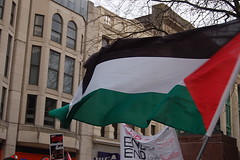
Freedom For Palestine

Photo: Walt Jabsco

The direct negotiations between Israel and the Palestinian Authority (PA) that began in early September will go nowhere. Presented by the US as negotiations to create a Palestinian state, in fact the objectives of the US and other participants are not this at all. For the US and Israel the current framework of talks allows them to set an agenda that reinforces the occupation – as happened in the Oslo talks (1992-3) and subsequent negotiation processes – simultaneously settlements expand, more Palestinians are displaced, and Israeli missiles are fired on Gaza, whilst Palestinians are told they must not resist. The objectives are to weaken Palestinian resolve, deepen the internal Palestinian divisions, enhance the US’s image in the region and rehabilitate Israel’s battered international reputation. For Fatah’s Mahmoud Abbas, Israel’s chosen negotiating partner, it is hoped the international stage can bolster his reduced standing. Amongst Palestinians there is widespread understanding of, and consequently little support for, this framework.

No Image

The second round of the regional elections in France

16th April 2010 Socialist Action 0

By Marie Dupont

The second round of the French regional elections confirmed the defeat of the right wing parties. Indeed it was a historic scale of defeat. With 35 per cent the right received its lowest share of the vote since 1958. The left received its highest share, 54 per cent, in the same fifty two year period with the sole exception of the presidential elections in 1988. The left won 21 regions and the right only one – Alsace.

But the analysis of the results is more complex than that of a simple shift of votes from right to left.

No Image

Guns, not butter for Greece

31st March 2010 Socialist Action 0

By Nicky Dempsey

The leading countries of the European Union, led by France and Germany have insisted that the Greek government must respond to the financial crisis by a series of ferocious attacks on working class living standards. Job losses have mounted rapidly as pay has been cut, welfare and pension entitlements slashed and the retirement age suddenly increased. Yet one area of spending is exempt from this otherwise absolute requirement to reduce government spending, the military budget.

In what the Reuters news agency describes as “a bizarre twist to the Greek debt crisis, France and Germany are pressing Greece to buy their gunboats and warplanes, even as they urge it to cut public spending and curb the deficit.” France is looking to sell frigates, helicopters and fighter aircraft for €3.5bn while Germany is looking for back payments of €520mn plus €300mn for a submarine which failed sea-worthiness tests. It is reported that the deficit negotiations were used to strong-arm the Greek government into making the purchases.

No Image

Regional elections in France: Results of 1st round

18th March 2010 Socialist Action 0

By Marie Dupont

Last Sunday, 14 March, the first round of the regional elections in France saw a big shift in favour of the left – although there was a 52 per cent abstention rate. The Socialist Party won 30 per cent while the ruling UMP of President Sarkozy received 27 per cent. However in the second voting round the UMP will have no allies, while the Greens, who won 12.5 per cent and the Front de Gauche (Left Front), which won 7 per cent will call for a vote for the Socialist Party. The election overall therefore saw a big rejection of Sarkozy.

No Image

The economic crisis and Eastern Europe

24th January 2010 Socialist Action 0

By Jack Johnston

The global financial crisis has not only disturbed the previous course of capitalist economic development but also stalled many of its political projects. An example of this is the process of European Union expansion into the former non-capitalist states in Eastern Europe. While prior to the crisis these economies were enjoying high growth and falling unemployment, many have now been plunged into a severe downturn. This not only threatens their own internal political stability but also shakes the foundations upon which EU enlargement has been built.

The eastern enlargement of the EU, in 2004 and 2007, should be understood within the context of the restoration of capitalism that occurred throughout Eastern Europe from 1989. The economic collapse and social impoverishment, caused by the re-introduction of capitalism, were most severe and prolonged in the countries of the ex-Soviet Union. Yet the Central-Eastern European (CEE) states still suffered huge socio-economic declines. Ten years after the fall of the Berlin Wall, only Poland had crossed its pre-transition level of GDP; the Czech Republic, Hungary, Slovakia and Slovenia were just returning to this level, whilst the Baltic States still had a GDP level 20–40% below that achieved at the end of ‘communism’. Consequently poverty, unemployment and social inequalities all sharply increased, leaving millions of people with a standard of living worse than they had before capitalism was reintroduced.