
By Mark Buckley
The enduring appeal of archetypal tales such as The Odyssey lies in their capacity to be retold endlessly, so that they can be reinterpreted by every new generation. The makers of the blockbuster film ‘The Odyssey’ have joined the ancient line of storytellers who have reworked this story to allow us to reflect on human frailties, the conditions of our own society and to consider both through fresh eyes.
They have created a masterpiece.
The Trojan war probably took place around 3,500 years ago. The Bronze Age had become established under Greek slave-owning society, a fractious society of independent city-states. Superficially, it would appear to have little relevance for our time. But it is a tale of human suffering and struggle, shedding light on how society works, the ideological claims for how it works, and the gulf between the two.
In this film, that gulf reaches mythical proportions. At the outset, the determination of the Mycenaean king Agamemnon torecapture Helen from her Trojan lover Paris is simply a pretext. His real motivation is to use Greek military power to break the burgeoning Trojan dominance in trade. If this sounds familiar, so too does Odysseus’ naïveté in believing Agamemnon’s stated reasons for war and his surprise at the shocking brutality of the Greek sack of Troy and its wanton destruction.
There is an abundance of other contemporary parallels. The role of women is a particular focus in a tale where they could easily be relegated to walk-on parts between military adventures and horrifying battles. Instead, between Helen herself, Penelope, Odysseus’ abandoned wife, the sorceress Circe, the nymph Calypso and the goddess Athena, there is a series of strong women, each navigating the treacherous perils of violently patriarchal society.
Helen, ‘the face that launched a thousand ships’ has been disfigured by her jealous husband as retribution for her infidelity. Penelope must skilfully stave off a plague of suitors who have established a permanent feast in her palace, keen to usurp the absent Odysseus. In a rage at the claim that the throne is empty, she roars ferociously to her weak son, “I have occupied it for twenty years!” But it is Circe, perhaps the nearest to the portrayal of a prototype feminist, who has turned Odysseus’ troops to pigs, revealing a feature of their true nature as disgusting, rampaging beasts who consume all in front of them, without any regard to ownership or common decency. By contrast, the nymph Calypso represents a male trope of perfect indulgence and license, giving up all cares for the world or responsibilities in it, enticed by immortal indulgence.
Athena is the only one of the Gods to appear on screen. The meddling, capricious and devious gods who are central to Homer’s tale are not needed in this film, because they are no longer how humans attempt to make sense of a world they do not understand, or provide comfort from it. Not through these Gods, at least.
Instead, Athena continuously reminds Odysseus of his own obligations, to his family, his people and his kingdom as well as providing sharp rebukes when he attempts to blame others for the consequences of his own reckless or malicious actions.
Yet “Zeus’s law” is a constant refrain throughout the film. This is a universal law, both of social custom (hospitality to strangers, honour to hosts, respect for fellow citizens) as well as relations between states (upholding treaties, peace offerings should be genuine, wars should only be in self-defence or with just cause).
In a ‘Western world’ that regards itself as the inheritors of Greek culture, this is a poignant reminder of how that culture survived and thrived on brutality, lawlessness and conquest. No wonder conservative commentators hate this film (the ignoramus Musk even criticised the casting of Lupita Nyong’o as Helen because she is Black).
But it was from Homer that we learnt that all these laws to regulate the behaviour between humans and between states have been violated by the Greeks themselves, including the infamous deception of their peace offering to the Trojans. It is a tainted inheritance. All future generations who destroy these laws will have to live with the consequences, according to Christopher Nolan, the writer/director’s telling, including, naturally our own.
Donald Trump would probably hate this film. But that alone would not make it worth seeing.
Instead, marvellous directing, that humanises the giant Cyclops as the victim of Greek vindictiveness, as well as uniformly excellent acting with a special mention for Anne Hathaway who has created a tragic Penelope of Shakesperean proportions, elevate this film towards excellence. But it is the reworking of this ancient tale in its broadest sense, including a dazzling, complex script, that makes this film a modern masterpiece, which speaks to us about our world and its actual, rather than imagined norms.
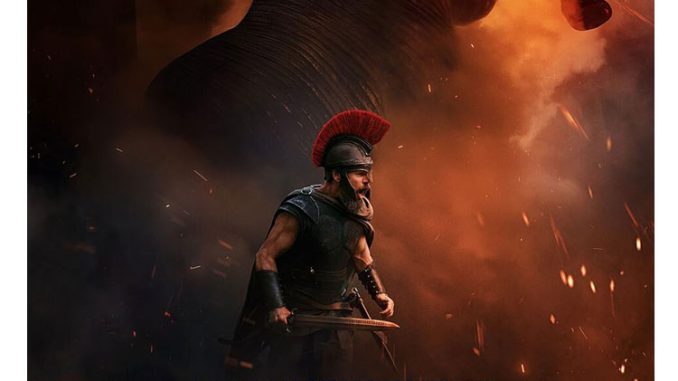
Image: Publicity material for the film ‘The Odyssey’; cropped.