
By John Ross
Introduction
The U.S. mid-term elections displayed one of the American people’s greatest rejections of U.S. government policy in history – it was almost comparable in scale to the results of the post-World War I 1920 election and the post-World War II 1946 election. Polls show that this result concentrated on the refusal of the U.S. population to pay the costs of the Trump administration’s policies, both its tariff policies and its war against Iran, combined with real revulsion against Israel’s genocidal atrocities in Gaza and U.S. support that made these possible.
The effect of rejection of the attacks on U.S. living standards created by U.S. aggressive wars was analysed in earlier posts on this Substack – in “U.S. elections – the people say no to war and cuts in living standards, capital says we won’t accept that answer” and “the American people want out of the Middle East – U.S. imperialism refuses.” This post examines the consequences for the U.S., and potentially globally, of the U.S. electorate’s rejection of Trump’s tariff policies.
At the mid-term elections, economic issues and concerns about attacks on U.S. democracy overwhelmed Trump and the Republicans’ racist attempts to claim that the problems of the American people were due to immigrants. An extremely large, 80,000 strong sample, poll carried out by The Associated Press/Social Science Research Solutions, with a consequent sampling error of only 0.6%, found that 39% of U.S. voters said the most important issue in the election was the economy and 33% the state of U.S. democracy, compared to only 13% who said it was immigration. The next most important issues were 8% naming health care, 4% foreign policy, and 3% crime. Among African American and Hispanic voters, concern with the economy was even more overwhelming with, respectively, 51% and 45% of voters saying it was the most important issue.
In relation to tariffs, already by February 2026 a Pew Research poll found 60% of U.S. electors disapproved of the Trump administration substantially increasing these, including 39% who said they strongly disapproved. By contrast, 37% said they approved of the increased tariffs.
A poll carried out for the U.S. Council on Foreign Relations by Morning Consult, in the same month, found that more than 65% of voters said that tariffs had made a range of everyday items less affordable – including food and groceries (82%), clothing and footwear (80%) technology and electronics (79%), housing and transportation (72%), and health care (71%). In October a Fox News poll found 69% of electors disapproved of Trump’s handling of tariffs.
A HarrisX poll showed that voters believed that tariffs were the most important cause of price rises – 33% blaming tariffs, 24% government overspending and deficits, and 23% the conflicts in West Asia.
Among Democrats, and potential Democratic voters, opposition to the tariffs was overwhelming with 90% of Democratic and 93% of Democratic-leaning voters disapproving of the tariffs, including 70% who say they strongly disapprove compared to only 7% who said they approve.
A Reuters November 2026, post-mid-term, poll found 62% of U.S. adults back Congress repealing the tariffs introduced by Trump.
The difference between voters was which effects of the tariffs they most disapproved of. According to the Morning Consult poll, affordability concerns tied to tariffs were highest among lower-income Americans in essential categories such as food, groceries, and housing. For middle-income households, tariff-related affordability particularly affected childcare, clothing, home and auto maintenance, and medical costs
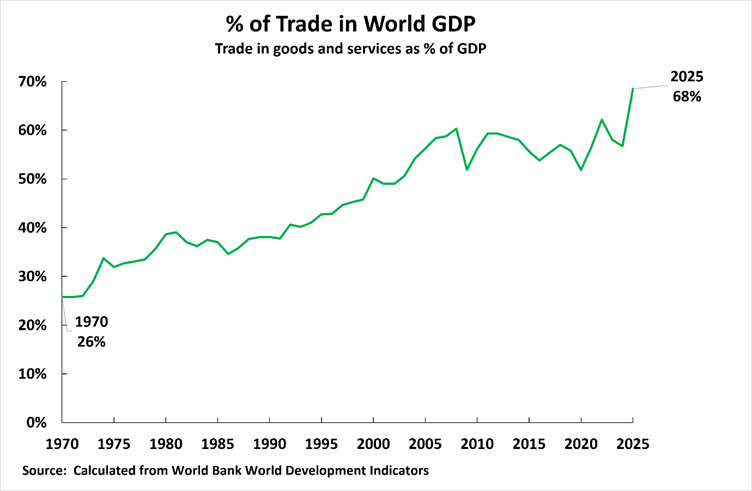
Such results are obviously extremely important for U.S. domestic politics, but they also have potential implications for the global economy. As discussed in the interview below, significant parts of the Western media in the last period have been attempting to claim that the main trend in the world economy is protectionism and deglobalisation. The author has been pointing out that this is not true, and it is to confuse trends in one large economy, the U.S., and to a lesser extent in Europe, and discussion in the Western media, with global trends. This was already strongly confirmed by the trade data for 2025, which showed the share of trade in world GDP at its highest level in history. . But the U.S. mid-term elections further show the trend.
A narrative had been attempted to be presented in much of the Western media that protectionism and deglobalisation were economically harmful but were being supported by the population. But the U.S. mid-term elections showed that, on the contrary, the U.S. population understood that protectionism was directly against their interests. Therefore, the real issue is not whether deglobalisation is objectively taking place, the international data already shows that it is not, but whether protectionism can survive in the U.S. itself, given its unpopularity?
This does not mean that tariffs, particularly in the Global South, always need to be rejected as a tactic, but the strategic goal is participation in the global economy. This is line with Marx’s analysis of the increasing socialisation of labour with economic development – international trade and investment is the widest form of socialisation of labour.
Although polls show that foreign policy rated far below the economy as an issue for U.S. voters, nevertheless the interrelation of U.S. economic issues with its foreign policy was clear. There was a strong rejection of the consequences of the U.S. war of aggression launched against Iran. Already by May 2026, Ipsos Iran Conflict Polling found 86% of Americans blamed the Iran war for price rises, while 64% of Americans said that increases in gasoline prices had affected their household’s financial situation, and 52% said taking military action was not worth it, versus only 24% who said it was.
By August 2026 Chicago Council on Global Affairs Iran Report found 68% of Americans believed the costs of the war outweighed the benefits. In Gallup’s late-October 2026 mid-term issues poll, 77% of registered voters rated the situation in Iran as extremely (47%) or very (30%) important to their vote. A post-election Reuters/IPSOS poll, completed on 9 November, found that 71% of Americans—including 93% of Democrats and 51% of Republicans—want the incoming Congress to pass legislation ending the war with Iran.
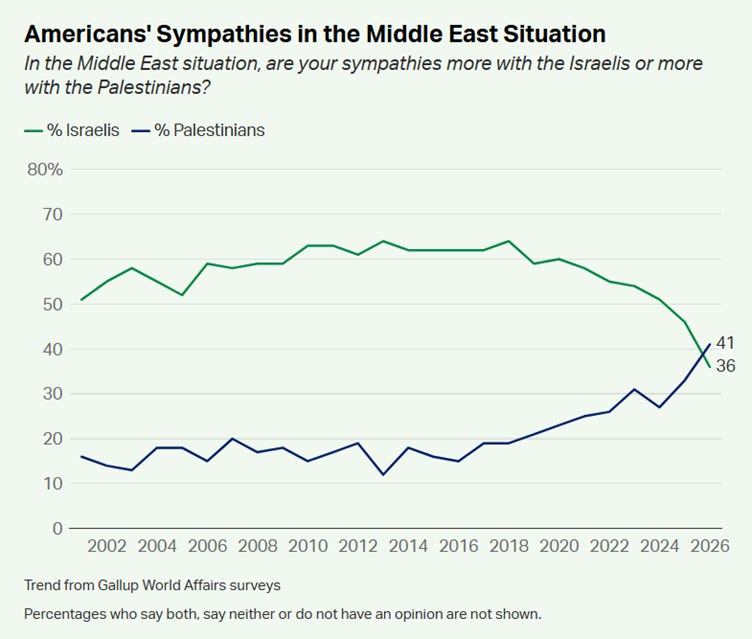
If the impact of the Iran war on the election was primarily against its consequences for the American people themselves, on Israel and Palestine and Gaza there was a clear shift to positive support for progressive forces. For the first time in history, polls showed more Americans sympathising with Palestinians than with Israel. Gallup found 41% said they sympathise more with the Palestinians, while 36% sympathise more with Israel. This was a huge change from the situation, for example, in 2018, when over 60% of Americans said they sympathised with Israel compared to only 20% with the Palestinians – see Figure 1. In Gallup’s final pre-election 2026 mid-term issues poll, 62% of registered voters rated Israel-Palestine as either extremely (35%) or very (27%) important to their vote. For a historical analysis of this this shift see the excellent article by Helena Cobban.
Figure 1
Guancha intervew
On 7 November the China media outlet guancha.cn (“Observer Network”) carried out an interview with John Ross on the results of the U.S. mid-term elections. The sections of the interview analysing the economic forces creating U.S. policy imperialist policy, and the rejection by the U.S. electorate of U.S. policy towards Israel, the Palestinians and Iran, were carried here previously. This section of the interview deals with the domestic and international consequences of the U.S. electorate’s rejection of Trump’s protectionist tariff policy.
Guancha.cn: What does this sweeping Democratic victory mean for the near future of the global economy? As we have observed, both the Democratic and Republican parties have been pushing protectionist policies for years—Trump via blunt tariffs, and Biden via domestic subsidies like the Inflation Reduction Act (IRA). Now that the Democrats have recaptured Congress, do you expect Trump’s unpredictable global tariff wars to end, or will they simply pivot toward a more institutionalised, regulatory-driven supply chain “decoupling,” particularly targeting China?
John Ross: We must strictly separate two things here: First, what is America’s economic policy toward China? Second, what is America’s overall global trade policy?
On China policy, unfortunately, I believe the Republicans and Democrats share a high level of consensus: both parties view China as a fundamental strategic competitor and seek to do everything possible to slow down China’s economic development. I wish that weren’t the case—their approach is foolish, and China is by no means an enemy—but that is their actual stance.
What can truly deter America’s economic attacks on China is China’s strength, not the goodwill of American politicians. We all clearly remember when Trump launched a tariff war with rates as high as 145% against China on his so-called “Independence Day” in 2025, and China immediately delivered an incredibly fierce counter-blow. China’s message was crystal clear: “We will never fire the first shot, but if you dare to strike, we will hit back hard.” Trump quickly learned the weight of those words and realised the U.S. could not bear the heavy costs of China’s retaliation, forcing him to pause his tariff offensive.
This truce was not born out of goodwill; it stemmed entirely from China’s strength. As long as China remains powerful, whether Democrats or Republicans are in power, they will not dare lightly launch a new massive tariff war against China, and China-U.S. economic relations will probably maintain relative stability anchored in a balance of power.
However, within the broader framework of global trade, the situation is undergoing a major shift. Over the past 18 months, many Western media outlets have been asking me: “What is your take on the rising tide of deglobalisation and trade protectionism?” I have consistently answered: “It has not occurred. Do not mistake the noise in American newspapers or the wishful thinking of Washington for what is actually happening in the world.” The U.S. indeed turned toward protectionism, and it is a very major economy, but it no longer possesses the power to single-handedly derail the trajectory of the global economy.
Prior to 3 November, what was the most central fact? Late this summer, the World Bank released the global trade data for 2025: the total volume of global trade in goods and services as a share of global GDP reached 68%, the highest level in human history. “Deglobalisation” did not happen; that is not a debate over opinions, but a fact – see Figure 2.
Figure 2
Why did the share of global trade rise instead of fall? Because the major economies of the “Global South”—which are now the primary engines of world economic growth—simply do not want deglobalisation or protectionism, and the U.S. lacks the strength to disrupt their progress. Currently, the U.S. accounts for only about 12% of total global trade, and a mere 11% of global goods trade. The U.S. can certainly relatively seal off its own borders—by my calculations, Chinese exports to the U.S. have indeed dropped by about 51% from their peak—but this is nowhere near enough to dictate the direction of the global economy.
Furthermore, the 3 November mid-term elections established a new reality: can generalised trade protectionism survive domestically within the U.S.? You must realise that the single biggest trigger for voter backlash against the GOP was soaring prices (inflation), part of which came from the Iran war and another part directly from tariff hikes.
Ordinary Americans might not understand trade theory, tariffs or economic concepts like “comparative advantage,” but they know better than anyone when the prices of things they buy skyrocket. The latest polling shows that over 60% of Americans oppose increasing tariffs. Two years ago, most Americans probably were not quite sure know what a “tariff” was about; today, they understand and oppose Trump’s tariffs.
What happens next? If Trump were to dismantle his own tariff policies, it would be tantamount to admitting the total bankruptcy of his core platform, and I doubt he can bring himself to lose face like that. However, for any candidate preparing to run in the 2028 U.S. presidential election, anyone who dares campaign on a platform of “supporting protectionism and raising tariffs” might as well not run at all—they would probably have zero chance of winning. Consequently, not only has deglobalisation failed to manifest internationally, but protectionism has also suffered a severe blow within the United States itself.