
By Paul Atkin
There are moments in which a chronic background crisis suddenly becomes acute and burns its way to the front of attention.
Excess deaths
Just in Western Europe, the current heatwaves have caused 2700 excess deaths in the UK, a similar number in France, and over 5000 in Germany. In the UK that’s five times the number of people murdered in the year ending March 2025, and almost double those killed in road accidents. France has had to shut down nuclear reactors because the river water they rely on to keep cool has been too warm to do the job, and German industrial production in the Ruhr is at risk because the heat is seriously reducing water levels in the Rhine. In the UK there is a wave of wildfires, with blazes in north Wales – that led to homes being evacuated – and Durham, Derbyshire, east London and Greater Manchester. This has been described as a nationwide “firewave” that is increasingly threatening urban areas. The fire in Wennington on Rainham marshes in 2022 that burned out 18 houses is a warning of things to come. Last Monday afternoon, the National Fire Chiefs Council said emergency services were dealing with 19 wildfires. The Met Office warned that this is “the new normal”.
Organising
So, doing “normal” things – walking or driving to the shops, leaving children in a car, “just for a bit”, going to work – has suddenly become difficult, sometimes an ordeal, sometimes dangerous, sometimes lethal: and people are starting to react.
- In August, heat is the theme of the month for UNISON’s Year of Green Action
- The TUC is hosting a heatwave organising call at 1pm on Wednesday 29 July, to share advice on how to keep your workplace cool — with actions you can take to win protections now and build towards a national maximum temperature.
- The Heat Strikemovement has been galvanising grassroots action in workplaces across the country.
- Bus drivers in London have been issued with Section 44 letters by Unite, emphasising the provision in the Health and Safety at Work Act for workers to be able to refuse to work in unsafe conditions, as a reminder to employers of their legal responsibility to ensure reasonable working conditions, including temperature controls in bus cabs after some drivers felt compelled to carry on driving when feeling sick, disoriented and faint; a serious safety issue for passengers too.
- In the education sector unions are organising around a joint protocol to get Heads to agree to relax dress codes, improve hydration, add extra cooling and ventilation, reschedule sports days. The GMB, which organises some Teaching Assistants, premises managers and office staff, has called for schools to be closed when the outside temperature is above 30C because, as the Guardian reported this week, amelioration is now all too often not enough to prevent “nausea, fainting, heatstroke” and extreme distress among children as well as staff.
Maximum workplace temperature demand
The demand for a maximum workplace temperature is gaining momentum. It has TUC support and new Green MP Hannah Spencer has introduced a private members bill in Parliament to
- set up an independent body to recommend maximum safe workplace temperatures
- and set out how those recommendations should be implemented.
The strange argument against this from the Health and Safety Commission, that a legal maximum is unworkable because some workplaces – like bakeries – are too hot regardless of what the weather is like, begs the question of why the HSE does not recommend additional cooling for such workplaces; or for outdoor work, like the refrigerated clothing now standard in Japan. They also don’t seem to have noticed that such a maximum seems perfectly workable in Spain, where, along with rules requiring a bearable level of relative humidity there are maximum levels of :
- 27ºC for sedentary work
- 25ºC for indoor light manual work
- While there are no specific limits for heavier work, inside or outside, employers forcing people to work in exceptional heat and without adequate protection, especially heavy labour in very hot weather, risk hefty fines, closure, or imprisonment, for putting their staff in danger.
If Andy Burnham is serious about taking measures to improve everyday life, he will give government time to Spencer’s bill so that it doesn’t get talked out, as private members bills tend to be. Socialists should support a campaign in the Labour Party and unions to make sure he does.
Unhinged media coverage
The brutal reality of this new heat has led to new heights of absurd coverage in the Right wing media, even as their standard “Hotter than Morrocco! Glorious Weather!” schtick wilts as people increasingly seek out shade. They have actively belittled the impact of the heat itself, while 72% of the articles about it have made no reference to the climate change that is exacerbating it. In the case of the Sun, 94% of heatwave articles make no mention of climate change; as they busily bash climate targets in the rest of the paper. This level of disavowal – looking straight at something and refusing to see it – can’t help but be deliberate. “When the facts change, I keep my opinion and ignore the facts”. In failing to join the dots themselves, they are trying to nudge everyone else to do the same.
The heating trend
The current heatwaves are estimated as being 3-4C hotter than they would naturally have been thanks to the underlying global heating generated by greenhouse gas emissions. And this isn’t a one off, but part of a rising trend, as this graph from the Met Office shows.
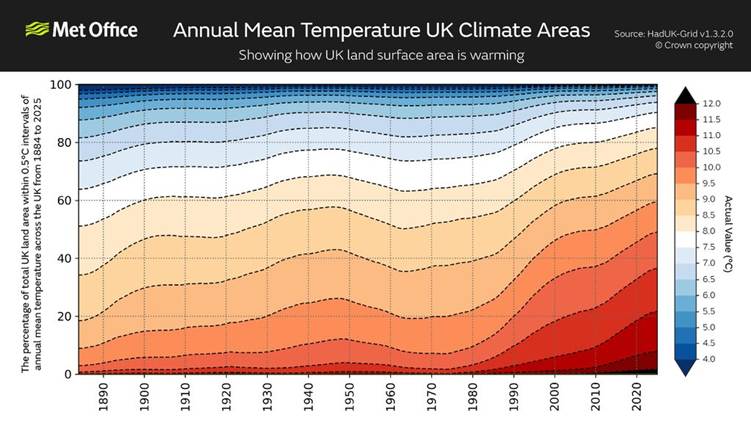
There will be no “return to normal”. Not even a return to 1976. This Winter will be cooler than this Summer, but temperatures are on a rising curve, and we are currently in the coolest climate that we will experience for the rest of our lives.
An aspect of this is increasingly sharp shifts in extreme temperatures which bely bland averages; referred to as “climate whiplash”.
Deflection arguments from the Right that none of this is to do with greenhouse gas emissions – as if you could increase the CO2 in the atmosphere from 280 parts per million (1850) to 428 parts per million (now) in just 175 years and it have no effect – are dealt with in this very popular Greener Jobs Alliance Blog; Was it Really Hotter in the Medieval Warm Period?
Half baked technical fixes
A paradox of the reaction to the heatwaves is that the same voices on the Right who downplay both the climate crisis and the heatwaves themselves, are nevertheless calling for a wholesale adoption of Air Conditioning as the only way to deal with a problem that they say doesn’t really exist. The doublethink – a capacity to believe two contradictory standpoints simultaneously with equal vehemence – is almost magnificent.
AC is a form of adaptation that – in its energy hunger and heat displacement – compounds the problem, but we are now in a situation in which having AC in many workplaces and public buildings like libraries will be essential to make them bearable to be in, and provide public cool spaces in future, even more intense, heatwaves.
The reason for low AC penetration in Northern Europe is because, in a mild, or cool, climate, it hasn’t been needed. That fact that it now is in all too many places, underlines the reality that the climate has already changed enough to require it. Just to spell it out for Right wingers who haven’t joined the dots in their own heads. If its getting hot enough to require AC in Northern England, climate change is not a hoax.
There is the added contradiction – for them – that Air Conditioning uses essentially the same technology as Heat Pumps; which the Right say don’t work, even though they know they do. The only consistent thread in the Right wing position is that they are in favour of anything that increases energy demand, and therefore the profits of energy suppliers, and against anything that reduces it.
A wider and quicker installation of reversible Heat Pumps, which provide warmth in Winter and cooling in Summer, to some extent squares the circle; counteracting the additional energy demand from Summer cooling by displacing the fossil fuels burned in gas central heating in Winter, and the electricity used for lots and lots of fans in the Summer.
Of course, costly AC is not the only solution; and the more measures – from enhanced building standards to double glazing to improved ventilation and natural shading – shade from trees reduces air temperatures by 1 -5C and surface temperatures even more – the more costs – and energy consumption – can be reduced.
Trade Union contradictions
The positions taken by Unite and GMB in defending their members against climate impacts have been clear and forthright. However, their leaderships are simultaneously arguing for increased oil and gas production from the North Sea, including allowing the Rosebank oilfield and Jackdaw gas field to go ahead; even though the greenhouse gas emissions from doing so will contribute to the climate impacts on their members – and the rest of us – everywhere else and in the North Sea. This is in contradiction to the ten unions – Unison, the NEU, FBU, PCS, CWU, UCU, Equity, BFAWU, UVW and IWGB, and more than 1,900 additional trade unionists – who have sent an open letter opposing Rosebank, with UNISON General Secretary Andrea Egan stating “New oil fields won’t do anything to reduce the prices…they will delay action for real energy security and climate justice through a shift to renewables” and “at the same time, the likelihood that Rosebank will lead to significant losses for the UK Treasury, while corporations, including one linked to Israeli war crimes, pocket billions, should outrage us all.”
This has involved them in uniting with the US administration and its local tools in pressuring Andy Burnham on his choice for Chancellor of the Exchequer, because Ed Miliband is too committed to “net zero”. The indications are that this has been successful and Burnham will choose Shabana Mahmud. The phrase “be careful what you wish for” comes to mind.
Along with this it is now being widely reported that the Rosebank oilfield and Jackdaw gas field will be approved. This will pour fuel on the fire of climate change, as production from any new fields is incompatible with global climate targets, and will do nothing significant to stop the rapid decline in offshore jobs. To quantify this.
- The North Sea is a “mature basin”, so remaining reserves are harder and more expensive to extract (it costs four times as much to “lift” natural gas from the North Sea than it does in Qatar for example)
- Oil production is now a quarter of what it was in 1999.
- Jobs have been declining at an average rate of 725 every month for 27 years, and projections for future job losses continue that trend.
- The total number of jobs created by Rosebank are 1600 to set it up and 450 to run it, according to the BBC.
- Taken together, that’s just two months worth of the decline that’s been going on for twenty seven years (three hundred and twenty five months). The company claims twice as many jobs will be created, but that would still counteract just four months worth of lost jobs out of 325 and barely dent the 60,000 jobs that are on their way out regardless.
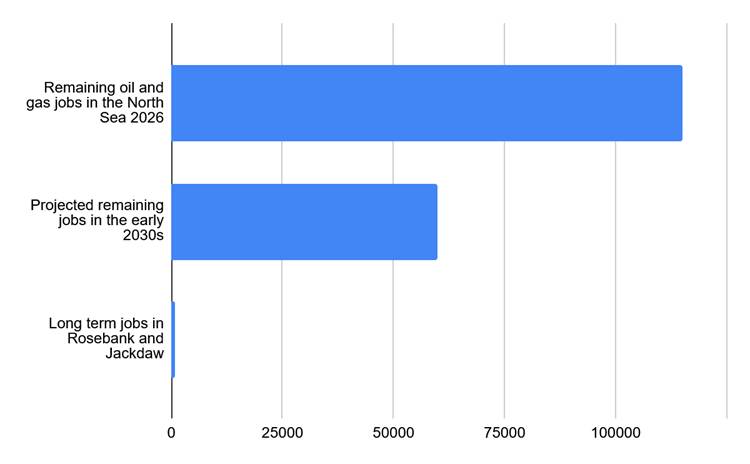
The figures used for the long term jobs in Rosebank and Jackdaw in this graph are the larger ones supplied by the company, not the smaller ones reported by the BBC. Approving them is obviously not the solution to job losses.
So, that means, offshore oil and gas workers will still be losing their jobs hand over fist unless there is a serious plan for them to transition into comparable jobs in offshore wind and decommissioning redundant rigs; a massive job that the owners will have to be forced to pay for.
Its that campaign that the whole trade union and climate movement can, and should, unite around.
Burnham’s triangulation?
Burnham’s reported position, which may be kite flying or possibly an attempt to bounce him into it, is an attempt to triangulate.
- Maintain the manifesto commitment to oppose any further oil and gas licences – as a full scale abandonment would cause ructions and prevent any migration of votes back from the Greens.
- Approve Jackdaw and Rosebank on the basis that their licences had already been granted when Labour was elected – even though a subsequent court case has established in law that the emissions from either would breach the UK’s legally binding targets under the Climate Change Act
- Encourage further production from existing fields. This is probably the most limited prospect practically, but the most dangerous politically. Even with higher oil and gas prices (and therefore profits) driven by the US war on Iran, too few of the remaining North Sea oil and gas reserves are viable without subsidy. The development costs for Rosebank and Jackdaw have largely been footed by the Treasury – the profits will go to Shell, Equinor and Ithaca. So the practical content of the campaign to “open up the North Sea” will be pressure against windfall taxes on profits, and pressure for more tax breaks to improve the marginal economics of additional extraction. It is worthy of note that Andrew Bowie, the Conservative shadow Scotland secretary, has said the UK should aim for“maximum economic recovery”(my emphasis) of oil and gas from the North Sea; meaning that beneath the grandstanding about defending jobs and communities is a standard grubby campaign to lever more resources from the public to subsidise the profits of fossil fuel producers. The Conservatives, Reform and the companies know that the delusion of an easy fix – especially a nostalgic one – is easier to sell than the reality: which is why they are so allergic to figures in their arguments. Complicity in such a campaign from unions will not defend their members jobs, but will lead them up the garden path and deliver them to the Right. The only way to defend “the people and places that have powered this country for generations,” is to defend the people and places by changing the source of power.
The less you mitigate, the more you have to adapt
The slow pace of climate mitigation (removing the causes of climate change by cutting down greenhouse gas emissions as fast as possible) is now causing an increasingly heavy price in adaptation (measures needed to cope with the changed conditions) that would not have been needed had the mitigation been deeper and faster.
The argument from the Right that mitigation is unnecessary and adaptation cost free is already exposed.
The tendency to carry on as “normal” until it gets impossible to do so, and then try to brass it out or panic, is exposed in the 2025 report to Parliament from the Climate Change Committee on the UK’s adaptation to climate change. In a scathing assessment it reported that:
- The UK’s preparations for climate change are inadequate. Delivery of effective adaptation remains limited … planning for adaptation continues to be piecemeal and disjointed. The vast majority of our assessment outcomes have the same low scores as in 2023. In terms of adaptation delivery, we do not find evidence to score a single outcome as ‘good’. Adaptation progress is either too slow, has stalled, or is heading in the wrong direction…
- The Government has yet to change the UK’s inadequate approach to tackling climate risks. … The slow pace of change indicates that adaptation is not yet a top priority across government.
And recommended four key action areas:
- Improve objectives and targets. … to provide an actionable and measurable framework for the rest of government and beyond. As part of this, the Government must communicate clearly the respective roles of government, the private sector and households in delivering and funding adaptation.
- Improve coordination across government. …Government adaptation efforts must be better linked with wider resilience planning to ensure that adaptation becomes a true cross-government priority.
- Integrate adaptation into all relevant policies. The next Spending Review needs to ensure that climate adaptation planning is supported with sufficient resources across government. Public assets, and critical public services such as the NHS, need to be resilient to current and future weather so that they can operate effectively, and in the case of new infrastructure, without costly retrofitting.
- Implement monitoring, evaluation and learning across all sectors. The long-standing gap of an effective monitoring and evaluation framework for adaptation must finally be closed.
Some of this is about planning and organisation across government. Some of it implies government by campaign, in mobilising society to meet the challenge. Some of it is about funding, and making it a priority. It won’t be possible to defend our hospitals from floods and overheating by building drones; any more than you could stop a hurricane by, as President Trump once suggested, bombing it. Fighting for adequate resourcing to defend essential infrastructure from increasing damage will collide with the suicidal drive for ever increasing war expenditure.
So, the early indications that Burnham’s government will be Starmerism with a human face, and even retreat on climate policy, will mean that things will get hotter – in more ways than one.
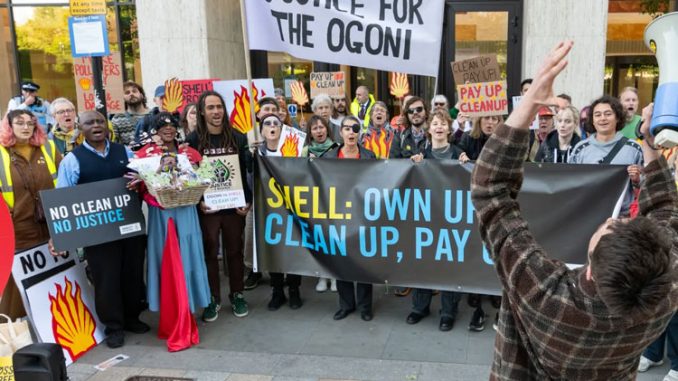
Image: Photo from Fossil Free London.