
By Steve Bell
The signing of the Islamabad Memorandum of Understanding (MOU) by Iran and the United States does not signify the end to US imperialism’s long-term assault upon the Islamic Republic. It does, however, represent yet another defeat in the war against Iran initiated by the US in February 2026.
If the clauses referring to issues arising from the war are put aside, then the rest of the agreement is positions established in negotiations prior to the start of the war. The US government is settling the unprovoked war it initiated on terms available to it before that war.
The initial failure of the US/Israel military campaign was its inability to overturn the independent state of Iran (“regime change”). “Operation Epic Fury” ended in an agreed ceasefire in April, with Iran’s sovereignty intact. On April 13 US imposed a blockade of Iranian ports from the Gulf of Oman during the ceasefire, demanding Iran “open” the Strait, under the duress of having its economy suffocated. Yet it soon became clear the Strait would not be opened under duress. This was the second failure – underestimating a people who had endured 47 years of US sanctions so far and will endure further. The third failure was the US naval offensive to seize the Strait of Hormuz. “Operation Project Freedom” began on May 4 during the ceasefire and was suspended the following day after US naval vessels withdrew under fire.
This third failure created an immediate crisis for the Trump administration. Once again, it faced the choice between an escalation of notable risk or accepting an unfavourable peace. The MOU is a choice for a “peace” that the US government hopes will blur the real failure of US foreign policy.
The immediate embarrassment of the US government does not mean it has abandoned the goal of subordinating the Iranian people. The imperialist beast is injured, not dead. It still hopes to unwind the achievements Iranian resistance has imposed in the MOU text.
The actual cost of the US government’s failures is yet to be determined. It will be decided both in the negotiations for a final “deal,” and through the struggle to define the practical implementation of the MOU. (1)
Lebanon and the first ambiguity of the MOU
The MOU’s 14 points are a combination of immediate measures to be implemented, along with a series of issues to be negotiated in a sixty-day period. The war is not actually terminated, as that is to be part of the final deal. But immediately there is a commitment “not to initiate any war or military operation against each other.”
This is to cover “all fronts, including in Lebanon.” Here is the first ambiguity. The US and Israel did not wish to include Lebanon. Their preference was for Israel to negotiate with the Lebanese government – giving the upper hand to the occupying power. Iran’s insistence upon this inclusion is a real service to the Lebanese people facing a permanent occupation otherwise.
The MOU does not explicitly state that Israel must withdraw. It ties the two parties to “ensuring the territorial integrity and sovereignty of Lebanon.” Any objective observer would recognise that cannot be achieved whilst Israeli occupation forces are tearing apart the south to create a permanent security “buffer”.
Unsurprisingly, the first test of the MOU has been registered immediately after its signing. Israeli armed forces continued armed actions from Wednesday 17 June until Saturday 20June. In response, the Iranians reimposed a ban on vessels crossing the Strait.
Iran is bound in the agreement to ensure the “safe passage of commercial vessels.” This was implemented immediately on Wednesday 17 June, but Iranian patience was exhausted by Saturday 20 June. The first hurdle to implantation, Israeli government opposition, will only be removed by US government determination to restrain its key tool in the region. At the time of writing negotiations between US Vice-President J. D. Vance and Iranian Foreign Minister Abbas Araghchi are in discussions to resolve the issue.
The ambiguity in the text can only be resolved in the actions of governments. An initial pause of Israeli actions is holding. But only Israeli withdrawal will finally guarantee this key clause in the MOU.
Opening the Strait and Iranian ports
The US is to immediately begin removing its naval blockade of Iranian ports, with this to end within thirty days. The further removal of US forces “from the proximity of the Islamic Republic” will only be within thirty days after the final deal. The threat of immediate return to war will remain while the forward deployment of US forces continues.
For its part, Iran will make “its best efforts for the safe passage of commercial vessels, with no charge for 60 days only.” There will be a dialogue between Iran and the Sultanate of Oman” to define the future administration and maritime services in the Strait of Hormuz, in discussion with other Persian Gulf littoral states. The indication is that there will be a formal mechanism of joint management of the Strait by Iran and Oman, where commercial vessels could be charged for services.
This issue had been heavily promoted by pro-US commentators as Iranian interference in freedom of navigation or incursion into “international waters.” The United Nations Convention on the Seas (UNCLOS) defines territorial waters as 13.8 miles from the coast. As the Strait is just twenty-one miles wide between Iran and Oman, then their territorial waters overlap across the Strait. Given the attempt of the US to seize the Strait, and the hostile action of the US navy in the “Tanker War” after 1984, it is surely legitimate of the Iranian government to insist upon the joint sovereignty with Oman over the Strait.
US allies in Europe and elsewhere have focused on the Strait. The British government and some EU governments have insisted that they have a mission to defend shipping against Iran and hence to exert their power in the Strait. The British Labour government has spent much time and effort in self-promotion as the hinge to the Strait’s door.
This has culminated in the “Joint E4 Leaders Statement on the US-Iran peace deal”, dated 14th June. (2) The key signatories are the governments of the UK, France, Germany, and Italy – alongside thirty-six other states. We read:” The urgent re-opening of the Strait of Hormuz with unconditional and unrestrained freedom of navigation is essential. We are committed to play our part to achieve this.”
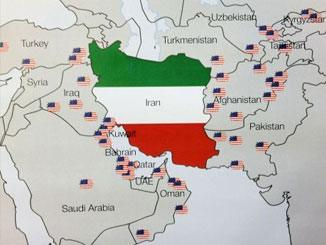
The signatories to this piety have yet to condemn the US/Israeli war on the Iranian people, despite the obvious breach of the UN Charter. Somehow the four key signatories found the energy to condemn the Iranian government’s defensive response of taking out US bases and interests in the Gulf. Equally, despite verbal “opposition” to the US war, the key signatories provided direct assistance to the US aggression. This included allowing the US to use airfields for bombing Iran, providing intelligence to the US and Israel, and deploying aerial resources to intercept Iran’s counter strikes against the US and Israel.
Such actions provide another example of how the profession of “universal values” by imperialist powers only involves the global promotion of hypocrisy. Iran, along with the Palestinians and Lebanese people, does not have “the right to defend itself” from the unprovoked assault of the US and Israel.
This is one reason these powers have made themselves irrelevant to global diplomacy. They have chosen the role of understudy actors in the US theatre of operations. Meanwhile, Pakistan, Qatar, Oman, Turkey, Egypt, Saudi Arabia, and China have all contributed to securing the MOU, which even the E4 have been forced to “warmly welcome”.
Despite their statement, the MOU offers no rational for the E4’s offer to “reassure commercial shipping and conduct mine clearance operations”, The MOU gives that responsibility to Iran, including any removal of “military obstacles and demining.” The E4 friends would better serve the cause of peace by ending their arming and assistance to the Israelis’ genocidal campaigns against the peoples of Palestine and Lebanon.
Allowing Iran to export and access its assets
The final set of immediate actions are concerned with removing some of the most significant obstacles to Iran using its resources to the benefit of its people. The US is bound to immediately issuing waivers which allow Iran the “export of crude oil, petroleum products and derivatives, and all associated services including banking transactions, insurances, transportation, etc.”
The US is not immediately removing its illegal, unilateral sanctions against Iran. It is simply providing written confirmation that companies and governments engaging in trade in these products will not be sanctioned by the US. Actual removal of sanctions will be part of the final deal. With these waivers, Iran has immediately increased oil exports.
Equally, the vast sums of “frozen or restricted funds and assets of the Islamic Republic are to be made “fully available” to Iran. Actual release is being negotiated, but the justice of allowing the Iranian people to utilize Iranian resources is brilliantly obvious. The US is obliged to issue “all necessary licences and authorizations accordingly.”
Here, however, is a further ambiguity, as the freedom secured is circumscribed while sanctions remain in place. Trade will still face serious restrictions. Iran may be confined to purchases permissible under sanctions, e.g. humanitarian goods. Sales will be restricted by the waiver categories. Further, the international banks, financial and insurance companies are likely to be cautious about resuming trade, preferring to “over-comply” by not trading at all.
Fortunately, Iran’s ingenuity in dealing with sanctions has allowed it to retain substantial economic relations around most of the globe. Since 2019, Iran has traded goods with more than 170 countries. It will surely further expand its partners despite the impact of the war, and the continuation of sanctions.
Issues being negotiated in the final deal
All other issues are subject to further negotiations in a comprehensive final deal. This is framed by a common commitment to “respect each other’s sovereignty and territorial integrity and to refrain from interfering in each other’s internal affairs.” This involves no change for Iranian policy. It would be a substantial shift for the US. Trump recently admitted that the US was delivering arms for use by “protestors” during the January riots this year, while various Israeli sources have confirmed organised Mossad involvement.
The sixty-day period for negotiating the final deal can be extended by mutual consent. There is not so much to resolve as in the first nuclear agreement, the JCPOA. However, it should be borne in mind that the first conversation between US President Obama and Iranian President Rouhani took place on September 27, 2013, when Obama told the White House press corps that :” I believe we can reach a comprehensive solution [to the nuclear dispute].” (3) It took until September 2015 before the agreement negotiated was endorsed by Congress. Sixty days may be tight!
The essential issues to resolve are a reconstruction fund; the removal of sanctions; and the nuclear file.
Reconstruction
The final deal must include a plan and mechanism for a $300 billion fund for Iranian reconstruction and economic development. This recognition of Iranian reconstruction needs is clearly an attempt to address reparations by other means. A preliminary estimate made by Iran in mid-April gave an estimated economic loss of around $270 billion.
Trump has stated that the US Treasury will not be contributing, and that he hopes the Gulf States will contribute. That is optimistic given the impact of the war upon revenues for these states. Gaza has yet to benefit from the promises made by the US on the assumption of the Gulf delivering. What is quite possible is direct private investment from the US. In the 2015 JCPOA agreement such investment was ruled out by Iran. The option of US investment was strongly trailed by Iranian officials prior to the commencement of the June 2025 war.
Sanctions
The final deal will include a schedule for the removal of all sanctions “including the United Nations Security Council resolutions, IAEA Board of Governors’ resolutions and all unilateral U.S. sanctions, primary and secondary, in an agreed upon schedule.” For the Iranian people, the removal of sanctions would be a major achievement shared across the whole of Iranian society
The frightful impact of sanctions upon the civilian population has been widely documented, both in general (4), and upon the Iranian people. (5) If the text’s commitment can be secured it would transform the immediate and long-term perspectives for Iranian society. Because of this, we can expect the most reactionary international forces to attempt to slow down or prevent this commitment being implemented.
Right on cue, European Commission President Ursula von der Leyen stated on June 15th that EU sanctions on Iran will not be lifted unless there is “credible and verifiable” behavioural change on human rights violations and weapons of mass destruction programmes.
Further evidence, if needed, of the bankruptcy of European diplomacy. President von der Leyen wags a finger at Iran but has supported and aided EU complicity in Gaza. At no time has she proposed any restriction or sanction against the Israeli government in the face of the digital age’s first conclusive genocide.
Nor has she considered whether the EU has the credibility to lecture on weapons of mass destruction. Today we are witnessing the European economies and social services being wrecked simply to secure a new generation of weapons of mass destruction, the dispersal of nukes across Europe, and moves to conscription – all in pursuit of a potential world war with nukes present from day one.
But European concerns have no independent weight. Should the US genuinely act on the commitment to lift sanctions on Iran then the noisy running dogs of European diplomacy will obey their master.
The nuclear file
Iran reaffirms its commitment to not developing nuclear weapons. It will resolve the disposition of its stockpiled enriched material, “with the minimum methodology to be down blending on-site, under the supervision of the IAEA”. Future enrichment and related issues will be negotiated, recognising “Iran’s nuclear needs”.
This is likely to be the key headline issue. However, the principles may be more easily solved than some of the technical issues arising from the US’s earlier bombing of Iranian nuclear facilities.
For Iran, the right to enrich is an elementary right accorded by the Non-Proliferation Treaty, to which it is a signatory. This is also a matter of Iran’s sovereignty and national dignity. Which explains the importance of “the minimum methodology to be the down blending” of its 440kg of highly enriched uranium being “on site”, i.e. in Iran. The JCPOA was possible because the US changed its policy and recognised Iran’s right to enrichment. If the Trump administration drops its opposition to Iran’s enrichment rights, then a final deal is within reach.
Procedures towards the final deal
The final features of the MOU are essentially procedural. Prior to the final deal the “status quo” will be respected. Iran will not begin new nuclear initiatives. The US will impose no new sanctions, nor deploy additional forces.
An executive mechanism will be negotiated and established to maintain the implementation of the MOU and compliance with the final deal. The final deal will be subject to endorsement by a binding United Nation Security Council Resolution. Trump has also stated his intention to place the deal before US Congress. Given the deep unpopularity of the war in US society, it will be difficult for the Democrats to oppose a final deal.
In conclusion
The MOU offers the prospect of Iran ending a significant chapter of foreign aggression. As the stakes are so high we must expect many further difficulties, including a strong possibility of breakdown and a resumption of war.
However, the achievements of the Iranian people must not be underestimated. Having withstood nearly five decades of sanctions; the imperialist backed Iraqi war on Iran; the June 2025 US/Israel war; they are now negotiating a peace for the 2026 US war. This can significantly alter the political dynamics across West Asia.
Whilst the immediate course of this struggle will be determined by the Iranians and their regional allies, the anti-war movement in the imperialist countries has an important contribution to offer. It must press the US to honour and implement the commitments made in the MOU.
In Britain, we must demand that the Labour government ends all attempts to interfere in the Gulf. A diplomatic process is under way which is potentially beneficial to the oppressed peoples of Iran, Lebanon, Palestine, Yemen and across West Asia. Labour needs to stop sabre rattling and rediscover the power of diplomacy. It has played no part in securing a path to peace in the region, it should start contributing without bluster.
The highly successful events organised by StopRearmEurope and Stop Militarisation in Brussels and elsewhere on June 13; and the brilliant International Conference Against War in London on June 20 demonstrate that the international anti-war movement is entering a new phase. This renewed vitality can directly aid the peoples of West Asia by demanding full support for Iran’s breakthrough.
Notes
(1) Throughout, I have used the text of the MOU as provided by the Iranian government to Amwaj media, as published in “Document: A historic Iran-US memorandum of understanding,” June 17, Amwaj.media
(2) “Press release Joint E4 Leaders’ Statement on the US-Iran peace deal: 14 June 2026”, From Prime Minister’s Office, Gov.UK
(3) “Losing an Enemy: Obama, Iran, and the Triumph of Diplomacy,” Trita Parsi, Yale University Press, 2017, P.225
(4) The August 2025 issue of The Lancet contains a study which estimates that sanctions imposed by the US and EU were associated with 564,258 deaths annually from 1971 to 2021. The annual battle related deaths for the same period were 106,000.
(5) The best, easily accessible material on Iran is the collection, “How Sanctions Work: Iran and the Impact of Economic Warfare,” Narges Bajoghli, Vasli Nasr, Djavad Salehi-Isfahani, and Ali Vaez, Stanford University Press, 2024