
By Dennis Barton and Paul Taylor
The landslide victory of Péter Magyar’s Tisza centre-right party at Hungary’s recent parliamentary elections has removed Viktor Orbán’s Fidesz Party from power after 16 years in government. Magyar, whose origins are in the Fidesz Party, won the votes of many who opposed Orban and Fidesz, with the left winning no seats in the new National Assembly.
Although these elections are unlikely to lead to any substantial changes in domestic policy, they will have significant repercussions for its relations with other countries. Whilst Orbán’s defeat represents a setback for some political aspects of Trumpism in Europe, it will strengthen the European Union’s militarisation drive, including its policy of arming Ukraine. Hungary is now more likely to agree to Trump’s demand that the EU and Britain carry the cost of the US proxy war in Ukraine so that Washington can prioritise its resources against China.
The economy
The new Hungarian government will face the same economic dilemmasas Orbán.
Firstly, how to grow and improve living standards, faced with the impact of a stagnant EU and a weak German economy. Both have accepted subordination to Washington: on the US proxy war in Ukraine, energy dependency on the US, increased military spending, tariffs, and pressure to invest in the USA by Biden and Trump.
The latest economic attack on Europe from the White House will hit Hungary hard and further underline how the US has no economic offer for Europe. Trump’s new 25% tariff on European cars will price Hungary out of the US market. For example, BMW’s Debrecen plant will lose competitiveness, while Audi and Mercedes factories in Győr and Kecskemét face falling exports. This risks 10,000–12,000 auto sector jobs and could take around 0.4% off GDP.
Secondly, how will Magyar navigate Hungary’s economic relationship with China and the Belt and Road, the most dynamic part of the world economy? Whether the new government chooses to weaken the Hungarian economy by adopting an anti-China posture under pressure from the USA and the EU remains to be seen. The 27 EU Commissioners are set to debate their China strategy on 29 May and Hungary will be put under duress to weaken its ties with China. If Hungary were to do so, then the space left by its retreat as a key destination of Chinese investment and participant in the Belt and Road Initiative could be filled by other countries such as Bulgaria and Serbia.
Fidesz Failures
The Hungarian elections took place against the background of a period of sustained stagnation over the past few years: GDP grew by only 0.4 percent in 2025. This has suppressed living standards and widened social inequalities. The Fidesz government was ridden with accusations of corruption, including wasting EU funds. Its economic failures were accompanied by authoritarianism and social conservatism, introducing extremely reactionary policies on issues such as migration, some of which Magyar has pledged to continue.
Contradictions and Autonomy
Orbán’s right-wing conservatism was underlined by his association with Trumpism. As well as being one of Donald Trump’s strongest allies in the region, Orbán also forged a close relationship with Benjamin Netanyahu, who openly endorsed Fidesz during the elections. Hungary announced it would withdraw from the International Criminal Court after it had issued an arrest warrant against Netanyahu over Israel’s genocidal actions in Gaza. The Fidesz government also vetoed attempts inside the European Union to condemn Israel for its illegal war against the Palestinians.
Despite such subordination to the USA and Israel, the outgoing Hungarian government was also one of Europe’s strongest critics of the NATO-EU policy towards the war in Ukraine. Orbán’s administration blocked some of the EU’s planned military aid to Ukraine and also opposed attempts to further integrate Ukraine into the EU’s structures. It supported an immediate ceasefire in Ukraine and maintained ‘friendly’ relations with Russia to secure the ongoing delivery of Russian gas, in defiance of EU pressure to buy and become dependent on much more expensive LNG from the USA.
Druzhba oil pipeline
Hungary’s vulnerability with its oil supply was exposed when Ukraine blocked the flow of Russian oil through the Ukrainian section of the Druzhba pipeline before it reaches Hungary via Slovakia.
Hungary’s opposition to the NATO-EU policy on Ukraine resulted in the Ukrainian government blocking the flow of Russian oil through the Ukrainian section of the Druzhba pipeline. This added to Hungary’s economic difficulties, which had been exacerbated by the EU’s refusal to pay a large proportion of designated cohesion and reconstruction funds to Hungary, worth €21bln (equal to around 8 percent of GDP). These were ostensibly withheld due to the accusations of corruption and violations of judicial independence by the Hungarian government. This provided a means for the EU to apply pressure on the Hungarian government and to exert its influence during the elections, and has given it leverage over the incoming government.
As an energy consultant, John Roberts explained, “Druzhba was … the backbone of supply for Central Europe….The loss of Druzhba to most of Western Europe is a big annoyance, but it’s not desperate … That’s not true for Central Europe.” New PM Magyar also warned Ukraine that it would not ‘give into blackmail’ over the opening of the pipeline. He added, “If the Druzhba pipeline is in a condition to carry oil, then it should be reopened as promised. We also call on Russia to supply oil into the pipeline. Without it, it cannot function.”22
Orbán’s government therefore juggled contradictory international policies, as it attempted to steer an autonomous path. Orbán portrayed himself as standing up for Hungarian national interests, including supporting the rights of Hungarian minorities in neighbouring countries (an issue emphasised by the new PM over Hungarian minority rights in Ukraine) and helping to maintain stability and security at home.
China
As well as standing against the NATO position on Ukraine, the Orbán government also developed relatively good relations with China, with Hungary becoming one of the largest recipients of Chinese economic investments in the region. Orbán blocked common EU positions on issues such as its unfounded attacks on China’s human rights and its hostile policies towards China on the Hong Kong and Taiwan territories. The new government foreign minister designate, Anita Orbán, has welcomed a continuation of close economic relations with China, with a pragmatic balance between Hungary’s relationship and support for the EU and the benefits to Hungary of Chinese investment and trade.
Change and Continuity
The election of Magyar as Prime Minister is unlikely to change Hungary’s pro-Israel policy. Magyar has said that Hungary and Israel share a ‘special relationship’ and that they are important economic partners. Nevertheless, he has also said that he could no longer guarantee that his government would block EU decisions on Israel, and it would halt Hungary’s withdrawal from the International Criminal Court. Therefore, Netanyahu’s planned visit to Hungary this autumn is in jeopardy.
Whilst the new government’s partial distancing from Orban’s most extreme pro-Israeli policies will be welcomed by many in Hungary, its alignment with NATO-EU policy on Ukraine will be less popular. There is great scepticism within Hungarian society towards sending Hungarian weapons to Ukraine and large opposition to deploying Hungarian troops in Ukraine or accepting Ukraine as an EU member. Nevertheless, the new Hungarian government has already dropped its opposition to releasing a €90 billion loan to support Ukraine’s finances, of which two-thirds is earmarked for defence. Magyar has also proposed a meeting in June with Volodymyr Zelensky. It may not be so easy for Budapest to ‘reset’ relations with Ukraine, due to large hostility within Hungary to the Ukrainian government’s introduction of laws which restrict the cultural and linguistic rights of minorities, including the Hungarian minority.
Regional Re-Alignment?
Any change in Hungary’s policy towards Ukraine will have repercussions in Central and Eastern Europe. Orbán had previously aligned closely with the Slovakian PM Robert Fico around the war in Ukraine and more recently with the Czech Prime Minister Andrej Babiš, who was elected in December 2025. The Polish government and President have meanwhile been the most supportive of the NATO-EU policy towards Ukraine, alongside the Baltic States.
Magyar has already announced that his first trip abroad as Hungarian Prime Minister will be to Poland. Tusk will champion Hungary’s return to the European Union mainstream and support the EU granting Hungary their suspended funds, as happened to Poland after the defeat of the Law and Justice Party in December 2023. In return, Hungary will be expected to maintain its support for the EU policy of replacing the United States as the main military supplier of Ukraine, a policy paradoxically promoted by Trump. Simultaneously, Hungary will be expected to break its relations with China and Russia and fall into line with the strategy of European militarisation.
The new EU funds now flowing into Ukraine may grant Magyar’s government some temporary respite, if they are invested efficiently. However, the EU’s plan to hike military spending, support the ongoing war in Ukraine – alongside its hostile relations with China and Russia – will have a negative effect on the country’s economy and security.
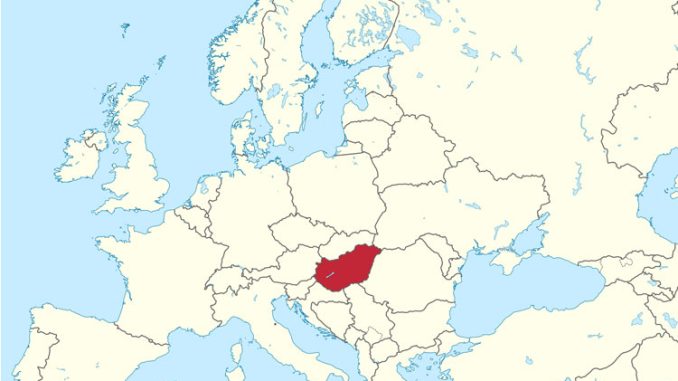
Image: Hungary in Europe (-rivers -mini map); Author TUBS; Licensed under the Creative Commons Attribution-Share Alike 3.0 Unported license; Image cropped.
