
By Angela Craig
A hallmark of Starmer’s government is its attacks on some of the most oppressed in society and the use of reactionary, divisive rhetoric to justify these. So it is with the relentless assault on disabled people. The very constancy of this offensive can make it difficult to keep track, and a focus on the attacks on disabled people can also be limited by the tendency to approach issues affecting disabled people as less ones to do with structural oppression as we might view similar struggles.
Encroaching assisted suicide laws must be opposed
First and foremost is the existential threat posed by encroaching legislation on assisted suicide. While some on the left naively consider this to be an issue of individual rights and overlook both the wider socio-economic context and that all lives are far from considered or treated as equal: devalued and stigmatized lives will meet legalized assisted suicide in very different ways from lives socially more protected. And do so in countries which already have such laws. Hence the strong opposition of disabled people’s organisations to such laws.
Assisted suicide legislation is making progress in the following countries and areas.
In the Isle of Man legislation was passed in March 2025 to allow terminally ill adults with less that 12 months to live to end their own lives. It has not yet received Royal Assent because of concerns over potential coercion powers.
Jersey passed legislation in February 2026 for assisted suicide for people with terminal illnesses expected to die within six months, or 12 months for those with neurodegenerative conditions. These kinds of timescales are notoriously liable to lack of precision.
In Wales the Senedd voted on 24 February to allow assisted dying, subject to legislation being agreed at Westminster.
The Scottish Parliament is voting March 12 on stage 3 of a bill with wide ranging provisions including no illness requirement. It has been widely opposed by medical professional organisations and disabled people’s organizations.
At Westminster the private member’s bill introduced in 2025 by Labour MP Kim Leadbetter may run out of time in the House of Lords. Supporters of the legislation have claimed opponents are unduly blocking the bill. What was claimed to be a ‘marathon’ Second Reading was in fact only two days. Due to more than 1000 amendments being tabled 14 days for scrutiny by a Lords committee were agreed. The number of amendments reflects a higher level of awareness on this issue in the House of Lords compared to the Commons – though as the debate in the Commons showed, attitudes there shifted in the course of debate – due to at least six previous assisted suicide bills being debated in the Lords in recent decades.
Alongside this runs a series of attacks on disabled people under Starmer’s government. The backdrop to these was twofold: the long years of Coalition and Conservative government so-called austerity and the Covid pandemic when disabled people were much more likely to die than non-disabled people.
This context calls for massive remedial intervention. Instead there has been a continuation of similar policies. This article is highlighting only a few.
SEND proposals will deepen inequality and exclusion
Most recently Labour published its proposals for ‘Special Educational Needs’ education, SEND. These were launched amidst a media narrative asserting overdiagnosis and a growing climate of hate against disabled people. The government claims an aim of increased inclusion in mainstream education. Under the Conservatives there was an increase in segregation. Disability organisations say it will increase segregation and oppose what they call the rebranding of specialist units in mainstream schools as ‘Inclusion Bases’. A legal challenge has already been taken on the basis that the proposals weaken SEND Tribunal powers and shift legal duties from local authorities to schools.
The government says £1.6bn will be spent over the next three years on ensuring needs in mainstream schools are identified and met. The campaign Special Needs Jungle say this sounds a lot but spread across the sector ‘it wouldn’t be enough to pay for more than a few hours a week of teacher time in a school. It wouldn’t even be enough, by itself, to pay for an extra teaching assistant.’ While another £1.8 billion is promised for ‘speech and language therapists, educational psychologists and wider professionals’ a chronic lack of these skills promise delay in implementation and therefore are vulnerable to a rightwards future shift in government.
The key proposal is for a cut in EHCPs (education, health and care plans), a legal document that sets out what provision a child must get, often only achieved after a considerable battle. The aim is to cut these by 270,000 over a decade by narrowing eligibility and restructuring assessment into 7 more formulaic categories. The proposals are reminiscent of how Disability Living Allowance assessment was restructuring with the aim of slashing numbers of recipients.
Benefit cuts and policy retreats
Disabled people receiving care packages in their own homes are facing increased costs because of a decision in February to maintain a freeze in the capital people are allowed to have before paying for their care. This has been frozen for 16 years meaning a fall in the real value of savings over time, with more people pulled into paying for care. The lower capital limit is only £14k.
From April cuts under the Universal Credit Act will half the health element of Universal Credit for most new claimants and also remove this entirely for most disabled people under 22.
Cuts are also taking place to the Access to Work scheme which provides equipment and funding to disabled people in the workplace with cuts in the number and size of grants being made and a long backlog of 62,000 claims waiting.
In November the government announced restrictions to the Motability scheme, a long-standing vehicle lease scheme funded by Personal Independence Payment if the person receives enhanced rate mobility support. The changes included higher up-front costs and restrictions on the make or model of vehicle allowed. The latter was supported by a media campaign about scroungers driving tax-payer funded BMW’s when, in fact, certain vehicles are necessary because of the nature of adaptations needed.
In the context of a crisis in availability of accessible housing the budget for Disabled Facilities Grants, which funds essential adaptations to homes, has been frozen. In December the government set out proposals to sharply reduce the proportion of new homes that would be built to accessible standards.
It is unsurprising that in this climate disability hate crimes are high. Yet in January the Home Office announced that police should stop investigating lower level hate crime, called ‘non-crime hate incidents’, something criticised as likely to miss incidents of disability hate that are already greatly under-reported and normalised.
The forced retreat on £5bn planned cuts in disability benefits, particularly through further restricting eligibility to PIP, reflected pressure on MPs from constituents. But a repackaging of the proposals is awaited.
This is a sample of the political approach worsening lives for disabled people. Alongside specific attacks such as these lies the negative impact of general government policy. Socialists should do all they can to understand, publicise and oppose this deeply negative direction of political travel.
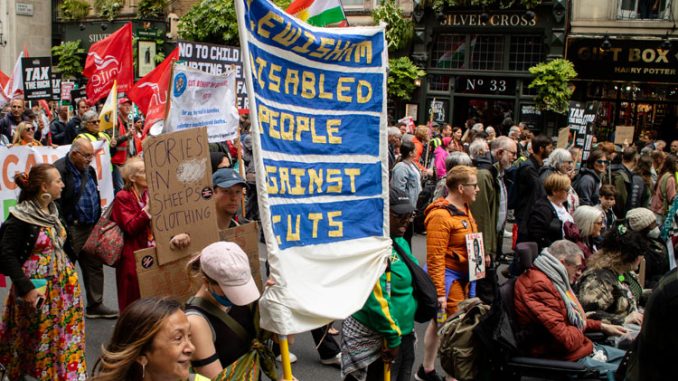
Image: People’s Assembly – Cut War Not Welfare march, London 7th June 2025; By Steve Eason; Licensed under the Attribution-NonCommercial 2.0 Generic CC BY-NC 2.0 license; image cropped.