

By Paul Atkin
The statistics on capital investment from the Budget are stark.
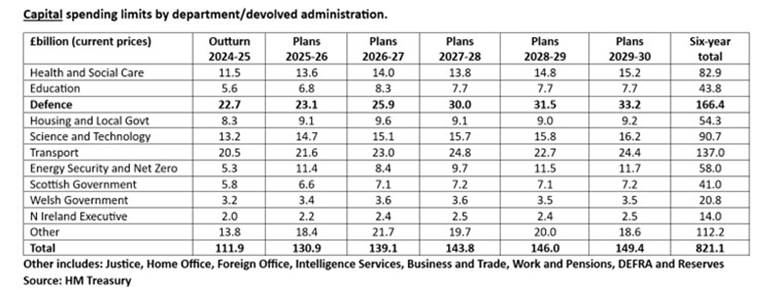
“Defence” gets the biggest single outlay. Its £166 billion is double the outlay on Health, three times the outlay for Energy Security and Net Zero, and quadruple the outlay for Education.
It was as the United Nations Framework Convention on Climate Change met last June in Germany to set the stage for COP30, that Trump pushed NATO countries to increase their military spending. This sucked the air out of discussions to increase public global climate financing, a key agenda item at the recent COP 30 in Belém (which, as a result, produced a tripling of the target by 2035 with no pledges to meet it).
There is no ambiguity about it. Just before last year’s General Election, Rachel Reeves abandoned a Labour pledge to invest £28 billion a year in green investment, claiming it as too much outlay to meet her “fiscal rules”. But the cost of actually meeting the 5% of GDP on war that Trump has demanded from all NATO members is more than double the current UK 2.3%. To fully meet it would require £77 billion a year. That’s almost three times the green investment pledge, falsely claimed as “unsustainable”.
The initial rise in military spending to 2.5% from 2.3% was funded from a deep slash in the Overseas Aid Budget. This was to suggest to voters they would not be directly hit in their own pockets, trying to avoid making voters angry and Labour MPs nervous. But, now that they have slashed Overseas Aid, there’s not enough left for the remnaining 2.5% increase. The attack on working class living standards through the squeeze on other Departments’ public services, and the freeze on tax thresholds will be paying for it. Increasingly government finances are being sucked into the gaping black hole of military spending. This will most likely make this a one term government.
The paradox of the Overseas Development Aid cut on “national security”, which is what the increased defence spending is supposed to enhance, is highlighted by the stifling of a Report from the Intelligence Services, which had been due to be published at the end of October. This stressed that a failure to mitigate climate breakdown around the world (by financing it) poses a serious national security risk, partly from the impact of the failure to mitigate globally, partly from the kickback from the social collapses and political turmoil that it will increasingly drive. The government, with no leg to stand on having just cut its existing meagre contribution to mitigation, simply blocked publication.
The recent National Climate and Nature Emergency Briefing (NEB) at Westminster Central Hall made it very clear that this turmoil can be expected domestically as well as overseas.
- Professor Tim Lenton explored the most apocalyptic of the upcoming Climate Tipping Points: the risk of overturning the Gulf Stream (AMOC), as the Greenland Ice Shelf pours billions of tonnes of cold fresh water into the North West Atlantic. All surveys show that the AMOC is weakening. The only question is how much and how fast. Some climate models for a 2C increase project that there would be two frozen months in mid Winter and in February the Arctic sea ice would reach as far as The Wash, with average temperatures in London at -20C and – 50C in Edinburgh; while Summers would be hotter than they are now. It would be almost impossible to grow food and there would be insufficient water to sustain the population in the Summer. Infrastructure engineered for a temperate climate would buckle under conditions more severe than currently in Irkutsk. It is hard to imagine a viable state surviving in that context; and most people from the UK would find themselves climate refugees: heading South across the Channel looking for a safe place in a world rapidly running out of them as, in this scenario, harvests from bread basket areas would halve. Whether any of them would want to take flags with them is a moot point.
- Professor Hayley Fowler examined oncoming weather impacts, pointing out that what we have now is “the least extreme climate you will experience in your lifetime” and that, so far, both rainstorms and heatwaves have been more intense than models have predicted. Mega storms, in which 8 months worth of rain falls in a few days, are becoming more common. The damage done is unimaginable until it happens. Our current infrastructure is built for a world that no longer exists and by 2050, on current trajectories, 1 in 4 homes would be at risk of flooding.
- Professor Paul Behrens noted that the chance of a major crop failure in major bread basket areas is 1 year in every 16 at the moment. Getting beyond a 1.5C increase, that comes down to 1 year in every 3. At 2C, it’s every other year. As we are certain to be beyond 1.5C by 2030, we are heading for hungry times – and everything that goes with them. The UK has had 3 of its 5 worst recorded harvests in the last ten years. 80% of its farmers see climate change as a threat to their futures. At present the UK grows 54% of its food, so 46% is imported. 25% of UK food imports are from the Mediterranean region, which is being hit hard by climate change too. Already, a third of price inflation in 2023 was driven by climate impacts, helping generate an increasingly febrile politics. 40% of food experts believe widespread civil unrest linked to food shortages is ‘possible or likely’ in the UK within the next 10 years. Over 50 years, nearly 80% of experts believe civil unrest was either possible, more likely than not.
- Professor Hugh Montgomery also noted that at present, the food industry is concerned that it cannot rely on “predictability of supply” a point also underlined by Lt General Richard Nugee, who noted that food inflation is already at 4.9% and cited Alfred Henry Lewis’s 1906 remark that “There are only nine meals between mankind and anarchy.”
The paradox of Gen Nugee’s contribution is that he echoed the assessment of the US military in 2019 that, as climate impacts broke down US society, the armed forces would be drawn in, first as emergency support, but inexorably taking on state functions as civil society broke down and, eventually, overwhelmed themselves, but he still took the UKs current “defence” orthodoxy, enshrined in the Strategic Defence Review, and its alliance with the United States as a given. As the Trump administration is a complete rogue state on climate; seeking “global energy dominance” by doubling down on fossil fuels and trying to drag the rest of the world down with it, any country that allies with that, and everything that flows from it, is part of the problem.
While he noted that “Climate change is a threat now; and one thing I was taught in the military is that you have to face the threat in front of you as it actually is, not how you’d wish it to be” he was unable to confront the reality that the scale of investment in the military, and the militarisation of society, in the way the SDR requires, makes facing that threat impossible – with all the consequences that flow from that.
This contradiction between the drive to war and global cooperation to save ourselves from climate breakdown is becoming ever more stark and should be a central plank of the upcoming year of trade union climate action, and fed into debates at the NEB’s follow up film showings from the Spring, which will be held in unusual venues like cathedrals.
The NEBs follow up open letter demanding that the government fulfill its obligations under Article 12 of the Paris Agreement and hold a comparable COVID style national briefing on all media should have mass support. Their reluctance to do so is buttressed because they have chosen war, are afraid of the population understanding the gravity and urgency of the crisis, because resolving it needs much more radical changes than they are prepared to contemplate; not least a shift away from the war drive.