Gerry Adams on the Ireland election

2nd March 2011 Socialist Action 0

Gerry Adams, leader of Sinn Féin and elected to the Dáil in the recent Irish elections, draws out the historic turn in the politics of Ireland marked by the 1981 hunger strike and the elections of hunger strikers Bobby Sands (to the Westminster Parliament) and Ciaran Doherty and Paddy Agnew (to the Dublin Dáil). He draws out how this period marked a turn in the politics of Ireland on both sides of the border and shaped the subsequent three decades of Irish politics. The article orginally appeared on his blog.
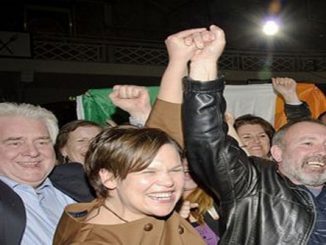
Photo: An Phoblacht

Historic breakthrough for Sinn Féin as Dáil election marks turning point in Irish politics

2nd March 2011 Socialist Action 0

By Frances Davis

The 2011 Dáil election last Friday represents one of the most significant political shifts in the 26-county state for over nine decades. As Sinn Féin President Gerry Adams said, it potentially represents ‘the beginning of a realignment of Irish politics’. He also pointed out that, while the outcome is likely to be Fine Gael and Labour implementing Fianna Fáil policies – one right wing government replaced by another one – an examination of the results reveal a more fundamental change. This is the beginning of the break-up of the post-civil war political domination by Fianna Fáil (FF) and Fine Gael (FG) and in fact some significant move to the left – most notably the dramatic rise in support for Sinn Féin and their consolidation as a significant party in the south, potentially the leading opposition voice in the coming Dáil.

Cuts, socialists and international politics in Europe

24th January 2011 Socialist Action 0

By Bryan Connor

During the international financial crisis US imperialism has succeeded in striking further blows against its European and Japanese capitalist competitors. Data on the US economy to be published later this week will probably show US GDP has regained its pre-crisis level. That means an average zero percent US growth for three years – a terrible performance. But Japanese and European production are even worse, remaining below their previous levels four years into the crisis. The US, however, has been pursuing policies that worsen the economic position of its European and Japanese competitors – pushing Japan to engage in confrontational policies with its largest trading partner, China, and in Europe both cheering on every step of belt tightening in countries such as Greece and Ireland and trying to break up the Euro.

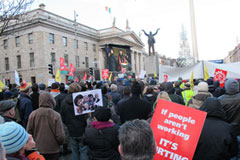
National Demonstration, Dublin, Ireland, 27th November 2010

Sinn Féin’s electoral advance

9th December 2010 Socialist Action 0

By Frances Davis

National Demonstration, Dublin, Ireland, 27th November 2010

Photo lusciousblopster

Sinn Féin’s stunning victory in the Donegal South West parliamentary by-election on 25 November represents a huge advance in what was the first electoral test for the Dublin government since the sharp deepening of the state’s economic crisis. Sinn Féin’s Pearse Doherty saw his party’s vote soar from 21 per cent at the last general election in 2007 to 40 per cent of first preference votes. In a reversal of previous showings, Sinn Féin also won an increasing share of the transfers from the eliminated candidates.

Lisbon Protest

Portuguese general strike

26th November 2010 Socialist Action 0

By Nicky Dempsey

Lisbon Protest

Photo NunoRibeiro

The Portuguese general strike on November 24th registered a major increase in the response of the working class and its allies against the attacks on social welfare, pay and jobs. The government claim that there was only 30% support for the strike in the public, and even less in the private sector was widely derided.

Political response to economic crisis in Ireland

10th November 2010 Socialist Action 0

Sinn Féin offers a better way

By Nicky Dempsey

Sinn Féin has published its response to the Dublin government’s threatened plans to cut public spending once more in its Budget for 2011, There Is A Better Way. The Fianna Fail/ Green coalition in government has outlined planned further cuts totalling €6bn in both capital and current spending, including welfare payments to the poor. This would bring the total level of ‘fiscal tightening’ to €20.6bn since the end of 2008, which is now equivalent to 13.1% of GDP. For comparison the British government’s current plans – among the most draconian of any major European country – amount to 9.2% of GDP.