Two classes, two responses to the crisis

1st June 2012 Socialist Action 0

By Nicky Dempsey

Martin Wolf, the chief economics commentator for the Financial Times, has laid out a devastating critique of current government economic policy in Britain. In a widely-reported article titled ‘Cameron is consigning UK to stagnation’ he says it is a scandal that the government has cut its own investment, especially when it can in effect borrow for free, as real interest rates are at zero.

Photo by endiaferon

Europe’s economic crisis

19th May 2012 Socialist Action 0

By Jane West

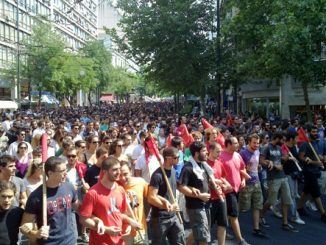
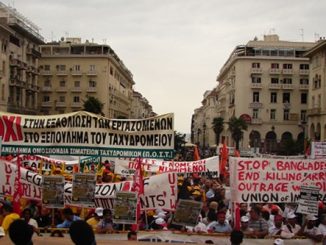
As the Euro-crisis unfolds and Greece heads to new elections, the left party, Syriza is capturing the support of most of those in Greece who want to reject the austerity programme imposed by the EU.

It is striking that the impact of the world developments, and particularly the growth of the left in Latin America, has clearly interacted with this political leadership of resistance to austerity in Greece. It was recently reported in the Guardian, of Syriza’s leader, Alexis Tsipras: ‘one of his heroes is Venezuelan leader Hugo Chávez, with whom he shares the same birthday.’

Photo: apαs

Who will pay the cost of Europe’s defaults?

23rd May 2011 Socialist Action 0

By Nicky Dempsey

Open disagreements have broken out between the EU Commission and the European Central Bank on the issue of whether Greek government debt should be ‘restructured’  or ‘reprofiled’ in some way.  Debt restructuring would require that the bondholders, mainly European (including British) banks, take some losses on their bonds by having their value written down. ‘Reprofiling’ is a much more modest proposal which may involve little more than extending the life of the bonds, so that interest and capital repayments are drawn out over time.

Marxism and the Economic Crisis

27th April 2011 Socialist Action 0

By Nicky Dempsey

All societies based on social classes tend to produce surplus value, to a greater or less extent. The character of the society may be determined by which class receives the bulk of the surplus.

The economic and financial crisis that became apparent in 2007 and 2008 was located primarily in the imperialist centres, led by the United States. The crisis was engendered by a crisis of profitability, a reduction in the surplus available to the capitalist class. Economic policy since that time has been designed to restore as far as possible the greater proportion of that surplus to the capitalist class in the imperial centres.

No Image

A serious work of Marxist economics – meeting on 11 July

9th July 2007 Socialist Action 0

First published: 9 July 2007

On 11 July there will be an opportunity to attend a meeting on a book summarising very serious work in Marxist economics – Andrew Kliman’s Reclaiming Marx’s Capital. The notice for the meeting is appended below, for those who wish to skip to it. But to understand its importance it is worth making some observations on the developments which led to it.

It is a truism of Marxism that theory has a relative autonomy from the direct development of the class struggle. Both parts of that phrase, the autonomy and that it is relative and not absolute, are important.

Figure 1

Capitalism and the rise of world poverty

1st November 1998 Socialist Action 0

First published: October/November 1998

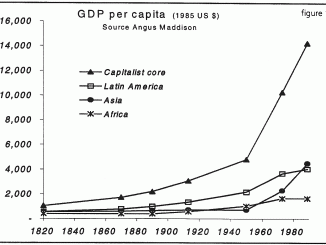
It is appropriate in the year of the 150th anniversary of the Communist Manifesto to draw up the economic balance sheet of capitalism in the twentieth century. In addition to the destruction of two World Wars and numerous regional wars, the record is that economic development of a small core of imperialist states occurred at the expense of the populations of the majority of market economies falling further and further behind. The only large economies to close the gap with the major imperialist states are those where capitalism was overthrown. Where capitalism was restored that progress was reversed. With capitalism entering a new period of global turmoil, translating into impoverishment, starvation and untold misery for hundreds of millions of people, Marx and Engels’ view that the working class is the only social force which can take humanity as a whole forward retains all of its force today.

Since the mid-1970s, inequality has risen to the highest levels in history. Impoverishment, starvation, avoidable disease and death have devastated whole continents and destroyed the lives of millions of people.