

By Paul Atkin
Two new words sum up this summer.
Kokushobi: a Japanese word meaning “cruelly hot day”, applied to days when the temperature gets above 40C and now in common use because there are so many of them.
Pyrocumulonimbus : which describes storm clouds generated by fires that are intense enough to create their own weather systems; as the ferocious consumption of oxygen in the fire draws in air into a vortex that generates its own lightning and sucks debris into the stratosphere, much as firestorms did in cities that were carpet bombed in WW2. These were first noted in the late nineties in Australia and North America. They have now been seen in Europe. As they have previously been so rare, but are now likely to be generated more and more as background temperatures heat up, the impact of the debris in the stratosphere is only just starting to be studied. We don’t know what impact they having up there yet, though the impact of the fires at ground level is now obvious.
This isn’t a blip, its a warning
“Extreme weather”, from excessive rainfall to droughts, and the “climate whiplash” between the two, is now having an immediate impact in floods and wildfires.
- At the moment there are wildfires across North America (700 in Canada alone) Europe and just about everywhere else.
- There have been floods leading to loss of life in India, Pakistan, Afghanistan, New Zealand, Cote d’Ivoire, Ghana, Kenya, South Korea and China.
- Hundreds of thousands of people have had to be evacuated as the fires have posed a threat to urban areas. 860 buildings were burned down in Spokane in Washington State, in the same way as 6,837 buildings were in the Palisades area of LA last year. The city of Bordeaux, with a population of a million people was threatened and a quarter of a million people evacuated from its suburbs. This is leading to entire areas becoming uninsurable, as companies have reneged on claims.
- The excess heat and drought in Europe has led to rivers running lower and warmer, with the Danube in Budapest at one point down to 10cm “deep”, a word that can only be used ironically. How long before “the beautiful blue Danube” shrivels to a fetid orange creek? This has made river borne trade more difficult, as not all boats are shallow drafted enough not to get stuck on the bottom, and impacted on industrial processes used to having a plentiful supply of water. Nuclear power stations, as well as hydro electric and some coal plants, sited alongside rivers in France, Hungary and Romania have had to be closed, either because there has not been enough water to cool the reactors, or because what water there is has been too warm to do it effectively. A cautionary tale for those who argue that nuclear power can provide reliable all weather baseload electricity generation.
- The effect on harvests has also been severe, which is already leading to the price of food rising and the National Farmers Union warning of shortages in some areas. Domestically there are some estimates that costs could rise as much as 50% by the end of the year from their level in 2021. This will compound the increases from fossil fuel prices caused by the war on Iran and will need a response that goes beyond tweaking to avoid real hardship. The idea that billions can be poured into the military while people are struggling to put affordable food on the table should be challenged from the Left. Internationally, the UN forecasts that an additional 50 million people – equivalent to the population of South Korea or , Uganda or Columbia – could be forced into acute hunger.
These impacts are not a one off, a blip after which everything goes “back to normal”, even a normal that’s a bit hotter. The “new normal” is not characterised by stability. It is not a plateau that we can “get used to”. It’s more an accelerating, destabilising vortex. A bit like a pyrocumulonimbus cloud. So the issue is not just about adaptation to new conditions, though that is vital and underinvested in, but doing as much as possible to limit the damage by cutting greenhouse gas emissions as fast as possible.
An indication of accumulating economic damage from increasing heatwaves for Western Europe is indicated here.
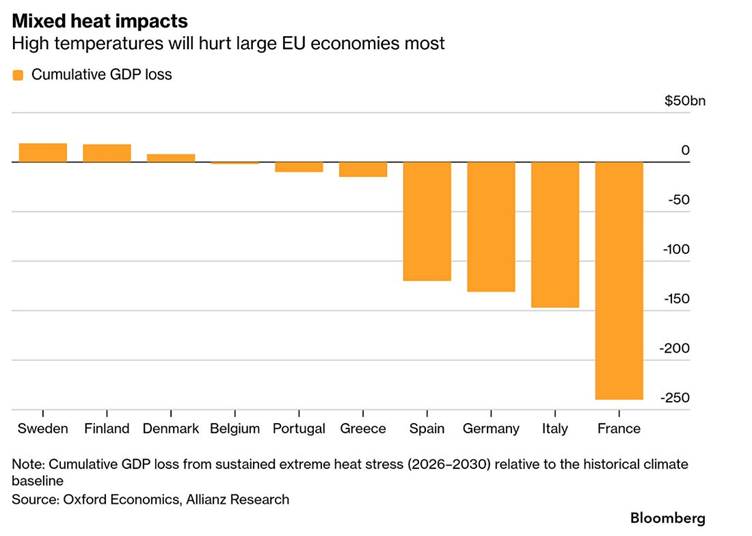
France stands out as the worst hit, with $250 billion worth of damage by the end of the decade, which makes Jean Luc Melenchon’s call for a Sixth Republic to be founded on a “social and ecological basis” not only urgent and relevant for the French Presidential election and what follows, especially as he is now far and away the main challenger to the climate denialist xenophobe Marine Le Pen, but also a necessary model for the rest of the Left across the continent.
“Pragmatism” in the UK
Not least in the UK. As well as turning down a push from unions and climate campaigners for a maximum workplace temperature, Andy Burnham has signalled that he will be “pragmatic” when it comes to climate policy.
What this seems to add up to at the moment is to retreat on polices like the EV mandate – to allow more fossil vehicles to be built and sold for longer, even though, with EVs now cheaper to buy and run, this is a road to nowhere – weakening the 95% electricity generation from renewables target for 2030, and possibly allowing production from the Rosebank oilfield and Jackdaw gas field, even though these will neither reduce costs nor prevent jobs bleeding from a dying industry.
The government has also already eliminated reaching climate targets as a criteria in the weighting system for public contracts, as if there is no urgency to do so and even the very welcome £2 bus fare cap was financed from shifting overseas climate finance for the world’s poorest countries from grants to loans.
So, in a context in which climate has once again become a top five public concern, even the Daily Telegraph is holding a debate on it, indicating vulnerability on the denialist Right, and trade unions like Unite are taking action because of the heat impacts, the response of the government is to signal that they will go slower. It’s as if they are not looking out of the window.
There is a sort of inertia and disavowal in this. It’s as if they think that if they continue to behave as though we were still in the Holocene, we really would still be in the Holocene.
It’s of a piece with getting around the enormous water demands from the Data Centres they want to shoo through as essential national infrastructure by pretending – in the planning process – that there aren’t any; so, the impacts on water supply for local communities can be ignored until after they are built and become an actual problem. Or are absorbed into the planning process for any new housing, which will cut the supply if a proposed development is competing with a Data Centre. And, on an even bigger scale, in responding to the Report from the Intelligence Services last year that the impacts of climate change pose an imminent threat to “national security” by refusing to publish it and not allowing the issues it raises – which demands increases not decreases in Overseas Development Aid focussed on climate – to deflect them from armour plating the country instead of improving it.
Again, this brings back the centrality to the climate movement of opposing the war drive and the cold war mentality that goes with it. That will increasingly pose how the Left, the climate and labour movements understand what is happening in China and cut across the militarisation drive from Washington that targets it.
China shifts up a gear
The latest Chinese 5-year plan inserts green transition into all areas of industrial planning for the first time, cementing this in at “an unprecedented strategic level”. China is now close to peak fossil fuel use. In absolute terms, coal fired power was up 3% in the first half of this year, after plateauing for two years – reflecting increased demand from air conditioning and the need for grid connectivity to catch up with renewable energy installation – but for the first time its proportion of total energy generated was below 50%; as almost all new generating capacity was provided by solar and wind. The pace of solar installation has been extremely rapid, but is likely to level off this year as subsidies have been phased out.
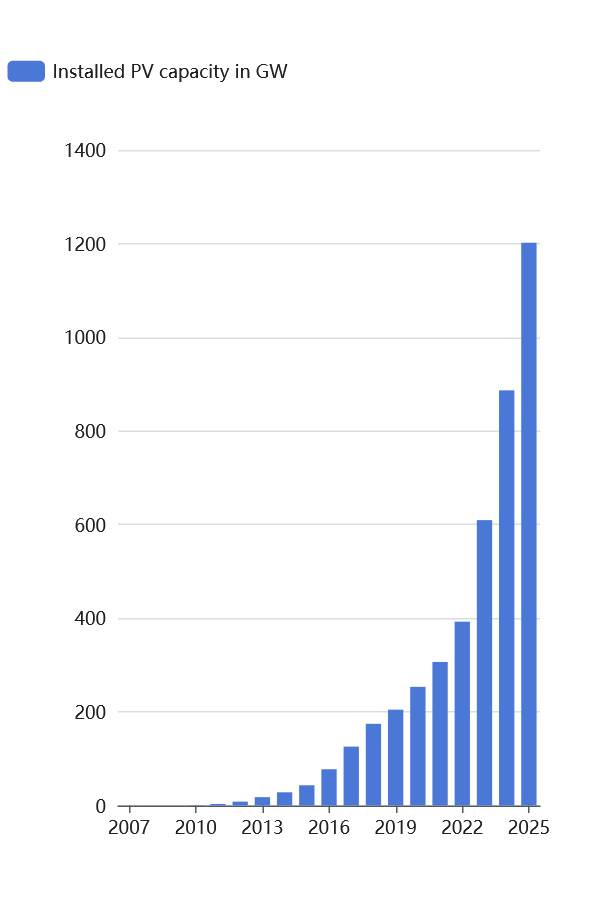
Nevertheless, solar capacity is rising at an average 10GW a month at present as the industry consolidates, a rate which will add 600 GW of extra capacity by 2030.
Even before the paradoxical boost to the global shift away from fossil fuels driven by Trump’s war on Iran, China’s exports of solar cells were up 60% from April 2025 to April 2026, while 56% of all Belt and Road investments were in green energy and construction in the same period.
At a time in which the US is trying to reassert “global energy dominance” based on fossil fuels, they are finding themselves on the wrong end of their own market-based presumptions; as countries increasingly shift away from the expense, the volatility, and the leverage that fossil fuel dependency generates. A majority of countries have now passed their peak use of fossil fuels. The only question is how fast the transition will be. The global political fall-out from this is immense, and some of the unhinged tone and invective that comes from parties and media still cheering on a US dominated fossil future, reflects the desperation they feel about being on such thin ice (which is, of course, melting faster thanks to their efforts).
In the meantime, the major Western fossil companies are doubling down on their core business, abandoning and pretence at going “Beyond Petroleum” (as BP tried to claim) not because they see a long-term future in it but because it is 4 to 5 times more profitable than renewables and they are trying to make as much as they can while they can. And Western banks are following suit. This is a bit like a financial corporate version of the hedonistic frenzy during the last days of Nazi Berlin, during which people who knew they were doomed and would pay for their crimes abused their power while they could.
Articles are also now being published in China stating that it will be playing “a more active role in global climate governance”, aiming to “lead and shape it”. This should also have a huge impact on the Left, the climate movement and will pose some strategic questions to the government, the labour movement as a whole and the Greens too. Be prepared!
Image: Golden Sun; https://jooinn.com/golden-sun.html; Licensing under the Creative Commons CC0 (Public Domain) license.