
By John Ross
In the Western media numerous articles appear calling for China to increase the percentage of consumption in GDP, in order to make China’s economic structure more like a Western model. This is called “boosting consumption”. In reality both the facts and economic theory show that increasing the percentage of consumption in China’s GDP would lead to a slower growth of consumption and living standards in China. This is because there is a negative correlation between the percentage of consumption in GDP and the growth rate of GDP i.e. increasing the percentage of consumption in GDP would lead to slower growth of consumption. This applies both in China, which the present article deals with, and in all major economies.
Those who call for a higher percentage of consumption in GDP in fact calling for a slower rate of growth of living standards for the Chinse people, and a slower growth of consumption.
This is an edited version of an article which originally appeared in Chinese at guncha.cn. It received over 100,000 hits within 24 hours of publication.
* * *
The aim of economic development is consumption—that is the highest possible living standard of the population. But investment is indispensable as a means by which economic development, and therefore a high and growing level of consumption, can be achieved.
It is, therefore, extremely serious that a fundamental confusion on the role of consumption appears in sections of the media. This is because misunderstanding, a wrong position, on this would necessarily lead to lower rate of increase of the living standards of China’s people and a slowdown in China’s economy.
It is necessary to be clear that this confusion is not about short term policy. For short term stimulus packages, for example, if there is a very low level of consumer growth, it may well be correct to launch a short-term consumer stimulus packages. But it is a confusion about the strategic goal of the proportion of the economy which should be used for consumption. This is the fact that the proportion of consumption in GDP and the growth rate of consumption are inversely related. That is, increasing the percentage of consumption in GDP leads to a lower growth rate of consumption and also a lower rate of economic growth.
An elementary confusion on consumption
The typical popularly expressed form of this fundamental confusion is very easily outlined. It is frequently stated: “it is necessary to increase consumption.” But what is meant by this? Because it could mean two entirely different things. Worse still, the two are directly contradictory.
It could mean:
· It is necessary to increase the consumption growth rate.
Or it could mean.
· It is necessary to increase the percentage of consumption in GDP.
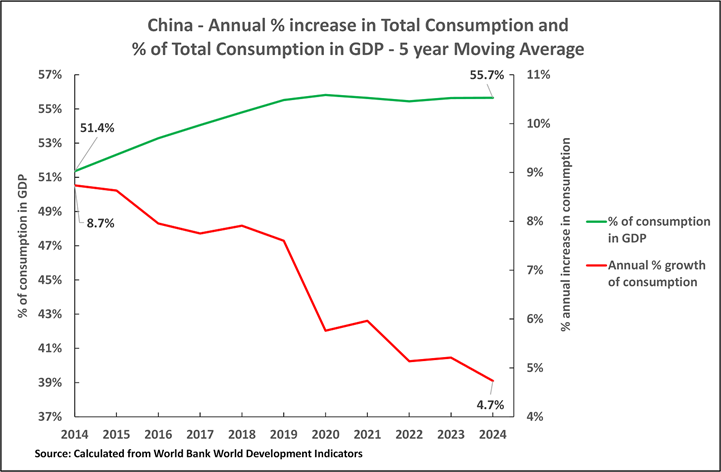
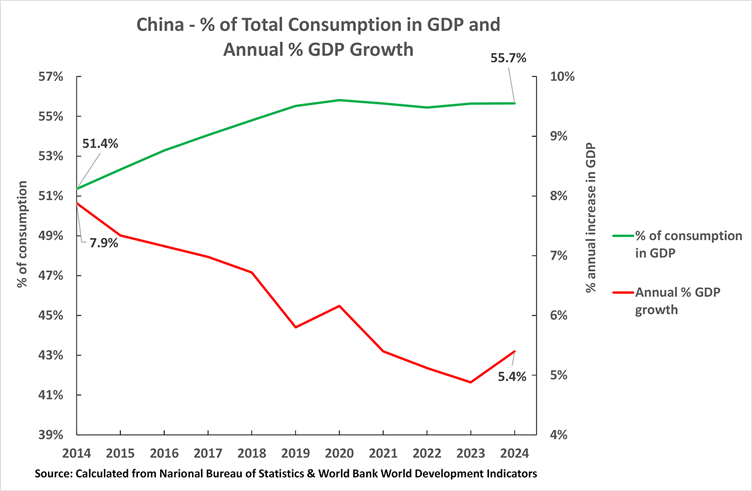
That these two meanings and policy objectives are not merely not the same but directly contradictory is immediately demonstrated by Figure 1. This shows the percentage of consumption in China’s GDP during the last 10 years and the annual percentage increase in consumption—using a five-year moving average to remove purely short-term fluctuations (such as Covid). Their completely contradictory pattern is clear. The higher the percentage of consumption in GDP, the lower is the annual growth rate of consumption.
Thus, between 2014 and 2024, the percentage of total consumption in China’s GDP rose from 51.4% to 55.7% of GDP—an increase of 4.3% of GDP. But simultaneously the annual rate of growth of consumption fell from 8.7% to 4.7%, a decline of the annual growth rate of consumption by 4%, or by almost half from the original level.
Expressed statistically, there is an extremely high negative correlation, -0.81, between the percentage of consumption in GDP and the growth rate of consumption. That is, the higher the percentage of consumption in GDP, the lower is the growth rate of consumption.
This negative correlation, -0.81, is so high that it is completely impossible to avoid its practical consequences. In particular, it means that if the percentage of consumption in GDP is increased, as some sections of the media call for, the rate of growth of consumption, and therefore the rate of growth of living standards, will fall. In addition, as shown below, the higher the percentage of consumption in GDP, the slower will be the economic growth rate.
Therefore, raising the percentage of consumption in GDP will both slow down the rate of growth of consumption and slow down the growth rate of the economy. The higher is the percentage of consumption in GDP, the slower will be the growth rate of consumption/living standards, and the slower will be the economy’s growth rate.
Figure 1
This fact that the higher is the level of consumption in GDP the lower is the growth rate of consumption, and therefore the slower is the growth rate of living standards, is exactly what would be predicted by economic theory—as analysed below. This point is concealed only by an elementary confusion in economics in sections of the media which will be analysed below.
However, we will follow the method of “seek truth from facts”. First, the factual relation of consumption to other components of the economy will be analysed, as will be the issue of which is most important, the growth rate of consumption or the percentage of consumption in GDP. After clearly establishing the facts, the theoretical explanation for these factual relationships and their consequences will be considered.
The relation of investment and consumption
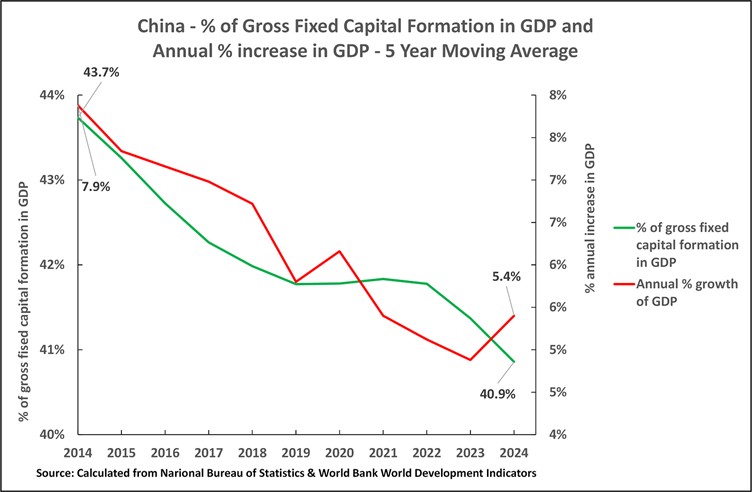
Consumption and investment together constitute 100% of the domestic economy and fixed investment is by far the largest component, 97%, of total investment. Therefore, if there is a negative correlation between the percentage of consumption in GDP and the growth rate of consumption, it would be anticipated that there would be a positive correlation between the percentage of investment in GDP and the growth rate of consumption. That is, it would be anticipated that the higher the percentage of investment in GDP the higher will be the growth rate of consumption.
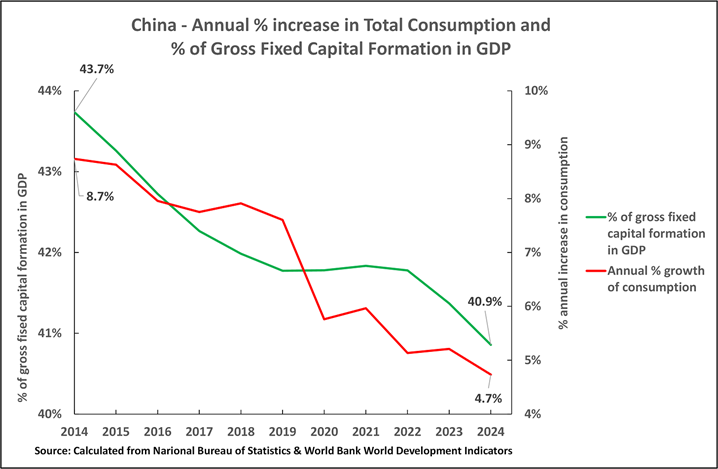
Figure 2 fully confirms this. This shows that in China, when the percentage of gross fixed capital formation in GDP was 43.7%, the annual percentage increase in consumption was 8.7%. When the percentage of gross fixed capital formation in GDP fell to 40.9%, the annual percentage increase in consumption fell to 4.7%. That is, the higher the percentage of investment in GDP the higher is the growth rate of consumption whereas, as already seen, the higher is the percentage of consumption in GDP, the lower is the consumption growth rate., Statistically, this positive correlation between the percentage of gross fixed capital formation in GDP and the annual growth rate of consumption is an extremely high 0.86.
Once again this correlation, in this case a positive correlation, is so high it is impossible to avoid its practical consequences. Nor is it necessary to establish causation. This correlation makes clear that if the level of investment in GDP is cut, by increasing the percentage of consumption in GDP, which necessarily means a reduction in the percentage of investment, then the growth rate of consumption will fall. Furthermore, it is impossible to increase the rate of growth of consumption without increasing the percentage of investment in GDP.
To summarise, the facts in Figure 1 and Figure 2 show:
· The higher is the percentage of consumption in GDP, the lower will be the growth rate of consumption.
· The higher the percentage of investment in GDP, the faster will be the growth rate of consumption.
Figure 2
The relation of GDP growth rate and consumption
The reason that a higher percentage of consumption in GDP leads to a lower growth rate of consumption, while a higher percentage of investment in GDP leads to a higher growth rate of consumption, is due to the extremely high correlation between the growth rate of consumption and the growth rate of GDP—and the directly contradictory effects of investment and consumption on GDP growth.
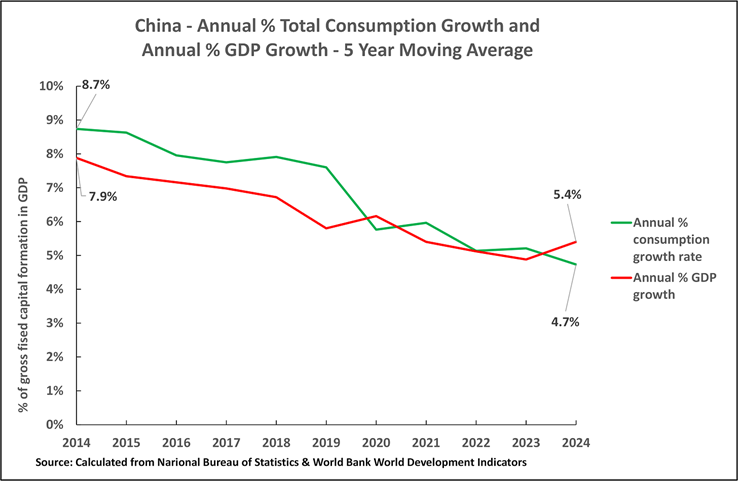
Figure 3 shows the extraordinarily close correlation, 0.90, which exists between the GDP growth rate and the growth rate of consumption—0.90 is as close to a perfect correlation as exists between any real economic phenomena. Given such a high correlation, it is therefore impossible to have a high rate of growth of consumption without a high rate of GDP growth.
But, as seen below, the percentage of consumption in GDP and the percentage of investment in GDP have totally opposite effects on the economic growth rate, i.e. the GDP growth rate. Consequently, the percentage of consumption in GDP and the percentage of investment in GDP also have totally opposite effects on the growth rate of consumption. To be precise.
· Increasing the level of investment in GDP increases the rate of growth of GDP and therefore increases the rate of growth of consumption.
· Increasing the level of consumption in GDP reduces the rate of growth of GDP and therefore cuts the rate of growth of consumption.
Figure 3
The relation of investment and GDP growth
Turning to the determinants of GDP growth, and therefore also consumption growth, Figure 4 shows the extremely close positive correlation, 0.88, which exists between China’s percentage of gross fixed capital formation in GDP and its GDP growth—i.e. the higher the percentage of investment in GDP the higher is the GDP growth rate. Given the very close correlation that exists between the growth rates of GDP and consumption, as shown earlier, an increase in investment as a percentage of GDP leads to faster growth in GDP, and therefore to faster consumption growth.
Figure 4
The relation of consumption and GDP growth
The exact opposite, that is the negative correlation of the percentage of consumption in GDP and GDP growth, is shown in Figure 5. The strongly negative correlation is -0.89 between the percentage of consumption in GDP and GDP growth. That is, the higher the percentage of consumption in GDP the lower is the GDP growth rate.
As the relation between GDP growth and consumption growth is an extremely high positive one, this, in turn, means that an increase in the percentage of consumption in GDP, by slowing the economic growth rate, leads to a lower growth rate of consumption.
Figure 5
Summary of the facts
Therefore it is possible to simply summarise the two inescapable factual relations which exist between consumption, investment, and GDP.
· The higher the percentage of consumption in GDP, the lower will be the growth rate of consumption and lower will be the economic growth rate.
· The higher the percentage of investment in GDP, the higher will be the growth rate of consumption and the higher will be the economic growth rate.
Why it is the growth rate of consumption that matters
Regarding the facts, it was already shown in Figure 1 above that the percentage of consumption in GDP and the growth rate of consumption are strongly negatively correlated—they move in opposite directions. It is therefore impossible to increase both at the same time—increasing the percentage of consumption in GDP will lower the growth rate of consumption, and increasing the growth rate of consumption requires lowering the percentage of consumption in GDP. Therefore, which of these two contradictory targets should it be the goal to increase?
It is obvious that it is the rate of growth of consumption that matters, and that it is this which should be maximised/increased—not the percentage of consumption in GDP. People do not eat, or use, a percentage of GDP. In contrast, if their real consumption increases that means that there is an increase in their living standards. If their consumption increases by 5% that is better than if it increases by 2%—they have better food, better furniture, better housing, more to spend on leisure, etc and therefore there will be minimal risk of social tensions.
Different rates of increase in consumption have an enormous effect over significant periods of time. If the rate of growth of consumption is 2%, then over a decade the increase in consumption is only 22%; whereas if it is 5% then the increase in consumption over a decade is 63%. Therefore, the rate of growth of consumption makes a tremendous difference to living standards. Consequently, the highest possible sustainable rate of increase in consumption/living standards is highly desirable.
But if the target that should be aimed at is the highest percentage of consumption in GDP, this has no comparable effect. The countries with the highest percentage of consumption in GDP in the world are those such as Somalia, Lesotho, Yemen and Afghanistan, which are among the poorest in the world. A high percentage of consumption in GDP leads to a lower GDP growth and is lower level of growth of consumption and a lower standard of living increasing.
Explanation
Having clearly established the facts on consumption, what explains this theoretically? If the facts show clearly that the higher the percentage of consumption is in GDP, the lower is the growth rate of consumption then why is this?
This negative correlation follows necessarily and immediately from the definition of consumption. Consumption, by definition, is not an input into production—if something is an input into production it is, by definition, not consumption. The fact that the higher the percentage of consumption in GDP the lower is the growth rate of consumption is therefore exactly what would be predicted by economic theory.
The reason for this is that as consumption is not an input into production, adding to consumption by itself does not add to production—consumption is not part of the supply side of the economy, only of the demand side. Investment, in contrast, is an input into production. It is part of the economy’s supply side, as well as its demand side.
Because consumption and investment together make up 100% of the domestic economy, an increase in the percentage of consumption in GDP necessarily means a reduction in the percentage of investment in GDP. This, therefore, means a reduction in the percentage of the economy which are inputs into production. Therefore, an increase in the percentage of consumption in GDP necessarily leads to a decrease in the rate of growth of production, that is a decrease in GDP growth. In turn, because of the extremely close correlation between the growth of GDP and the growth of consumption, this means that an increase in the percentage of consumption in GDP leads to a fall in the growth rate of consumption. This is why there is a negative correlation between the percentage of consumption in GDP and the growth rate of consumption. The higher is the percentage of consumption in GDP the lower is the growth rate of consumption. Therefore, the fact the higher the percentage of consumption in GDP the lower is the growth rate of consumption is exactly what would be predicted by economic theory.
Consumption is not an input into the production function
Put in technical economic terms, this means that consumption is not an input into the production function. Thus, for example:
· In Solow’s growth accounting, the most widely used in Western economics, the inputs are capital, labour and total factor productivity. Consumption is not an input into production.
· In KLEMS, a more recent form of Western growth accounting, inputs are capital (K), labour (L), energy (E), materials (M), and services (S). Consumption is not an input into production.
· In Marxist economics the inputs into production are constant capital and variable capital. Consumption is not an input into production.
· In some Western analyses, inputs of education and, in certain cases health, both usually termed consumption in national accounts, are redefined as investment in human capital/improvements in labour quality. This means that such economic sectors are no longer considered consumption. But it should be noted that their contribution to economic growth is small—for both China and the US, improvements in labour quality contribute only 0.2% a year to GDP growth.
In summary, consumption is not an input into production. Therefore, it is clear, for the reasons given, that an increase in the percentage of consumption in GDP, by reducing inputs into production, will lead to a fall in the rate of growth of GDP and therefore of the growth rate of consumption.
Summary of why an increase in the percentage of consumption in GDP leads to a fall in the growth rate of consumption
To summarise, the facts and theoretical issues above both confirm what would be the inevitable consequences of increasing the percentage of consumption in China’s GDP—as some sections of the media advocate.
· Because consumption is not an input into production, the strong negative correlation between the percentage of consumption in GDP and the rate of consumption growth is immediately explained. In contrast, the positive factual correlation between the percentage of investment in GDP and the growth of consumption is similarly immediately explained. They necessarily follow from the ultra-close correlation between the growth rate of GDP and the growth rate of consumption. Raising the percentage of consumption in China’s GDP will lead to a slower growth rate of consumption and therefore of a slower growth in living standards. A slower rate of growth of living standards is undesirable itself and will be negative from the point of view of social cohesion.
· If the percentage of consumption in GDP is increased, this necessarily means that the percentage of investment is reduced. As investment is an input production, and by definition consumption is not an input into production, therefore, by raising the percentage of consumption, the percentage of inputs into production are reduced. Therefore, the rate of growth of production, that is of GDP, will decline. Consequently, raising the percentage of consumption in China’s GDP will lead to a slower growth rate of GDP. As GDP growth is so closely correlation with consumption growth, therefore, the growth rate of consumption will fall.
· In contrast, if the percentage of investment in GDP is increased, this necessarily means that the percentage of consumption is reduced. However, investment is an input into production and, therefore, as inputs into are production being increased GDP will grow more rapidly. As GDP growth is so closely correlated with consumption growth, therefore, the rate of consumption growth will also rise. If the aim is to maintain or increase the growth rate of consumption and living standards, then the strategic goal should be to maintain or gradually raise the percentage of investment in GDP.
This is the explanation of why an increase in the percentage of consumption in GDP leads to a fall in the growth rate of consumption, and an increase in the percentage of investment in GDP, therefore a fall in the percentage of consumption in GDP, leads to an increase in the growth rate of consumption. The factual findings on consumption in China’s economy shown at the beginning of this article are, therefore, exactly what would be predicted by economic theory.
Conclusion
Given the extremely high factual correlations and theoretical relations there is absolutely no way to avoid these consequences. An increase in the percentage of consumption in GDP will lead to a lower rate of growth of consumption, and therefore of living standards, and slower rate of GDP growth.
These factual consequences should be clear even to those who are not familiar with the issues of economic theory which clearly explain them.
These trends show why confusion on the issue of consumption is such a danger to China’s people. Hidden behind this lack of clarity, the confusion of the difference between “increasing the growth rate of consumption” and “increasing the percentage of consumption in GDP”, due to the contradiction between the two objectives, are two contradictory outcomes for China’s economy.
The above article was originally published here on John Ross’ Substack.