

By Paul Atkin
In the last year there have been numerous reports of the fragility of Cuba’s power grid, resulting from four major incidents of widespread power cuts.
The problems of the grid are based on
- over reliance on ageing oil fired power stations, supplying 84% of electricity supply, which have been difficult to maintain under the US sanctions regime
- fuel shortages, as most of the oil is imported from Russia or Venezuela, both of which are also under stringent US sanctions
- the impact of US financial sanctions choking off access to loans to finance improvements in the system.
Peak daytime demand can reach up to 2500 MW, leaving a gap of between 800 and 1300 MW leading to widespread cuts.
These power cuts – not uncommon in the global South – have a hard impact on people’s lives, from cutting off water pumps and refrigeration (so your food goes bad) to knocking out communications. Backup generators are often insufficient because they also depend on diesel, which is in short supply, thanks to the sanctions again.
The way out of this crisis has had two aspects.
1) Investment in repair and maintenance and energy efficiency in the existing fossil fuel grid with some engineering support from Russia, firming up 850 MW of supply.
2) Work with Chinese assistance this year to build 55 solar farms capable of generating 1200 MW, which should be enough to cover any shortfalls by the end of the year – with a further 37 solar farms due to be completed by the end of 2028 to account for increases in demand and provide a bit of a buffer. On a smaller scale, 22 wind turbines are being refurbished to generate another 30 MW.
We should note that this development is not peculiar to Cuba, but is becoming a pattern across the global South. 60% of developing countries now have a higher proportion of their electricity generated by sustainable sources than the US does.
The graphs below from the energy think tank Ember show the pace of this development.
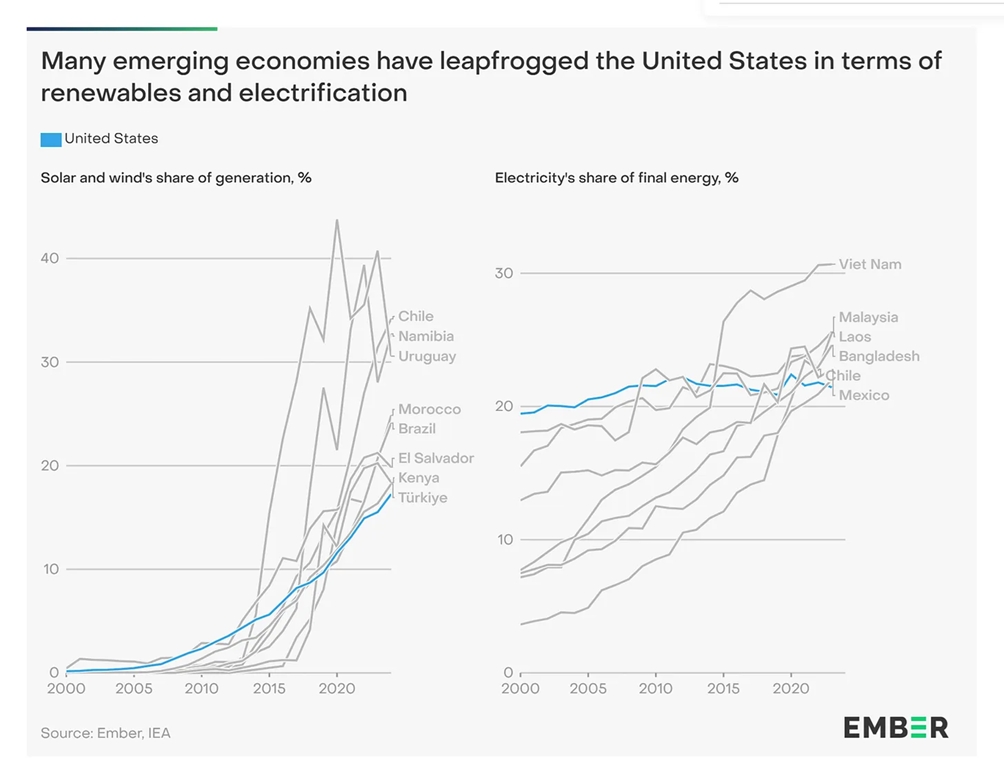
As the US under the Trump administration abandons Biden’s ambitions for an America First energy transition, with the Inflation Reduction Act as a magnet to pull green investment into the USA and away from its competitors (and allies) – with, as then world’s leading petro state – a straightforward reactionary attempt to prolong the fossil fuel era as long as possible – the rest of the world, when it can avoid being strong armed into forced contracts to buy environmentally ruinous US LNG with a carbon footprint 30% worse than coal per unit of energy – is moving fast towards electrification.
This is underpinned by several factors.
1. It’s cheaper, especially solar – and getting more so. As a relatively new technology we are seeing rapid gains in efficiency and cost reductions. Costs fall about 20% every time deployment doubles. And we’re currently on course for more than doubling by 2030. So, now 2/3 of global energy capital goes into electro-tech. Fossil fuels, by contrast, are becoming more expensive as old established fields dry up (like the North Sea) and new fields are relatively difficult and expensive to extract from.
2. It cuts costs long term because once the panels are in and the wind turbines up, there’s no need to import fuel. The wind blows. The sun shines. The batteries store. No charge. This underpins related decisions like Ethiopia banning the import of fossil fuel cars because they want to cut their fuel import bills.
3. Fossil fuels are wasteful. 2/3 of energy generated is lost. Electric motors are 2 to 4 times as efficient. So we can do a lot more with a lot less. A way to envisage this is in this graph. One container ship of solar panels will generate as much electricity as 50 ships full of LNG and 100 ships full of coal. This is also true of mining, in which the total amount of extracted metals required for sustainability by mid-century as equivalent to the amount of coal mining that had to be done to meet demand just in 2023.

With 70% of the world’s renewable energy potential in the global south and the massive potential supply, primarily from China, that we can see in this graph, the potential for generating a non-polar world, in which each place becomes free to express its unique version of our common humanity by breaking the lock-hold that fossil fuel based imperialist countries have on them.
The Trump administrations attempt to assert “US Global Energy Dominance” is currently taking the form of a threatened invasion of Venezuela, to get direct control of the world’s largest energy reserves and the rare earths it needs, not for the energy transition but for its military.
One last domestic point. While delegates at the COP have been heard expressing relief that the US government isn’t there sabotaging the process from the inside – they are corralling their political supporters everywhere on common toxic themes of climate change denial, racism, repression, deregulation and privatisation, militarisation and the insidious intrusion of big US tech companies into monitoring every aspect of our lives. As Kemi Badenoch puts it. “The model is Javier Millei”
In this sense, internationalism, anti-war, anti-racism and climate campaigning come together, and we should coordinate more.
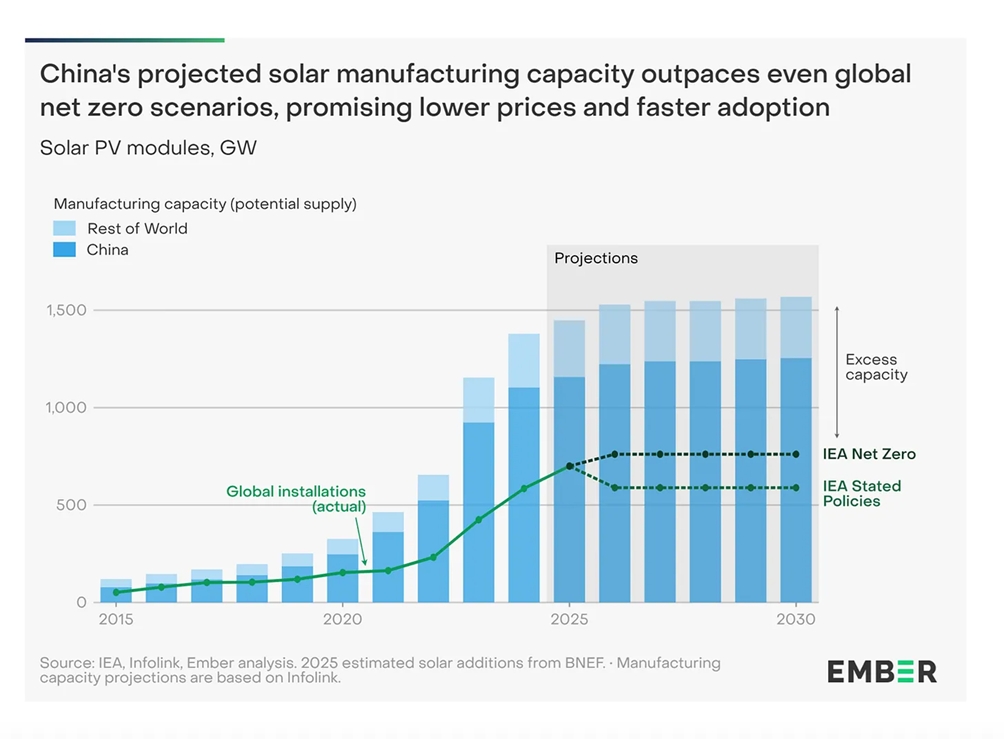
The graphs in the above article are from the energy think tank Ember (https://ember-energy.org/) and the website Carbon Brief (https://www.carbonbrief.org/).
Image: Map of Cuba; Cuba og naboland; Kart; Av Store norske leksikon; licensed under the Creative Commons Attribution-NonCommercial 4.0 International license; image cropped.