

Dr Michael Wongsam
The GOP and the Trump administration have made strenuous efforts to rig the 2026 midterm elections, including attempting to block mail ballots, attempting to purge voters from voting lists, threatening election officials with criminal charges, and more. There are even proposals to manipulate the next census to give the GOP a further advantage in future elections after 2030. The most serious efforts along these lines have been the use of the conservative majority on the Supreme Court to gut the 1965 Voting Rights Act, and the consequent attempt to racially gerrymander redistricting in several GOP-controlled states. Since the Black population overwhelmingly votes Democrat, this move is intended to produce a partisan advantage to the GOP as well as to reduce Black political representation.
The federal Voting Rights Act was adopted in 1965, and amended several times in 1970, 1975, 1982, and 2006. The 2006 revision included an extension of its special time-limited provisions, applicable primarily to southern states, to July 27, 2031. It is widely regarded as the most effective civil rights law in the history of the United States, opening the electoral processes in the former Jim Crow South to participation by Black people, and protecting their votes from being diluted by the adoption of election structures and rules that seriously impeded, and sometimes precluded, their ability to elect people from within the Black community. In terms of Black representation, the progress as a result of the Act is undeniable and most evident where the Act has been in force the longest. These provisions have now been rendered meaningless following both the Supreme Court ruling in Shelby County vs Holder (2013) which ended the preclearance regime that ensured jurisdictions with a history of voter suppression and racial discrimination obtained federal approval before changing any voting laws or redrawing maps, and the ruling in the case Louisiana v. Callais (2026).
Alabama, Georgia, Louisiana, Mississippi, South Carolina, and Virginia, and their political subdivisions, were all covered by the Act at the time it was adopted in 1965. Many counties in North Carolina also came under the provisions of the Act as well. In 1975, provisions were added to the Act to protect language minorities – such as Latinos, Native Americans, Asian Americans, and Native Alaskans – that brought Texas and its political subdivisions under coverage, as well as some counties in Florida.
Following Biden’s victory over Trump in the Presidential election of 2020, Trump’s attempt to overturn the result, and the mass assault on the Capitol building, the Democrats failed to enact new voting rights legislation, despite having a majority in the House of Representatives and having effectively a tied Senate with Vice President Kamala Harris having the tie-breaking vote. This failure – due to the use of the Senate filibuster – to strengthen voting rights legislation opened the door to the second Trump administration continuing the biggest attack against voting rights in general, and against the voting rights of the Black population in particular, since the end of the civil rights era.
The deep South is where the GOP sought to stiffen its resistance to the deepening crisis caused by the unpopularity of the President. This deep South red wall had been constructed over an extended period of time beginning with Nixon’s Southern Strategy of 1968 whereby, following the successes of the civil rights struggle which culminated in the passage of the Civil Rights Act (1964) and the Voting Rights Act (1965), a political realignment of white votes away from the Democrats and toward the Republicans was engineered. This realignment also “produced an impulse propelling the Republican Party to the right and consolidated a majority of racial minority votes in the base of the Democratic Party” and “produced a tendency for Democratic strongholds to be predominant in urban centres and Republican strongholds to be predominant in rural, suburban and small town districts.”
The GOP embarked on a program of partisan redistricting aimed at eliminating Democrat strongholds in the metropolitan areas and creating new GOP strongholds. Seven states; Alabama, Florida, Louisiana, North Carolina, Ohio, Tennessee and Texas, had redrawn maps favourable to the Republicans. The Democrats successfully enacted a map to flip GOP-held seats in California.
However, in spite of the unprecedented attack on the voting rights of the Black community and the attempt to reverse the previous secular rise in Black political representation, Trump and the GOP were subjected to a decisive and historic political defeat. The overall general issues underlying this defeat have been explained by @johnross43 here, here and here. Here, specifically the response to the attack against voting rights and representation of the Black community discussed above are discussed. The following points may be noted.
- Three of the four largest Southern states were won by the Democrats – Georgia, North Carolina, and Texas leading to a breach of the ’red wall’.
- States with heavy concentrations of Latinos, like Texas, saw massive flight from the Republicans, powered not just by the cost of living but also by the costs of the deportation sweeps that had devastated their families and communities.
- Southern states with high percentages of Black voters, like Georgia and Mississippi, saw high Black turnout in response to the Supreme Court’s gutting of the Voting Rights Act and its consequent unleashing of partisan Republican gerrymandering intended to diminish Black political power and interests as a means of gaining advantage over the Democrats.
- In the previous midterms, Mississippi had the lowest turnout in the entire union. This time however there occurred a spike in the number of people deliberately listed as inactive on voter rolls before this year’s midterm elections – an increase of nearly 60,000 since the presidential election two years ago. Given the unusually high number of registrations it can be argued that this was an effort to offset these by moving voters off the rolls..
- Democrats won so overwhelmingly that the surge to the Democrats easily outweighed the intended effect of the GOP’s newly drawn district lines.
- In several cases, Democrats won the seats that the Republicans targeted, sometimes gaining seats in the very states where Republicans redrew the maps to their advantage.
- Republicans still gained anywhere from four to seven seats overall as a result of the new maps, even if the exercise didn’t produce the result Republicans hoped for. There is only one state where the Republican redistricting effort seems to have backfired, if only barely: that of North Carolina. Elsewhere, Republicans came out ahead or the new maps didn’t make a difference either way.
- It has been reported that if every congressional map had been drawn fairly, using ‘party-blind’ methods, Democrats might have come close to winning a veto-proof two-thirds majority in the House.
The Southern states are increasingly demographically dominated by metropolitan areas, populated by racially diverse professionals, even more racially diverse service-sector workers, young newcomers from neighbouring states, the Northern states and the far west, and international migrants, and the steadily more cosmopolitan cultures coming along with them. Houston, Dallas, and Austin meet all those criteria in Texas, as Atlanta does in Georgia, while Charlotte and the Research Triangle play a version of that role in North Carolina.
This year’s exit polls indicate that the metropolitan population voted for Democrats over Republicans by 72%-27%, while 59% of suburbanites voted for Democrats, and even 41% percent of small-town and rural residents did. The current political division between Democrat metropolitan districts and Republican rural/small town districts, with contested suburban districts still persists albeit with an overall swing of all demographics toward the Democrats.
Texas, with its 40 Electoral College votes, has long been the anchor state of the modern Republican Party and American conservatism more generally. But it is not only increasingly urban and racially diverse, but is young with a median age of 36, the lowest of any state except Utah.
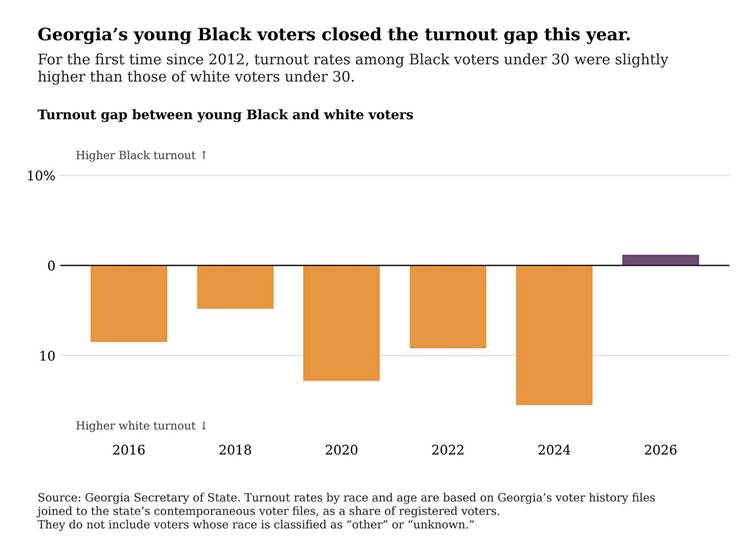
In Georgia – one of only a handful of states where voters can provide their race when they register to vote – the Black share of the electorate rose to its highest level in more than a decade. In particular, the turnout rate among young Black voters exceeded that of young white voters. Historically, there has been a gap between turnout of young white voters compared to young Black voters. This year, that gap was closed, with young Blacks turning out in marginally greater proportions than young whites. See the Figure below.
The swing of young Black voters toward the Democrats was more than twice as large as Georgia voters’ as a whole. Overall, Black voters made up at least 30 percent of Georgia’s electorate in 2026, the highest of any election since 2012, when President Barack Obama ran for re-election.
A significant number of seats in both chambers of Congress, as well as governors and mayors, were won by representatives of non-white racial minorities, including Latinos, Asians, and African Americans. These include:
- In California, Xavier Becerra became governor – the first Latino to be elected in that role for 150 years.
- In Texas, a Latina woman was elected governor for the first time.
- African Americans were elected governors in four other states: Keisha Lance Bottoms (first Black woman governor, in Georgia), Byron Donalds (first Black governor in Florida), David Crowley (first Black governor in Wisconsin), and Aaron Ford (first Black governor in Nevada)
- Nithya Raman – a member of the Democratic Socialists of America – was elected mayor of Los Angeles, the second-largest city in the US, becoming the first Asian-American, Indian-American, and Hindu mayor of Los Angeles.
- Particular attention is warranted by the victory in Michigan of Abdul El-Sayed, a Muslim of Egyptian origin.
- Scott Colom became the first Black Senator from Mississippi since Reconstruction.
Also, Angie Nixon – a Black woman, and a member of the Democratic Socialists of America – came within three percentage points of defeating Republican Sen. Ashley Moody in Florida. She did it in a state Donald Trump carried by 13 points just two years ago, where Republicans enjoy a 1.5 million-voter registration advantage and where national Democrats largely refused to make the investments necessary to compete. Where for instance Senator Jon Ossoff (D-Ga.) had $135 million invested in his campaign, compared with just $16 million invested in Angie Nixon.
One election result does not signify a realignment of politics. But the size of the electoral shift is sufficient to prevent any immediate advance in the progress of voter suppression. Moreover, it has produced record Latino representation, and record Asian American representation. While overall African American representation is down from 65 to 60 members of Congress, historic firsts have been recorded in representation at the gubernatorial level. Therefore, despite the Supreme Court rulings and the racial-partisan gerrymandering, the forward march of voter suppression has been arrested.
The above article was originally published here on Michael Wongsam’s Substack
To follow Michael Wongsam’s blog – subscribe here.