No Image

Turkish referendum – Victory for the AKP

20th September 2010 Socialist Action 0

By Juliet Altan

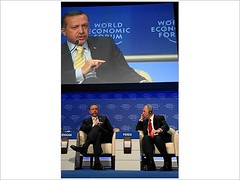
Recep Tayyip Erdogan, Shimon Peres - World Economic Forum Annual Meeting Davos 2009
Photo: World Economic Forum

Prime Minister Erdogan of Turkey attacks Israeli President Peres over Israel’s assault on Gaza at the World Economic Forum, January 2009.

On Sunday 12 September 2010, the 30th anniversary of the bloody military coup in 1980, Turkey voted to accept constitutional amendments that have widely been viewed as moving the country away from the grip of the army.

The turnout was 73.71%, of which almost 58% approved the reform package, whilst just over 42% rejected it. There was a high abstention rate of almost 27%, mainly as a result of the call by the main Kurdish party BDP for a boycott of the referendum.

Since the election of the AKP (Justice and Development Party) government in 2002, and its re-election on a strong vote in 2007, there has been a power struggle between the army and the government in Turkey. There were several attempts, some covert and some very overt, to destabilise the government over the last few years.

No Image

Analyses of the economic policy changes in Cuba

20th September 2010 Socialist Action 0

By Brian George

i'm away for a while
Photo: consumerfriendly

A great deal of media publicity has been given to the news that Cuba is to reduce state sector employment by half a million and transfer these workers to the non-state, including private, sectors. The eventual aim is to transfer about one million of Cuba’s state workers to the non-state sector.

No Image

Analyses of the economic policy changes in Cuba

20th September 2010 Socialist Action 0

By Brian George

i'm away for a while
Photo: consumerfriendly

A great deal of media publicity has been given to the news that Cuba is to reduce state sector employment by half a million and transfer these workers to the non-state, including private, sectors. The eventual aim is to transfer about one million of Cuba’s state workers to the non-state sector.

No Image

The Israeli-Palestinian Authority talks

20th September 2010 Socialist Action 0

 By Andrew Williams

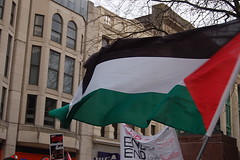
Freedom For Palestine

Photo: Walt Jabsco

The direct negotiations between Israel and the Palestinian Authority (PA) that began in early September will go nowhere. Presented by the US as negotiations to create a Palestinian state, in fact the objectives of the US and other participants are not this at all. For the US and Israel the current framework of talks allows them to set an agenda that reinforces the occupation – as happened in the Oslo talks (1992-3) and subsequent negotiation processes – simultaneously settlements expand, more Palestinians are displaced, and Israeli missiles are fired on Gaza, whilst Palestinians are told they must not resist. The objectives are to weaken Palestinian resolve, deepen the internal Palestinian divisions, enhance the US’s image in the region and rehabilitate Israel’s battered international reputation. For Fatah’s Mahmoud Abbas, Israel’s chosen negotiating partner, it is hoped the international stage can bolster his reduced standing. Amongst Palestinians there is widespread understanding of, and consequently little support for, this framework.

No Image

The Israeli-Palestinian Authority talks

20th September 2010 Socialist Action 0

 By Andrew Williams

Freedom For Palestine

Photo: Walt Jabsco

The direct negotiations between Israel and the Palestinian Authority (PA) that began in early September will go nowhere. Presented by the US as negotiations to create a Palestinian state, in fact the objectives of the US and other participants are not this at all. For the US and Israel the current framework of talks allows them to set an agenda that reinforces the occupation – as happened in the Oslo talks (1992-3) and subsequent negotiation processes – simultaneously settlements expand, more Palestinians are displaced, and Israeli missiles are fired on Gaza, whilst Palestinians are told they must not resist. The objectives are to weaken Palestinian resolve, deepen the internal Palestinian divisions, enhance the US’s image in the region and rehabilitate Israel’s battered international reputation. For Fatah’s Mahmoud Abbas, Israel’s chosen negotiating partner, it is hoped the international stage can bolster his reduced standing. Amongst Palestinians there is widespread understanding of, and consequently little support for, this framework.

No Image

Capitalism and the rise of world poverty

13th September 2010 Socialist Action 0

First published: October/November 1998

[NB this article refers to illustrative figures which we hope to include in due course.]

It is appropriate in the year of the 150th anniversary of the Communist Manifesto to draw up the economic balance sheet of capitalism in the twentieth century. In addition to the destruction of two World Wars and numerous regional wars, the record is that economic development of a small core of imperialist states occurred at the expense of the populations of the majority of market economies falling further and further behind. The only large economies to close the gap with the major imperialist states are those where capitalism was overthrown. Where capitalism was restored that progress was reversed. With capitalism entering a new period of global turmoil, translating into impoverishment, starvation and untold misery for hundreds of millions of people, Marx and Engels’ view that the working class is the only social force which can take humanity as a whole forward retains all of its force today.

Since the mid-1970s, inequality has risen to the highest levels in history. Impoverishment, starvation, avoidable disease and death have devastated whole continents and destroyed the lives of millions of people.